

A Human Story
Daniel Reed had prepared for months for a public-sector recruitment exam. His mother had been recognized for distinguished national service, and Daniel was registered as an employment-support recipient under the relevant law. He understood that this status could bring additional points in some hiring processes.
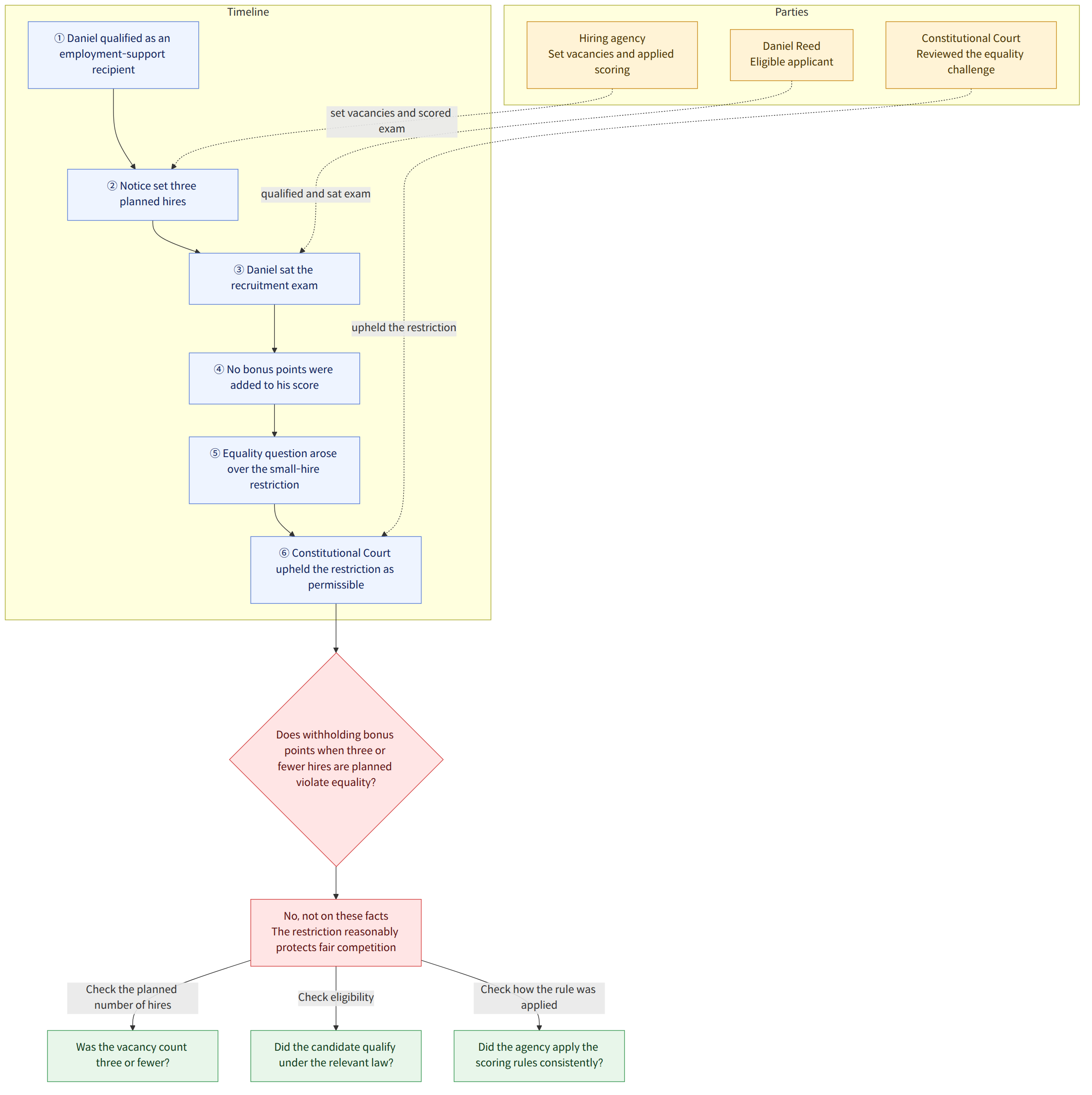
Then he read the recruitment notice: the agency planned to hire just three people. When the results arrived, Daniel saw no bonus points added to his score. He wondered whether excluding him because of the small number of vacancies treated him unequally, despite the very public purpose of supporting families like his.
The Legal Question
Does Korea’s restriction on employment-related bonus points in a recruitment exam with three or fewer planned hires violate the equality rights of an eligible child of a person of national merit?
What Korean Law Says
Korean law provides employment support for people who qualify through their relationship to persons recognized for national merit. One form of support is additional points in certain recruitment exams. But that preference operates within limits: the law also seeks to preserve fair access to jobs for applicants who are not eligible for the bonus.
For recruitment with very few positions, the rules do not award those bonus points. The underlying concern is that, when there are only a handful of openings, even a modest scoring preference can substantially affect who has a realistic chance of being hired. The law also limits the share of successful applicants who may benefit from the points.
Employment support is a legally recognized preference, not an unconditional right to bonus points in every hiring process.
The key points are:
- The candidate must qualify as an employment-support recipient under the relevant law.
- The recruitment process must be one in which the law provides for bonus points.
- The restriction applies when the planned number of hires is three or fewer.
- The preference is also subject to a limit tied to the proportion of planned hires who may be selected through the benefit.
How Korean Courts Approach This
Korean courts assess these rules by considering two interests together: the state’s responsibility to support persons who have served the country and their eligible family members, and the general public’s interest in a fair chance to compete for jobs.
The Constitutional Court has concluded that withholding bonus points in exams with three or fewer positions is not an arbitrary distinction that violates equality. In a small recruitment round, the restriction can be understood as a necessary measure to prevent the principle of fair competition from becoming merely theoretical. The Court has therefore treated the rule as a permissible balance between social support and equal employment opportunity.
Equality does not always require identical treatment in every setting. The question is whether the distinction has a reasonable basis and is proportionate to the aim it serves.
Applying the Law to the Case
Daniel’s situation turns on several straightforward points.
- His eligibility is not the same as an entitlement in every exam. His status may qualify him for employment support, but that does not mean bonus points must be available in every recruitment process.
- The number of positions matters. The notice provided for only three hires. That places the exam within the small-recruitment restriction.
- The restriction serves a recognized purpose. With so few positions, awarding bonus points could significantly narrow the practical opportunity for other applicants to compete. The law is designed to keep the selection process meaningfully competitive while retaining employment support in other eligible circumstances.
- The rule is not, by itself, an arbitrary denial of equality. Under the Constitutional Court’s approach, the different treatment has a rational connection to the goal of protecting fair access when the number of vacancies is very small.
If Daniel believes the agency miscounted the positions, misunderstood his eligibility, or applied the scoring rules inconsistently, those are separate issues worth checking against the recruitment notice and the exam records. For an individual review, he could ask [[lawyer]] to examine the notice, his eligibility documents, and any score or selection records relevant to how the rule was applied.
If the dispute turns on whether the recruitment notice counted the positions correctly or whether the agency applied the scoring rule consistently, you could ask attorney Ji-sun Ahn of Ijun Law Firm to review the notice, eligibility documents, and available score or selection records.
Conclusion: What Happened, and What Should You Do?
Daniel’s equality challenge, based only on the fact that he received no bonus points in a recruitment exam with three planned hires, would not succeed under the Constitutional Court’s reasoning. The restriction is treated as a reasonable way to protect fair competition where each vacancy carries unusual weight. His employment-support status remains important, but it does not override this specific limit.
For readers facing a similar situation:
- Check the recruitment notice to confirm the number of planned hires and whether the small-recruitment restriction applies.
- Keep your eligibility documents and the notice, score explanation, and result records; check whether the agency applied the rule as written.
- If you believe the agency made a factual or procedural mistake, seek advice promptly about the documents and the appropriate way to raise that specific issue.

















