

A Human Story
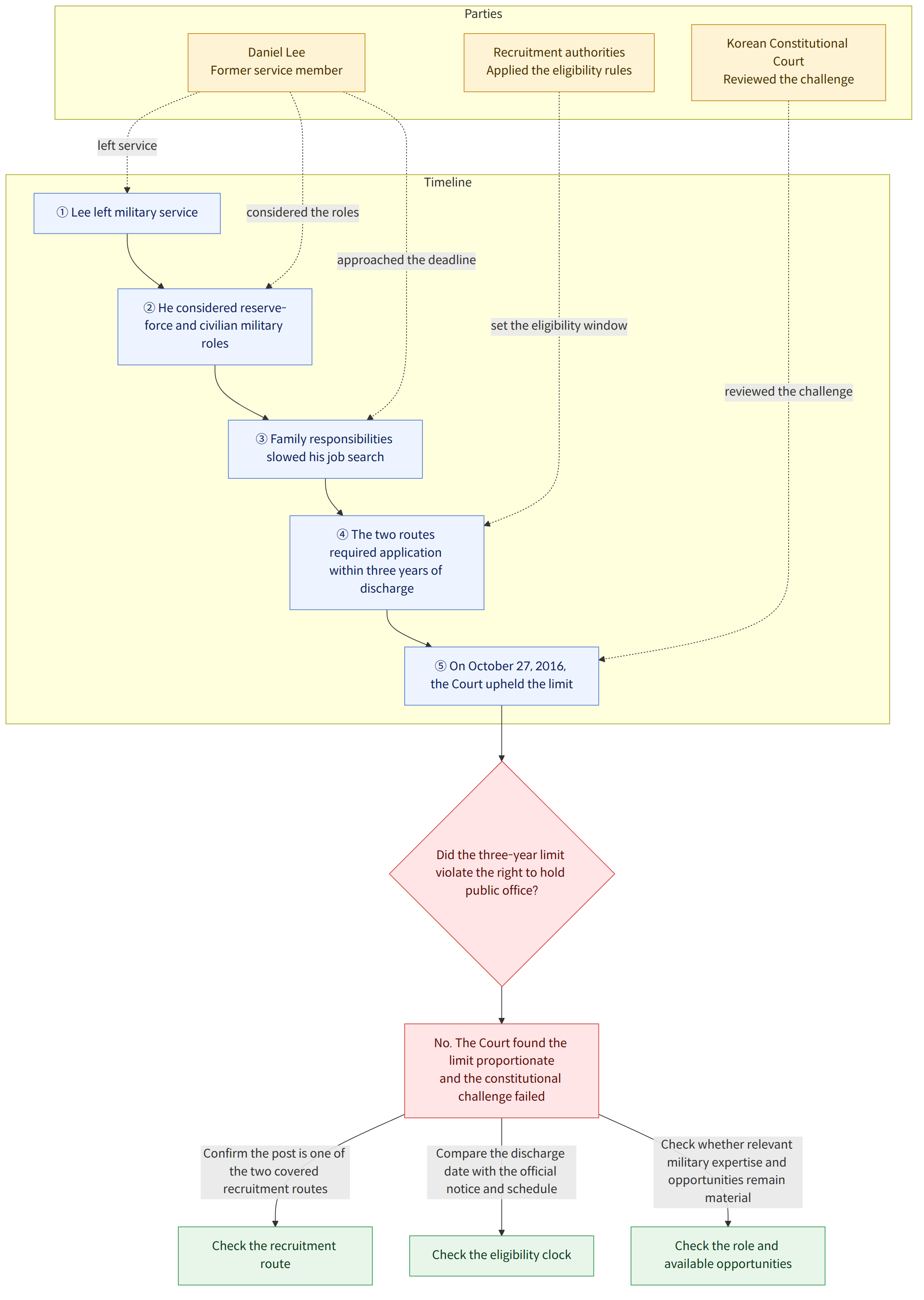
When Daniel Lee left the military, he expected his experience to open a path into public service. He had worked in the same field and at the relevant level as a civilian military post he hoped to fill. But family responsibilities came first, and the job search moved more slowly than he had planned.
As the third anniversary of his discharge approached, Daniel found that two routes he was considering—special recruitment as a civilian military employee and selection for a reserve-force management role—were restricted to former service members within three years of leaving active duty. He wondered whether that deadline unfairly shut out people with valuable skills simply because life had delayed their application.
The Legal Question
May Korea limit these recruitment opportunities to former soldiers who apply within three years of discharge, or does that restriction violate the constitutional right to hold public office?
What Korean Law Says
The Korean Constitution protects the right to hold public office. That protection does not mean, however, that every applicant is entitled to every government job regardless of the qualifications or eligibility rules established for it. The central question is whether a restriction has a legitimate public purpose and is proportionate to that purpose.
The rules at issue set a three-year post-discharge window for two kinds of recruitment: selection for reserve-force management work and special recruitment as a civilian military employee for a post corresponding to a former soldier’s experience and rank.
The Constitutional Court accepted that the window was intended to make practical use of recently acquired military expertise without additional training, and to support efficient performance of the relevant work.
In assessing whether such a time limit is fair, the Court considered several points:
- Purpose: Whether the rule serves a legitimate public need, such as using relevant skills promptly.
- Fit: Whether the deadline reasonably helps achieve that purpose, given that military knowledge and practical experience can become outdated over time.
- Opportunity: Whether eligible former service members still have meaningful chances to sit the examinations or apply.
- Balance: Whether the public benefit is proportionate to the restriction on an individual’s opportunity to compete.
How Korean Courts Approach This
Korean courts, including the Constitutional Court, do not treat every limit on access to public employment as a constitutional violation. They examine the rule’s objective, whether it is a sensible way to pursue that objective, and how heavily it burdens the people affected. In constitutional review, this is a proportionality analysis: a restriction should not impose a burden out of proportion to the public interest it advances.
In a decision dated October 27, 2016, the Constitutional Court applied that approach to the three-year limit. It reasoned that the experience and technical knowledge gained in military service may lose currency as time passes, making a prompt transition into the relevant work a rational staffing goal.
The Court also considered the practical availability of examinations: a soldier approaching discharge could have at least six opportunities to take the reserve-force management selection examination within the following three years, while special recruitment for civilian military posts was held regularly alongside open recruitment or as needed by individual units.
On that basis, the Court concluded that the time limit did not reduce applicants’ opportunities so severely as to make them practically unavailable. It also found that the public interest in using former service members’ expertise efficiently outweighed the disadvantage of being unable to apply through these routes after the window closed. The constitutional challenge therefore failed.
Applying the Law to the Case
Daniel’s situation raises the same issues the Court considered. The analysis would proceed in stages:
- Identify the relevant recruitment route. Daniel must determine whether the post is a reserve-force management position or a civilian military employee position filled through the special recruitment route. The three-year restriction described here applies to those routes, not automatically to every public-sector vacancy.
- Confirm the date that starts the clock. The relevant period runs from the date of discharge. Daniel should compare that date with the eligibility wording and the applicable examination or appointment schedule in the official notice.
- Consider why the limit exists. If the role depends on recent military experience, the government can argue that a prompt appointment allows it to use that expertise without a separate period of training. The Court accepted that as a legitimate and practical aim.
- Assess whether applicants have a real opportunity to compete. The Court relied on the number of possible examinations and the regular or needs-based timing of special recruitment. The limit was therefore not treated as an effective bar to applying while the three-year period remained open.
- Weigh the competing interests. Daniel loses the chance to use these particular recruitment routes once the window expires. But the Court found the public interest in efficient, timely use of military expertise more substantial than that limited disadvantage.
A careful review of Daniel’s discharge record and the precise recruitment notice would matter: the eligibility period and the particular post’s recruitment route determine whether the three-year rule applies to him. A reader in a similar position could ask [[lawyer]] to review those documents and the relevant examination schedule to clarify how the stated deadline applies to the individual application.
A careful review of your discharge record and the exact recruitment notice can help establish whether the three-year eligibility window applies to the post you are pursuing. You could ask attorney Ji-sun Ahn of Ijun Law Firm to review those documents and the examination schedule in light of your application.
Conclusion: What Happened, and What Should You Do?
Daniel’s concern was understandable, but the constitutional challenge did not succeed. The Constitutional Court upheld the three-year limit, finding that the aim of using recent military expertise efficiently justified it and that the available examination opportunities kept the restriction within constitutional bounds. For Daniel, that meant planning around the deadline rather than relying on a constitutional claim to extend it.
If you are considering a similar route:
- Check the official discharge date and calculate the three-year period from that date.
- Read the recruitment notice closely to confirm which selection route applies, what qualifications are required, and when examinations or appointments are scheduled.
- Keep the relevant documents together—including your discharge record, experience records, and the notice—and seek individual review if the eligibility wording or timing is unclear.

















