

A Human Story
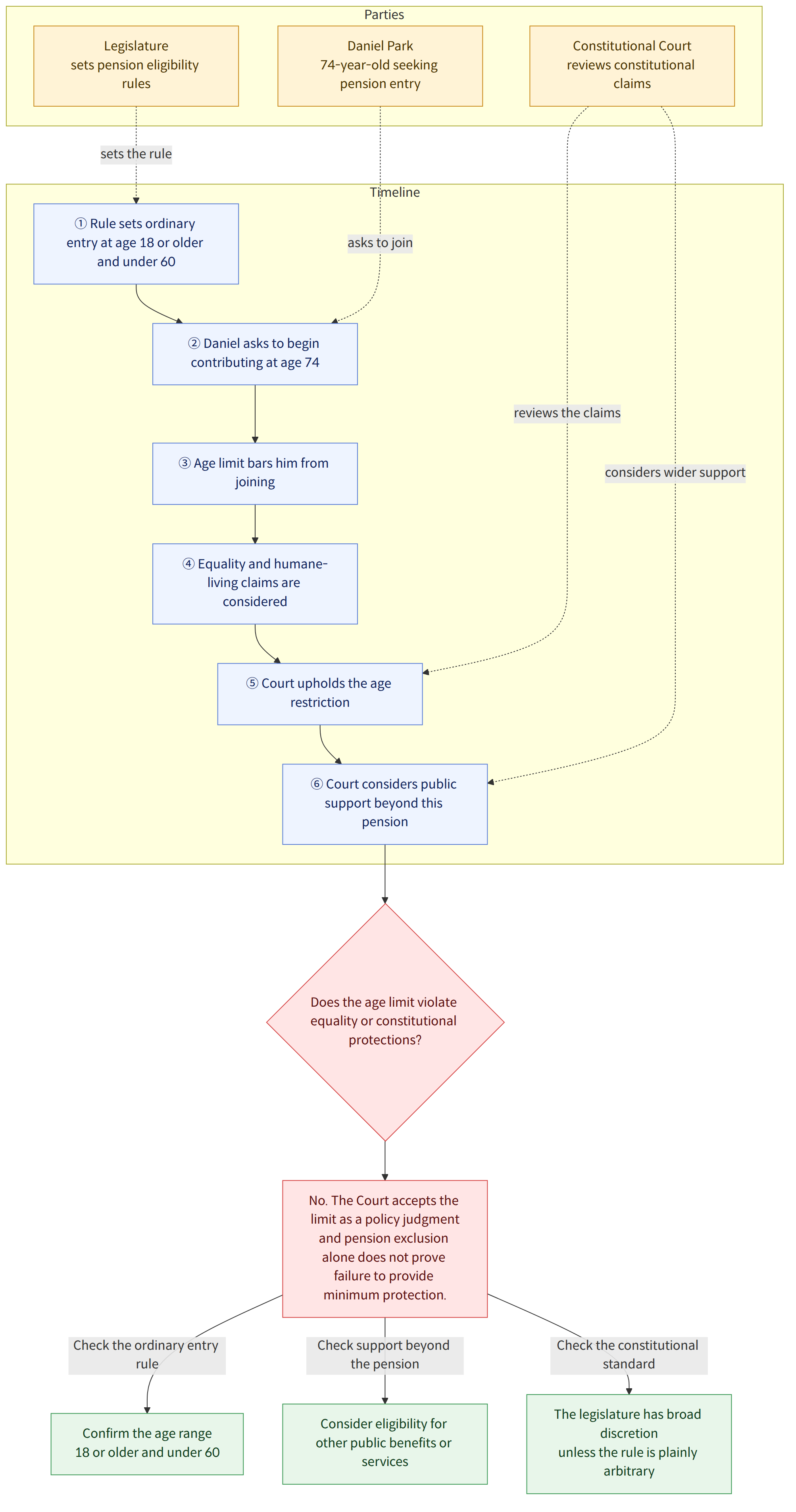
At 74, Daniel Park still takes long walks before breakfast and keeps a notebook of places he hopes to visit. He has no serious health problems and expects, perhaps optimistically, to live well into his eighties or beyond. When he asks whether he can begin paying into Korea’s National Pension now, he learns that the age rule stands in his way.
Daniel feels the answer is unfair. He is willing to contribute, and he believes a long life may mean a long retirement. If the pension system is meant to protect people in old age, he wonders, why should someone who is healthy and prepared to pay be shut out simply because he has passed 60?
The Legal Question
Does restricting entry into the National Pension to people below age 60 unconstitutionally discriminate against older people or violate their rights to dignity, happiness, and a humane standard of living?
What Korean Law Says
The statutory provision challenged in this dispute set the general membership range for people living in Korea at age 18 or older but under 60, subject to exclusions for people covered by certain public-service, military, and private-school pension schemes, among others.
“A person who resides in Korea and is at least 18 years old but under 60 is eligible to join the National Pension.”
The central constitutional principle is that the legislature has considerable room to design a social-insurance system. It may take account of how long people generally work, when they retire, average life expectancy, income levels, and whether the pension system can remain financially sustainable.
That discretion is not unlimited. A rule may be unconstitutional if it is plainly arbitrary or exceeds the bounds of the legislature’s authority. But a court does not replace the legislature’s policy judgment merely because another design might also be reasonable.
The right to a humane standard of living is considered in a broader context, too. The National Pension is a contributory social-insurance program: in general, benefits are connected to participation and contributions. The constitutional question is not answered by looking at that program alone. Other forms of public support, including assistance and services for people with low incomes, may also matter when assessing whether the state has provided the minimum level of protection required by the Constitution.
How Korean Courts Approach This
Korea’s Constitutional Court has upheld the age restriction against claims that it violates equality and the right to a humane standard of living. In its reasoning, the Court treated the design of pension eligibility, contribution periods, benefit qualifications, and payment levels as matters involving complex social and economic judgments.
The Court also considered the policy purpose behind the age boundary. The restriction was understood as part of an effort to organize a contributory pension around the period when people are generally expected to work and pay into the system, while providing income protection as earnings decline or stop in later life. The Court did not view the age limit as an arbitrary penalty against older people.
On the minimum-living-standard claim, the Court emphasized that the state’s constitutional duty cannot be measured only by asking whether an older person may join the National Pension. It considered the wider system of public assistance and support for older people. Exclusion from this particular pension, on its own, was not enough to prove that the state had failed to meet its constitutional obligations.
Applying the Law to Daniel’s Case
- Daniel is outside the ordinary entry range. At 74, he is well beyond the under-60 limit in the provision at issue. His health and willingness to contribute do not, by themselves, create an exception to the age rule.
- The difference in treatment has a policy rationale under the Court’s approach. The rule separates the usual working and contribution period from later life, when earnings are more likely to be reduced or to have ended. The Court has considered that type of boundary a matter for legislative judgment, provided it is not plainly arbitrary.
- Daniel’s long life expectancy does not settle the constitutional question. The pension framework must be designed for the population and for the system as a whole. A person’s individual health or expectation of living to 90 may be deeply relevant to personal financial planning, but it does not, under the Court’s reasoning, make the age limit unconstitutional.
- The broader safety net remains relevant. If Daniel has limited income, the question is not only whether he can enter the National Pension. It is also whether he may qualify for other public benefits or services under the rules applicable to his circumstances. His exclusion from the contributory pension alone does not establish a violation of his rights to dignity, happiness, equality, or a humane life.
Daniel’s constitutional challenge would therefore face a substantial obstacle: the Constitutional Court has already accepted the age restriction as a permissible way to structure the pension system, absent a significant change in circumstances or law. That conclusion does not mean every older person’s needs are met; it means that the age limit itself has not been found unconstitutional merely because it excludes people over 60 from joining.
If Daniel has received a written explanation of his ineligibility, or has records showing his contribution history and current income, those documents may help clarify whether the issue is the age limit itself or a separate question about another benefit or pension status. A reader in a similar position could ask [[lawyer]] to review those documents and explain the general legal options that may apply.
If you have a written eligibility decision, pension contribution record, or notice about another benefit, attorney Ji-sun Ahn of Ijun Law Firm can review the documents with you and help clarify whether the issue is the age restriction itself or a separate question about your status or available support.
Conclusion: What Happened, and What Should You Do?
Daniel cannot establish a constitutional right to join the National Pension simply by showing that he is healthy, willing to pay, or likely to live for many more years. Under the Constitutional Court’s approach, the age boundary is a policy choice that has been upheld as consistent with equality and the right to a humane standard of living. His practical next step is to check whether he may qualify for other forms of support and whether any separate issue appears in his pension or benefit records.
For readers facing a similar situation:
- Check the current eligibility rules and the written reason for any denial; rules and personal circumstances can differ.
- Gather relevant records, including pension contribution history, benefit notices, and documents showing income or household circumstances.
- Look beyond one program. Ask the relevant public office about other assistance or services for which you may qualify, rather than assuming that exclusion from one pension ends the inquiry.
















