

A Human Story
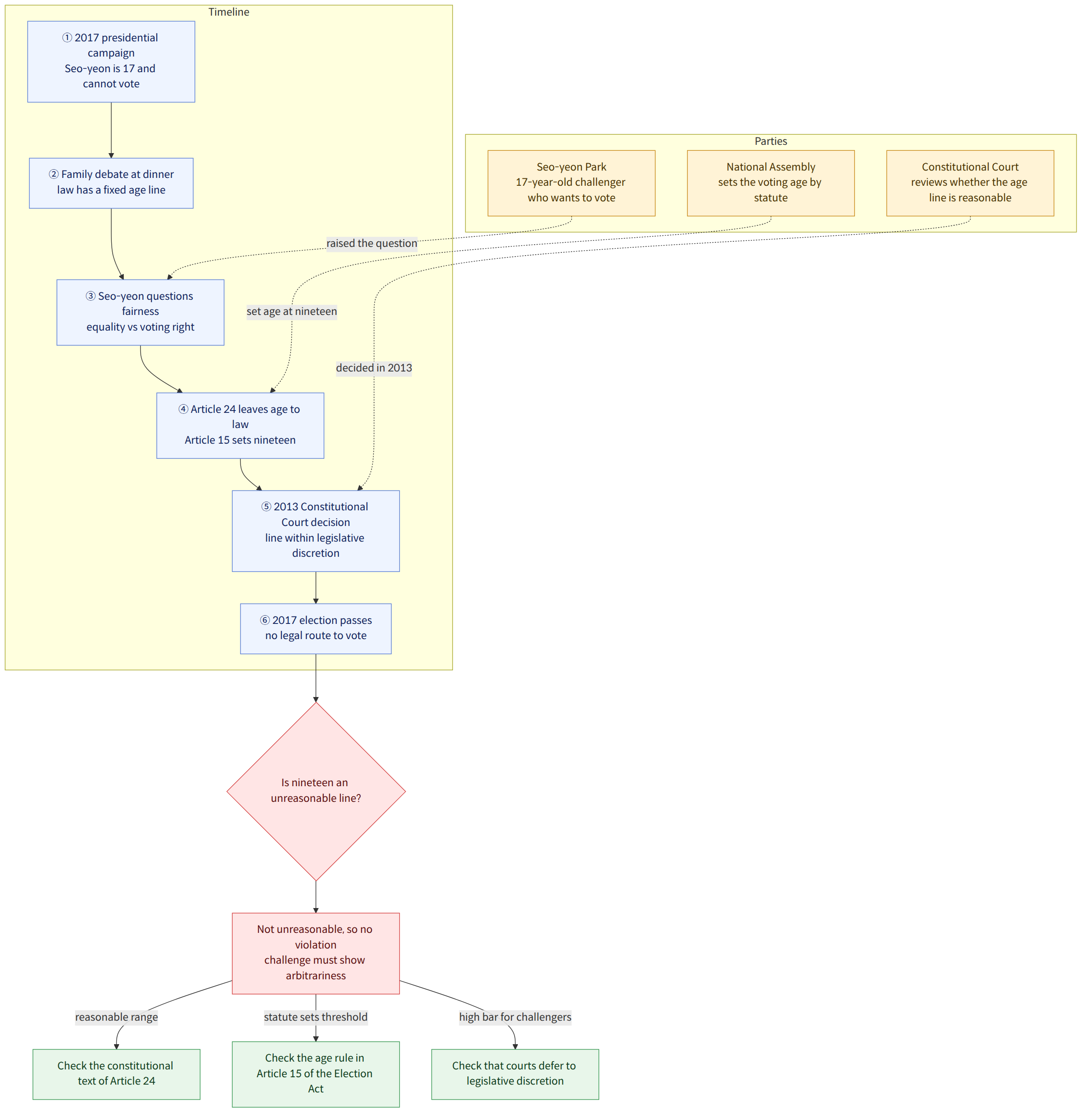
Seo-yeon Park was seventeen when the 2017 presidential election campaign filled the streets of her city with banners, loudspeakers and debates on every television channel. She had strong opinions about housing costs, school hours and the future of her generation. Her older cousin, who had just turned twenty, cast a ballot without much thought, and Seo-yeon watched with a mix of envy and frustration.
At the dinner table, she argued that people her age would live with the consequences of national decisions for the longest time, yet had no say at the ballot box. Her father, a schoolteacher, agreed that her interest was admirable but pointed out that the law had a fixed age line. Her grandmother simply said that the rule had been there long before her.
Seo-yeon began to wonder whether the law was unfair. Could a rule that shuts out everyone under nineteen really be squared with the constitutional promise of equality and the right to take part in elections? She decided to find out.
The Legal Question
Does the provision of Korea's Public Official Election Act that grants voting rights only to citizens aged nineteen and over violate the constitutional guarantees of equality and political participation for those under nineteen?
What Korean Law Says
The relevant rules come from two sources: the Constitution and the Public Official Election Act.
Article 24 of the Constitution provides that every citizen who has attained the age prescribed by Act shall have the right to vote under the conditions prescribed by Act.
This wording is important. The Constitution does not fix a number. It hands the question of age to the legislature. Article 15 of the Public Official Election Act then sets the threshold at nineteen for presidential and National Assembly elections.
Two constitutional principles are in tension here:
- Equality (Article 11): The state may not discriminate without a reasonable basis.
- Political participation (Article 24): Citizens have a right to vote, but the details are set by statute.
The key concept is legislative discretion. Where the Constitution leaves a matter to lawmakers, courts generally defer unless the chosen rule is clearly unreasonable.
How Korean Courts Approach This
The Constitutional Court addressed this exact question in a 2013 decision. Its reasoning rested on several points:
The legislature may reasonably conclude that most persons under nineteen are still forming their political views and remain practically dependent on parents or teachers, so they have not yet acquired enough mental and physical autonomy to make independent political judgments. Setting the voting age at nineteen therefore falls within the legislature's reasonable range of discretion.
The Court also made three further observations:
- Many countries set the voting age at eighteen, but voting age is a matter each nation can decide according to its own circumstances.
- Other laws that treat eighteen-year-olds as capable of work or military service do not require the same standard for voting ability.
- Because the line was within legislative discretion, the rule did not violate equality or voting rights.
In practice, this means courts will not easily second-guess the age threshold. A challenge must show that the line is arbitrary, not merely that a different line might be better.
Applying the Law to the Case
Let us test Seo-yeon's argument step by step.
Step one: Is there a constitutional right to vote? Yes. Article 24 guarantees voting rights, but only for those who meet the age set by law.
Step two: Who decides the age? The Constitution assigns this task to the legislature. The National Assembly therefore has primary responsibility.
Step three: Was the nineteen-year threshold reasonable? The Constitutional Court found that it was. Its reasons, though debatable, were grounded in a recognizable view of maturity and dependence, and it noted that other countries and laws draw the line differently.
Step four: Does the existence of different ages elsewhere prove discrimination? Not necessarily. Different legal ages for different purposes, such as working or serving in the military, do not automatically establish that the voting age is unfair.
Seo-yeon's argument is emotionally powerful, but legally, she faces a high bar. A court asks whether the line is unreasonable, not whether it is the best possible line.
Conclusion: What Happened, and What Should You Do?
Seo-yeon could not vote in the 2017 election. The Constitutional Court's 2013 decision meant that, as long as the Public Official Election Act kept the age at nineteen, no legal route existed for her to cast a ballot. Her frustration was real, but the law gave her no immediate remedy beyond waiting until she reached the threshold.
If you find yourself in a similar position, consider these practical points:
- Check the current statute. The age rule is set in the Public Official Election Act, so any change would come through amendment by the National Assembly, not through a court order.
- Use democratic channels. Contacting lawmakers, joining civic campaigns, or submitting public comments on proposed amendments are the most realistic ways to push for change.
- Understand the limits of a constitutional complaint. Courts have already upheld the nineteen-year threshold, so a new challenge would need compelling new arguments or circumstances to succeed.
If you are weighing a similar challenge, you could ask attorney Ji-sun Ahn of Ijun Law Firm to review the exact wording of the Public Official Election Act provision you are questioning, together with any prior Constitutional Court decision you plan to rely on, and to explain whether your situation offers anything materially different from the 2013 ruling.
















