
1. A Human Story
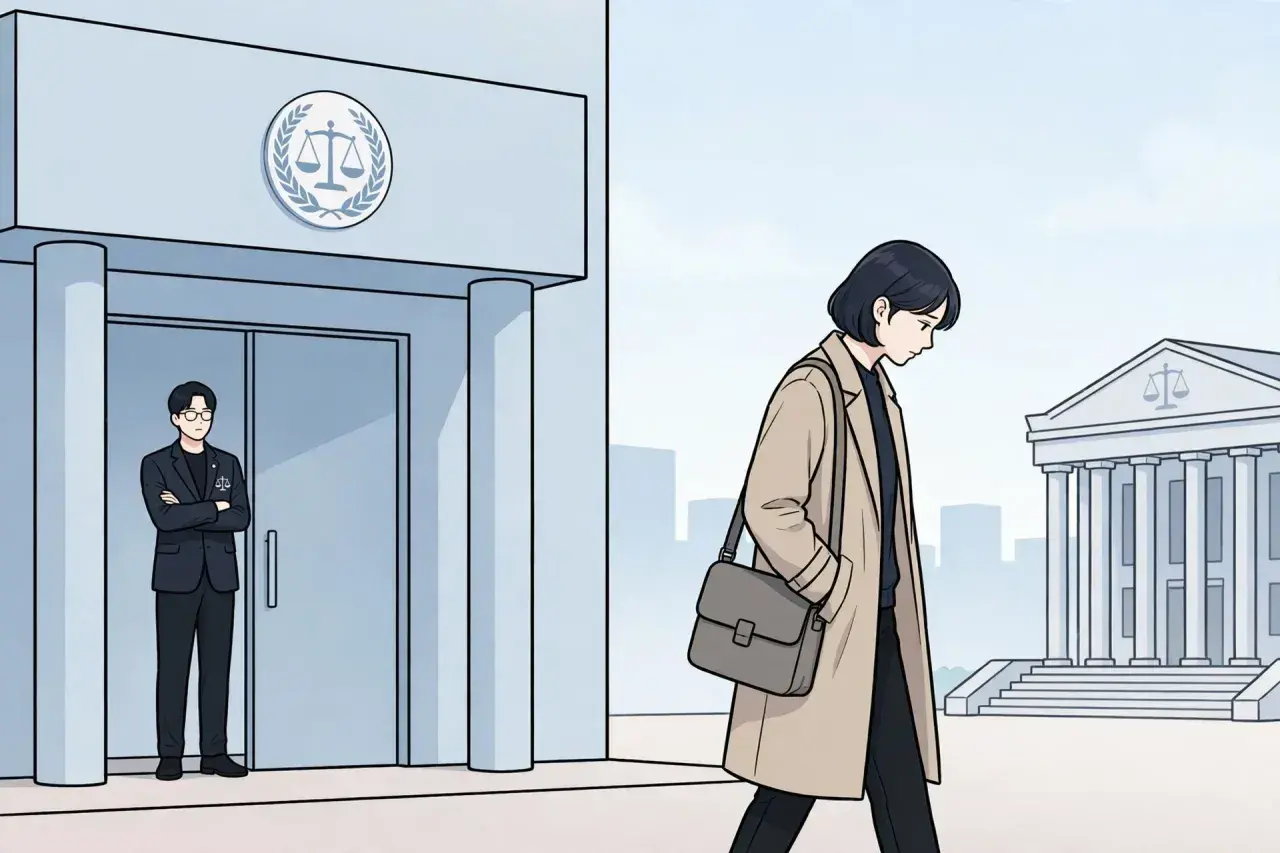
Daniel Park had spent weeks gathering messages, dates, and documents before he filed a complaint with Korea’s National Human Rights Commission. He believed that the treatment he had experienced crossed a line. He was not asking for a grand public campaign—just for an independent body to look into what had happened.
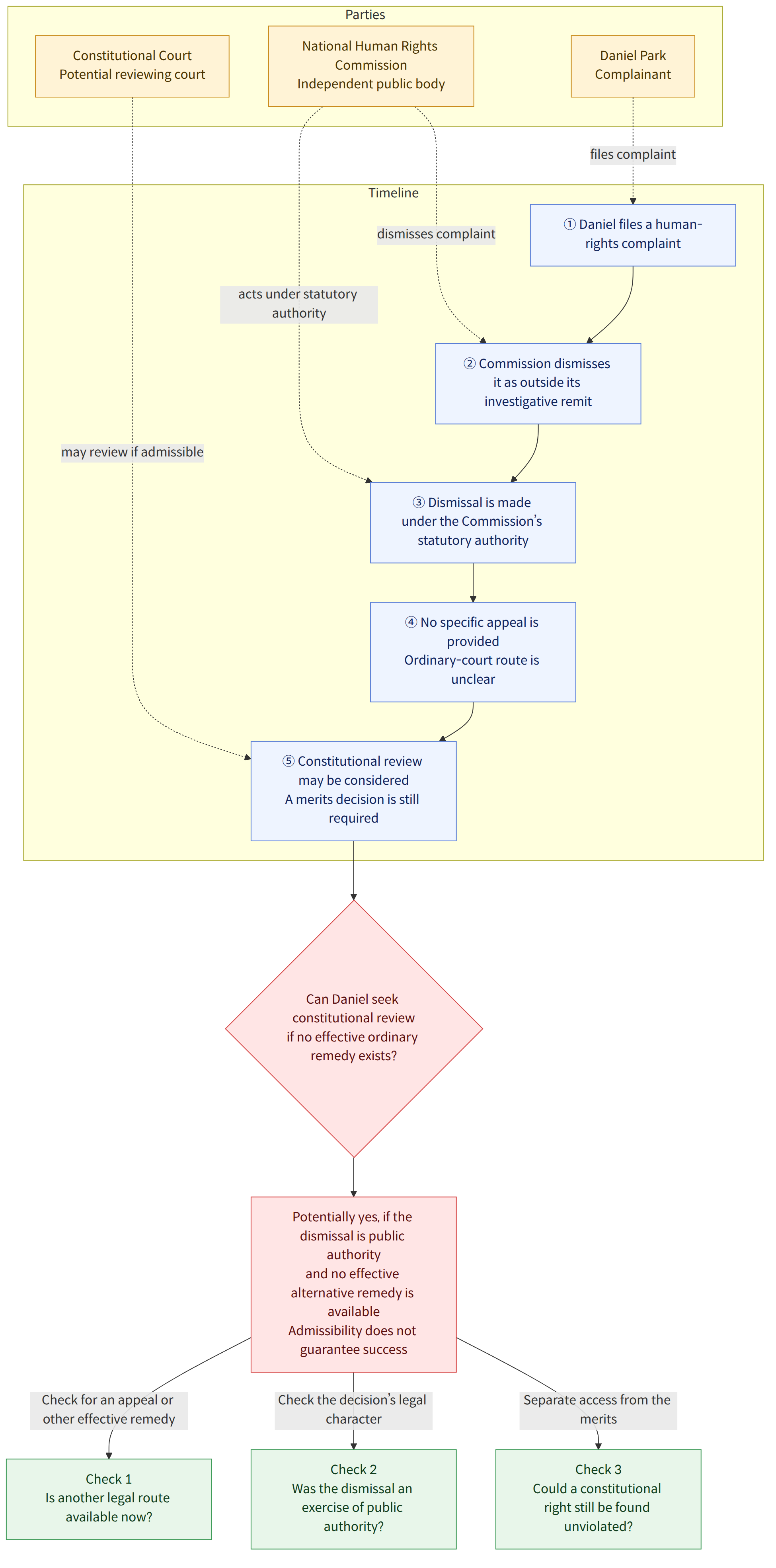
The reply was brief. The Commission dismissed his complaint because, in its view, the matter did not fall within the kinds of cases it was authorized to investigate. Daniel read the notice twice. It did not decide whether his account was true; it said the Commission would not investigate it. With no clear appeal route listed, he faced a pressing question: could he ask Korea’s Constitutional Court to review the dismissal?
2. The Legal Question
Can a person bring a constitutional complaint against the National Human Rights Commission’s decision to dismiss a complaint as outside its investigative scope? The answer depends on two separate questions: whether the dismissal is an exercise of public authority, and whether another effective legal remedy must be used first.
3. What Korean Law Says
The National Human Rights Commission is an independent public body established under the National Human Rights Commission Act. When it decides whether to investigate a complaint, it is exercising authority given to it by law—not merely offering private advice.
Under Article 68(1) of the Constitutional Court Act, a person may seek constitutional review when an exercise or failure to exercise public authority infringes that person’s basic rights, subject to the requirement that available legal remedies generally be exhausted first.
That framework creates two important steps:
- Public-authority requirement: The challenged act must be attributable to a public body exercising state power. A Commission decision dismissing a complaint can meet this requirement.
- Subsidiarity requirement: A constitutional complaint is generally not a substitute for an ordinary appeal or lawsuit. If another effective remedy is available, the petitioner usually must pursue it before turning to the Constitutional Court.
For a Commission dismissal, the second step matters. The National Human Rights Commission Act has not provided an appeal procedure specifically for challenging a decision to dismiss or reject a complaint. Nor has the administrative-law status of such decisions been firmly established by ordinary-court precedent. In that setting, the absence of a clear alternative remedy can allow the Constitutional Court to consider a constitutional complaint.
The key question is not simply whether a person dislikes the Commission’s decision. It is whether the decision is an exercise of public authority and whether the law provides another route that the person must first use.
This is an assessment of access to constitutional review, not a promise that the petitioner will win. The Constitutional Court may find a complaint admissible yet still conclude, after considering the facts and law, that no constitutional right was violated.
4. How Korean Courts Approach This
Korean constitutional review places significant weight on subsidiarity: constitutional complaints are intended to fill gaps in legal protection, not bypass remedies available in ordinary courts. But that principle presupposes that a usable alternative remedy actually exists.
The Constitutional Court has treated the Commission as an independent state institution that exercises public authority when it makes decisions under its statutory role. It has also considered whether a complainant had any legal avenue to challenge a dismissal. Where the statute offers no appeal and ordinary-court law does not clearly recognize the dismissal as an administrative disposition that can be challenged in an administrative lawsuit, the lack of another remedy may satisfy the subsidiarity requirement.
That conclusion is not permanent or automatic. If legislation later creates a specific appeal process, or court decisions establish that these dismissals can be challenged through an ordinary administrative action, a future petitioner may be required to use that route first. A constitutional complaint filed without doing so could then be rejected as procedurally inadmissible.
5. Applying the Law to Daniel’s Case
Daniel’s situation can be assessed in stages.
- The decision came from a public authority. The Commission was not acting as a private organization when it declined to investigate. It was applying its statutory authority to decide whether his complaint fell within its remit. That makes the dismissal capable of being treated as an exercise of public authority.
- The decision affected Daniel’s position. The dismissal ended the Commission’s consideration of his complaint at the threshold. It did not determine whether his allegations were true, but it did prevent the Commission from investigating them. That is enough to make the decision’s effect on his rights and legal interests relevant to constitutional review.
- He must check for another effective remedy. Daniel should examine the law and current court practice before filing. On the legal framework described here, the Commission Act provides no special appeal from a dismissal or rejection, and the ordinary-court route has not been clearly established. If that remains the position, the constitutional complaint is not barred merely because it is a last-resort procedure.
- Admissibility is not the same as a finding of illegality. Even if the Constitutional Court accepts Daniel’s complaint for review, he must still show that the Commission’s decision infringed a constitutional right. The Court’s review would focus on the constitutional validity of the dismissal, not simply on whether Daniel believes the Commission should have investigated.
Daniel therefore has a credible route to seek constitutional review, assuming no alternative remedy is available under the law and practice that apply when he files. The precise outcome would depend on the reason for the dismissal, the record before the Commission, and the constitutional arguments he can support.
If you are dealing with a similar issue, attorney Ji-sun Ahn of Ijun Law Firm can review the provision applied in your case, the ruling or notice you received, and the dates relevant to challenging it with you. These details can help clarify which options apply to your situation.
6. Conclusion: What Happened, and What Should You Do?
Daniel’s complaint was not automatically beyond review just because the Commission called it a dismissal. Because the Commission exercises public authority, its decision can be challenged through a constitutional complaint. And where no appeal or established administrative-court route is available, the usual requirement to pursue another remedy first may not prevent the petition from being heard.
That does not mean Daniel is guaranteed to have the dismissal overturned—or that the Commission will be ordered to investigate. It means he may ask the Constitutional Court to examine whether the decision violated his constitutional rights. For readers in a similar position:
- Keep the dismissal notice and the full complaint file. Record when you received the decision and preserve the materials that show what the Commission considered.
- Check whether a new or established remedy is available. The rules on appeals and administrative lawsuits can change; confirm the current position before relying on a constitutional complaint as your first step.
- Explain the constitutional harm precisely. Identify the right you say was infringed and connect it to the Commission’s decision, rather than treating disagreement with the outcome as sufficient by itself.

















