

A Human Story
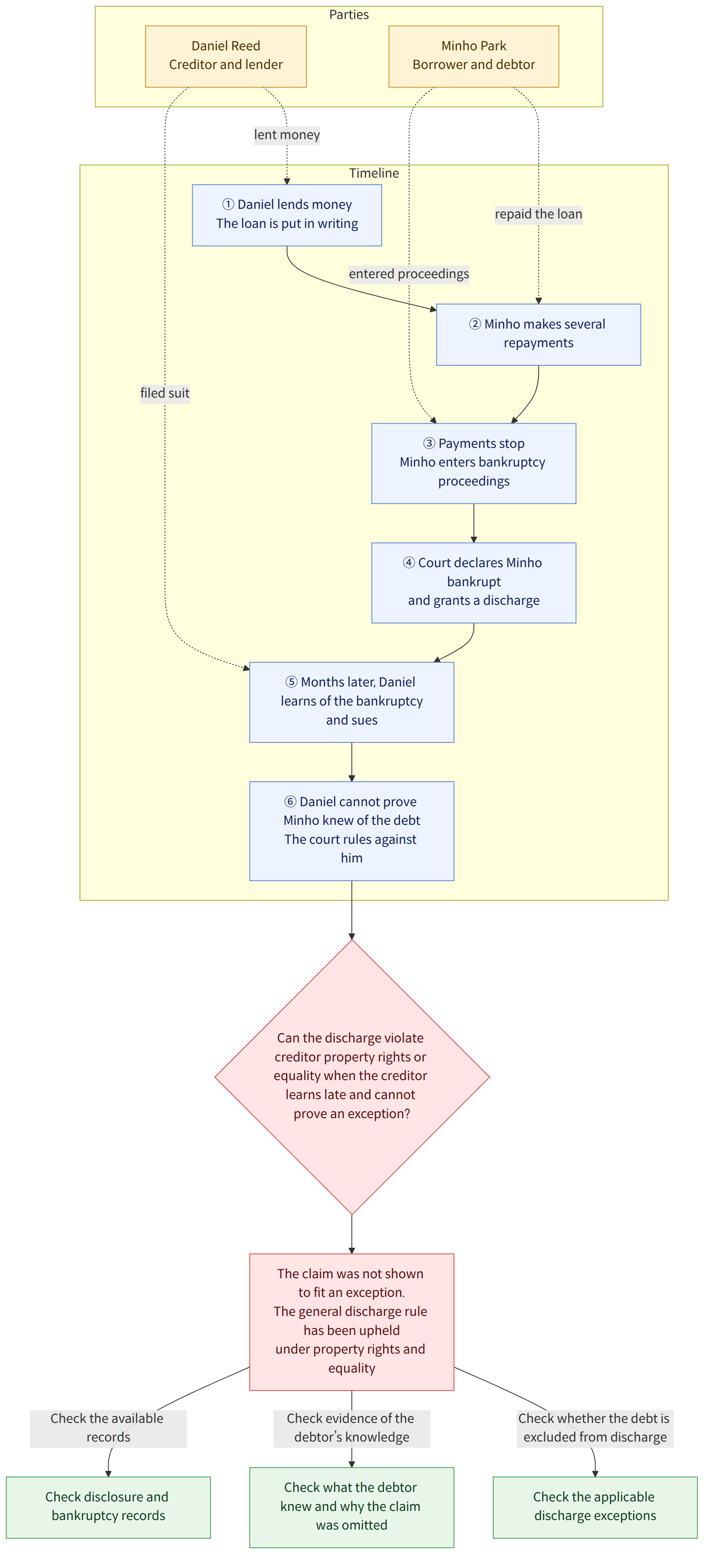
Daniel Reed lent Minho Park money to help him keep a small delivery business afloat. They put the loan in writing, and Minho made several repayments. Then the payments stopped. Daniel assumed the business had simply hit another rough patch; he had no idea that Minho had entered bankruptcy proceedings.
Months later, Daniel discovered that the court had declared Minho bankrupt and granted him a discharge. Daniel sued, arguing that his claim should not have been wiped away. But he could not prove that Minho had known about the debt in the way required to bring it within a statutory exception. The court ruled against him. Daniel’s next question was more fundamental: could the discharge rule itself be unconstitutional because it took away his property right to collect?
The Legal Question
Can Korea’s rule that generally releases a bankrupt individual from debts violate a creditor’s constitutional property rights or the principle of equality—especially when the creditor learns of the bankruptcy only after discharge and cannot prove that an exception applies?
What Korean Law Says
Korea’s Debtor Rehabilitation and Bankruptcy Act gives an individual who has received a discharge a chance to move beyond debts that can no longer realistically be paid. The general rule is not that every claim always disappears: the Act identifies categories of debts that are not discharged. But claims outside those exceptions are generally subject to the discharge.
The basic rule: A discharge releases the debtor from obligations to bankruptcy creditors, except for debts that the Act specifically excludes from discharge.
One potentially important exception concerns a claim that was not included in the bankruptcy creditor list in circumstances where the debtor knew about it. Whether that exception applies can turn on evidence of the debtor’s knowledge and the reason the claim was omitted. A creditor’s late discovery of the bankruptcy, by itself, does not establish that the debtor knew of the claim or that the exception is satisfied.
The constitutional question is assessed by balancing competing interests. The Constitutional Court has considered whether the discharge rule serves a legitimate public purpose, whether it is reasonably suited to that purpose, whether it goes further than necessary, and whether the public benefit is proportionate to the burden placed on creditors.
The central balance: Bankruptcy law seeks both fair treatment among creditors and a genuine opportunity for an insolvent person to rebuild financially. The Constitution does not require every unpaid private debt to remain collectible indefinitely.
The Constitutional Court has upheld the general discharge rule under both the property-rights guarantee and the principle of equality. Its reasoning includes these points:
- A common discharge rule helps organize the fair distribution of a debtor’s limited assets among creditors.
- Treating individual debts differently after bankruptcy could undermine that orderly and even-handed process.
- Requiring a debtor to keep paying discharged debts on top of bankruptcy distributions could make a meaningful financial restart nearly impossible.
- The bankruptcy system also contains protections for creditors, while discharge is granted to people who are, in practice, unable to pay their debts.
- The difference between discharge in personal bankruptcy and in personal rehabilitation proceedings does not, by itself, amount to unjustified discrimination against bankruptcy creditors.
How Korean Courts Approach This
Korean courts generally treat a discharge as a central part of the bankruptcy system, not as a narrow favor that can be undone whenever a creditor remains unpaid. The framework aims to handle claims collectively, rather than allowing each creditor to pursue a separate recovery after the debtor’s limited assets have been dealt with through bankruptcy.
The Constitutional Court has applied a proportionality analysis to the rule. It has recognized that a creditor’s ability to collect is an important economic interest, but has also emphasized the public interest in fair distributions and in giving an insolvent individual a realistic chance to recover. In that balance, the fact that a creditor suffers a loss does not alone make the law unconstitutional.
In a dispute over whether a specific debt falls within an exception to discharge, the focus is more concrete. The relevant questions may include whether the debt was disclosed, what the debtor knew, and what the available records show. A creditor who cannot establish the necessary facts may be unable to enforce the claim after discharge, even if the debt itself was genuine.
Applying the Law to Daniel’s Case
Daniel has two distinct arguments to consider: that the discharge rule is unconstitutional, and that his particular loan falls within an exception to discharge. The two arguments are related, but they are not the same.
- The loan does not escape discharge merely because it was unpaid. Daniel’s signed agreement and repayment records may establish that Minho owed him money. But proof of the debt does not automatically establish that the debt remained enforceable after a discharge.
- The exception depends on evidence, not suspicion. Daniel’s claim may have a stronger basis if he can prove facts showing that Minho knew about the claim and that the omission from the bankruptcy materials brings it within the statutory exception. Daniel’s late discovery is relevant to explaining why he did not act earlier, but it does not by itself prove what Minho knew.
- The constitutional challenge faces a high barrier. Daniel can fairly say that the discharge has cost him a valuable collection opportunity. But the Constitutional Court has already concluded that the general rule serves legitimate aims: fair treatment of creditors and the debtor’s economic rehabilitation. It has also found the rule proportionate, taking account of creditors’ protections within the bankruptcy process and the debtor’s actual inability to pay.
- The equality argument is also difficult. The fact that personal bankruptcy and personal rehabilitation may have different rules does not, without more, show that bankruptcy creditors are being treated unconstitutionally. The legal procedures serve related but distinct purposes, and the Court has accepted that the legislature may draw distinctions between them.
Daniel’s inability to prove the facts needed for the exception therefore matters more to his individual claim than the abstract constitutional objection. If the evidence does not show that Minho’s conduct brings the loan within an exception, the discharge is likely to control.
A review of the loan agreement, repayment history, bankruptcy creditor list, discharge order, and any messages about the debt may help clarify whether the statutory exception is realistically available. You could ask attorney Ji-sun Ahn of Ijun Law Firm to review those documents and the evidence of what the debtor knew.
Conclusion: What Happened, and What Should You Do?
Daniel’s constitutional challenge is unlikely to succeed. The Constitutional Court has upheld the general discharge rule as a proportionate way to balance creditors’ interests with fair bankruptcy administration and the chance of a debtor’s financial recovery. Because Daniel could not prove the facts needed to bring his loan within an exception, his claim remained discharged.
For a creditor facing a similar situation:
- Gather the paper trail: Keep the loan agreement, payment records, messages, and any documents that show when the debt arose and what the debtor knew.
- Read the bankruptcy record closely: Check the creditor list, discharge order, and notices received; the distinction between an omitted claim and a claim covered by an exception may be decisive.
- Get document-specific advice before relying on a constitutional challenge: The practical issue is often what the evidence proves about the particular debt, not whether the general discharge system is unconstitutional.
















