

1. A Human Story
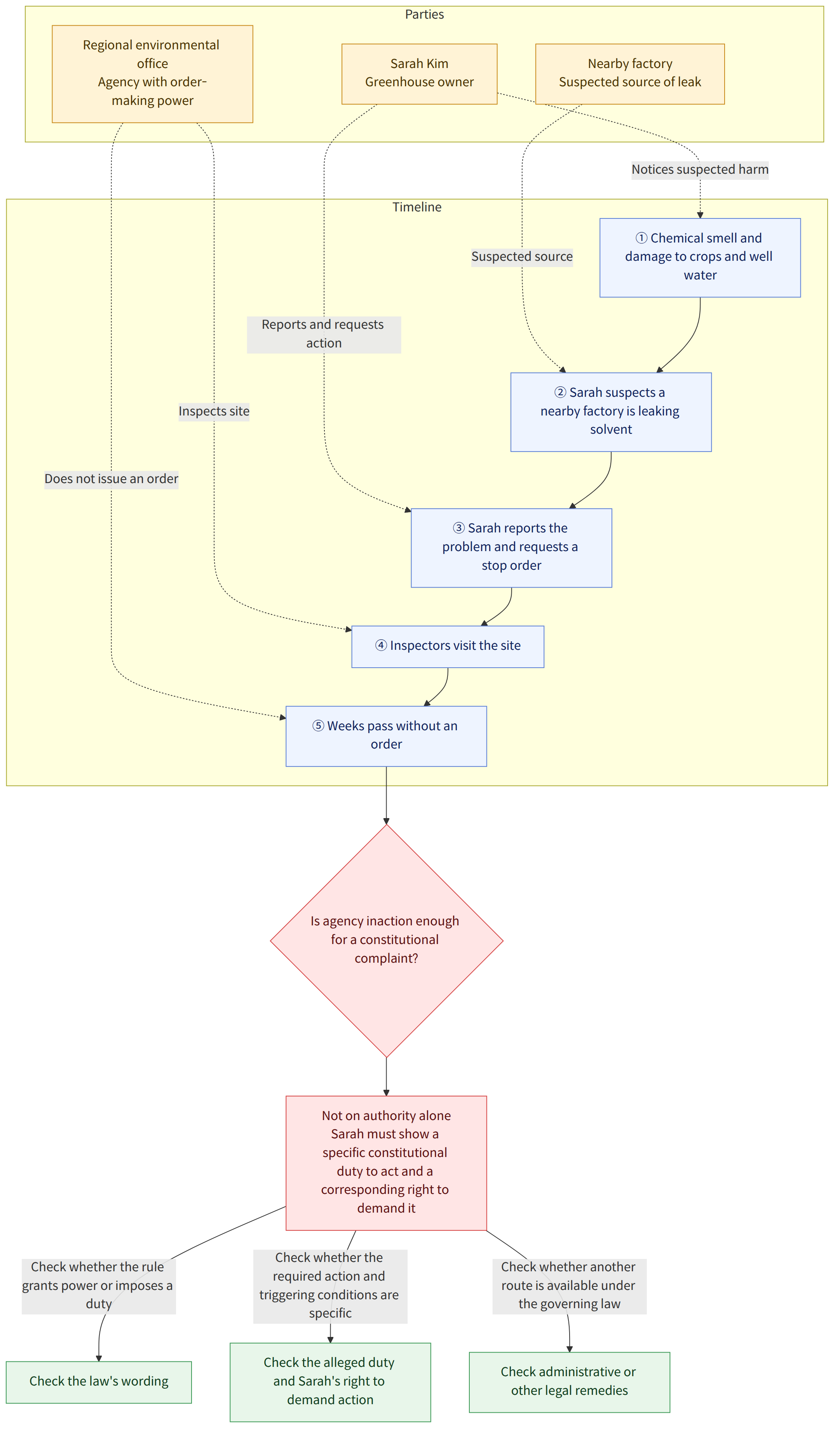
When Sarah Kim first noticed a sharp chemical smell near her greenhouse, she blamed the unusually hot weather. Then the leaves on her tomato plants began to curl, and a neighbor’s well water developed a strange taste. Sarah suspected a nearby factory was leaking solvent into the soil.
She reported the problem to the regional environmental office and asked it to order the factory to stop operating until the leak was contained. Inspectors visited the site, but weeks passed without an order. The law gave the office authority to issue one. Sarah’s question was simple: if the government can act and chooses not to, can she take that inaction to the Constitutional Court?
2. The Legal Question
The central question is whether an agency’s failure to use a power it possesses is, by itself, enough to support a constitutional complaint—or whether Sarah must show that the agency had a specific legal duty to take the requested action and that she had a corresponding right to demand it.
3. What Korean Law Says
A constitutional complaint may, in appropriate circumstances, challenge not only an act by a public authority but also its failure to act. Yet Korean constitutional law does not treat every government delay or refusal to use a power as a constitutional violation.
The key distinction is between authority and duty. An agency may have the power to take a measure without being legally required to take it in every case. For a complaint based on inaction to be available, the public authority must have a duty to act that is specifically and concretely grounded in the Constitution, and the individual must be entitled, on that basis, to ask the authority to exercise its power.
A constitutional complaint against governmental inaction is generally available only when a public authority has a specifically defined constitutional duty to act, and a person can claim a corresponding right to demand that action.
That principle has practical consequences:
- If a law says an agency “may” issue an order, it will usually indicate that the agency has discretion. The mere existence of that power does not ordinarily give every affected person a constitutional right to compel its use.
- If a law says the agency “must” take a specified step when defined conditions are met, that may support an argument that it has a duty. But mandatory wording alone does not automatically settle whether a constitutional complaint is available: the duty must also be sufficiently specific, connected to a constitutional obligation, and one the individual can demand.
- General constitutional protections, such as the right to health or the right to a healthy environment, do not necessarily require an agency to issue a particular order in a particular dispute. The claimed duty must be concrete enough to identify what the authority was required to do.
A constitutional complaint is therefore not simply a way to ask a court to substitute its judgment for an agency’s whenever a person believes the agency should intervene. Other legal routes—such as an administrative petition, a statutory appeal, or litigation where available—may be relevant, depending on the governing law and the facts.
4. How Korean Courts Approach This
Korean courts and the Constitutional Court focus first on whether a legally enforceable duty to act exists. They distinguish a public authority’s capacity to act from an obligation to do so. A statute that permits an agency to intervene can leave room for it to weigh evidence, risks, and competing public interests; that discretion does not, on its own, establish an individual right to demand a particular outcome.
The question is not merely whether the authority could have acted. It is whether the Constitution, through a sufficiently specific duty, required it to act in a way the complainant was entitled to request.
Courts also examine the nature of the alleged duty and the person bringing the complaint. A general duty on the state to protect the public may not be enough to show that a particular individual can demand a particular administrative measure. The closer the legal rule comes to specifying the responsible authority, the triggering conditions, and the required action—and to protecting the complainant’s own constitutional interest—the stronger the argument that inaction may be reviewable.
5. Applying the Law to Sarah’s Case
Sarah has a serious concern: a suspected chemical leak may be harming her crops, water, and health. But the seriousness of the suspected harm does not, by itself, answer the constitutional question.
- What power does the agency have? The relevant rule gives the environmental office authority to issue a stop or remediation order. That establishes that the agency can act.
- Does the rule require it to act? On the facts described, the rule says the office may issue an order. Unless another provision or a constitutional obligation makes the order mandatory once particular conditions are proved, that language ordinarily leaves the office discretion.
- Can Sarah demand this specific measure as a constitutional right? Sarah can point to concerns about health and the environment. But those important interests do not automatically create a concrete constitutional duty to issue the particular order she requested. She would need to identify a sufficiently specific duty and show that she is entitled to demand its performance.
- What does that mean for a constitutional complaint? If the agency’s only relevant obligation is a discretionary power to issue an order, Sarah’s complaint challenging the failure to issue that order would likely fail the threshold requirement for a constitutional challenge to inaction. That conclusion would not establish that the factory is safe or that the agency handled the report properly; it would mean only that this particular constitutional route may not be available on those facts.
The result could differ if, for example, a binding rule required the office to take a defined protective step once specified danger thresholds were met, and Sarah could show that the duty was grounded in a constitutional obligation that protected her. Even then, the precise remedy and the availability of other procedures would need careful assessment.
If you are dealing with a similar issue, attorney Ji-sun Ahn of Ijun Law Firm can review the provision applied in your case, the ruling or notice you received, and the dates relevant to challenging it with you. These details can help clarify which options apply to your situation.
6. Conclusion: What Happened, and What Should You Do?
Sarah’s request for an immediate order did not, by itself, create a constitutional duty for the agency to grant it. Because the rule she relied on gave the office discretion rather than clearly requiring the particular action, a constitutional complaint based solely on its failure to issue the order would likely be unavailable. She should pursue the evidence and any applicable administrative remedies rather than assume that the agency’s power to act gives her a constitutional right to compel a specific decision.
If you face a similar situation:
- Find the exact wording of the law. Look for whether it says the authority “may” act or “must” act, and check for provisions that define when action is required.
- Document the risk and your connection to it. Keep inspection records, reports, photographs, correspondence, and evidence showing how the inaction affects your own rights or interests.
- Check every available route promptly. Ask the agency for a written decision, seek advice on administrative review or other remedies, and get legal guidance before relying on a constitutional complaint alone.

















