

A Human Story
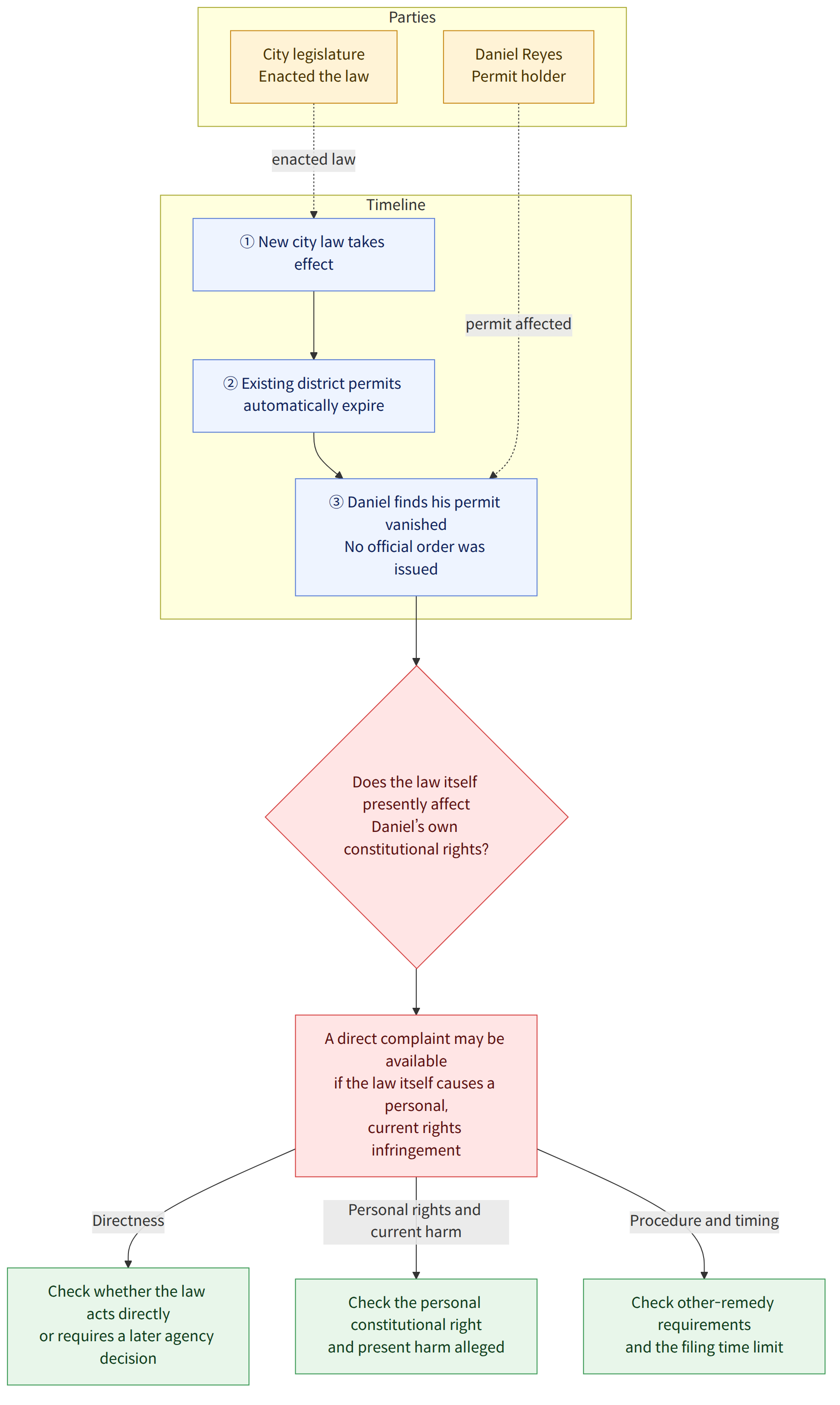
On the morning a new city law took effect, Daniel Reyes arrived at his usual corner with his coffee cart and found that his vending permit had, in legal terms, vanished. The fictional law said that existing permits in his district would automatically expire on its effective date. No agency had sent him an order, and no official had made a new decision about his case.
Daniel had built his small business around that permit. He wondered whether he had to wait for an official to enforce the new rule before going to court—or whether the law itself was already enough to challenge. His question is a practical one: when legislation directly changes a person’s legal position, can that person ask Korea’s Constitutional Court to review the law?
The Legal Question
Can someone file a constitutional complaint directly against a law when the law itself, without a separate administrative decision or other enforcement step, presently affects that person’s constitutionally protected rights? And how does that differ from a complaint about the legislature’s failure to act, or about a law that regulates a subject inadequately?
What Korean Law Says
The Constitutional Court Act permits a constitutional complaint against an exercise of public power that infringes constitutionally protected rights. Legislative action can count as an exercise of public power. A law may therefore be challenged directly—but not simply because someone believes it is unwise or unfair.
A direct complaint against a law may be available when the law itself, without a separate act of enforcement, directly and presently infringes the petitioner’s constitutional rights.
The central distinction is between a law that itself changes a person’s legal position and one that needs a further decision before it affects that person. If an agency must first decide whether a rule applies, that later decision may be the more appropriate target, subject to the available legal procedures.
A constitutional complaint can also concern legislative inaction, but the duty to legislate must be more than a general expectation that lawmakers should address a problem. The relevant principles include:
- Direct challenge to a law: The provision itself must cause a present infringement of the petitioner’s own constitutional right, without a separate enforcement act being necessary.
- Legislative omission: A complaint may be possible where the Constitution expressly directs the legislature to enact a law, or where constitutional interpretation makes a specific protective duty clear, yet the legislature has taken no action.
- Defective or incomplete legislation: If lawmakers have legislated but the rules leave a matter insufficiently or unfairly regulated, the challenge is generally directed at the provision that was enacted. The claim might, for example, be that the provision violates equality or another constitutional guarantee.
A constitutional complaint is not a general request for the Court to review whether legislation is good policy. The claimant must identify a personal, constitutionally protected right and explain how the challenged act or omission affects it.
Other procedural requirements may also matter, including whether another legal remedy must be used first and whether the complaint is filed within the applicable time limit. Those questions can depend on the law and the way the harm occurred.
How Korean Courts Approach This
Korean constitutional adjudication distinguishes an individual rights claim from an abstract objection to legislation. The Constitutional Court does not review a statute simply because a person disagrees with its policy. The petitioner must show that the law affects them personally and that the alleged harm is sufficiently direct and current.
That is why the role of any later administrative action matters. If a statute automatically cancels a permit on a specified date, the legal change may come from the statute itself. If the statute merely authorizes an agency to decide who qualifies, and the agency has not yet acted, a direct challenge to the statute may not meet the directness requirement. The later decision may instead be central to the dispute.
The Court also treats legislative omission and defective legislation as distinct forms of claim. Where lawmakers have done nothing despite a clear constitutional duty to act, the complaint concerns that failure. Where lawmakers have enacted a rule but allegedly left a constitutional defect in its design or scope, the petitioner ordinarily needs to challenge the enacted provision itself. Calling an incomplete statute an “omission” does not necessarily make it one.
Applying the Law to Daniel’s Case
Daniel’s position turns on what the fictional law actually does, not just on the fact that his business has been disrupted.
- The law appears to act by itself. In this scenario, the statute says that existing permits expire automatically on its effective date. No official must first decide whether Daniel’s permit should end. That supports the view that the law itself caused the change.
- The effect is current and personal. Daniel held one of the permits covered by the provision, and the law has already removed its legal effect. He is not asking the Court to resolve a hypothetical future problem affecting someone else.
- He must connect the impact to a constitutional right. Losing a permit may affect interests protected by the Constitution, but Daniel would need to explain which right is involved and why the statutory treatment of permit holders violates it. Showing financial loss alone would not automatically establish a constitutional violation.
- He must choose the right kind of claim and meet procedural rules. If the statute itself terminated the permit, a direct challenge to that provision may be appropriate. If an agency later issues a separate decision, Daniel would need to consider whether that decision provides a remedy he must pursue. Filing requirements and time limits also need careful review.
Daniel could ask [[lawyer]] to review the text of the statute, his original permit, and any notice or correspondence from the city to identify whether the law itself or a later decision caused the loss and what procedural route may apply.
On these facts, Daniel has a credible basis to seek a direct constitutional review because the law is described as automatically ending his permit. That does not mean the Court will find the law unconstitutional or restore the permit. He still has to establish that a constitutional right of his is directly and presently affected, and that his complaint meets the procedural requirements.
You could ask attorney Ji-sun Ahn of Ijun Law Firm to review the statutory provision, your permit, and any city notice or correspondence to help clarify whether the law itself or a later decision caused the change and what procedural questions need to be considered.
Conclusion: What Happened, and What Should You Do?
Daniel does not have to wait for an official enforcement order if the statute itself has already changed his legal position. His next step is to obtain a precise review of the provision and the documents showing his permit’s status, then determine whether a direct constitutional complaint is available and procedurally sound. The issue is not simply whether the law feels unfair; it is whether this law itself presently infringes a constitutional right that belongs to him.
If you face a similar situation:
- Keep the statute or regulation, your permit or other affected document, and every notice or decision you receive. The sequence of events can show whether the law itself or a later act caused the harm.
- Identify the specific constitutional right you believe is affected, and explain how the provision applies to you personally—not just why you object to its policy.
- Seek advice promptly about available remedies and filing requirements; do not assume that a direct challenge is available, or that waiting for an enforcement decision is always necessary.

















