

1. A Human Story
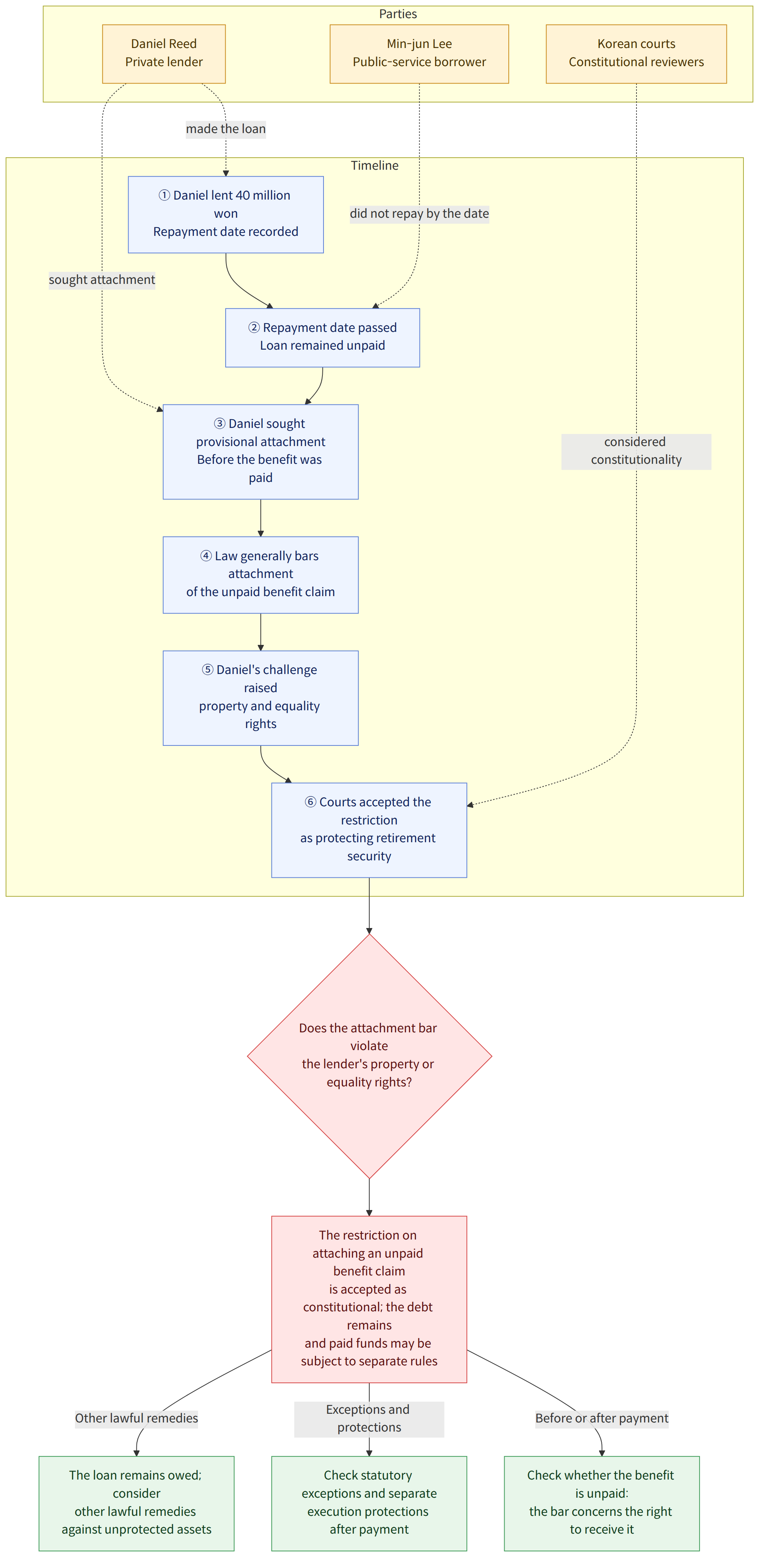
Daniel Reed had lent Min-jun Lee, a longtime colleague who worked in public service, 40 million won to help him through a difficult period. They wrote down the amount and repayment date. When that date passed without payment, Daniel tried to protect his claim before Min-jun’s retirement payment was disbursed. He applied for a provisional attachment against Min-jun’s public-official retirement benefit.
The application ran into a statutory barrier: Korean law generally prevents a creditor from attaching the right to receive benefits under the Public Officials Pension Act. Daniel felt that the rule left him with a valid debt but no way to secure it. His question was not only whether the attachment could proceed, but whether protecting Min-jun’s benefit in this way unfairly sacrificed Daniel’s property rights.
2. The Legal Question
Does the statutory prohibition on attaching a public official’s pension or retirement-benefit claim violate a private lender’s constitutional property rights or the constitutional principle of equality?
3. What Korean Law Says
The Public Officials Pension Act protects the right to receive benefits from transfer, attachment, and use as security, subject to specified exceptions. In substance, the rule is that a private creditor cannot seize the benefit entitlement before payment merely by obtaining an attachment order.
The Act provides that the right to receive benefits generally may not be transferred, attached, or pledged as security. It allows limited exceptions, including certain security arrangements for pension benefits and collection measures authorized by tax and other laws.
The Constitution protects property, but that protection does not mean every asset or claim must always be available for collection by a private creditor.
Article 23(1) of the Constitution guarantees the property rights of all citizens.
Article 11(1) guarantees equality before the law. The Constitution also recognizes an economic order that respects individual and business freedom and creativity.
In applying these guarantees, Korean law balances the creditor’s interest in collecting a debt against the purpose and nature of the asset being protected. The statutory bar is especially relevant to an unpaid benefit claim—the recipient’s right to be paid—not necessarily every form of money after it reaches the recipient. Once benefits have been paid, other rules governing execution and protected income may matter. A creditor should not assume, however, that deposited pension funds are automatically available for seizure; the applicable protections depend on the circumstances and current law.
The main points are:
- Before payment: A private creditor generally cannot attach the right to receive a benefit under the Public Officials Pension Act.
- Limited statutory exceptions: The Act allows certain arrangements and public-law collection measures, including those authorized for tax arrears.
- After payment: The specific bar on attaching the benefit entitlement does not itself answer whether funds in a recipient’s possession or account may be reached. Separate execution protections may apply.
- A debt still exists: The attachment restriction does not cancel the underlying loan or prevent a creditor from pursuing other lawful remedies against assets that are not protected.
4. How Korean Courts Approach This
Korean courts and the Constitutional Court have treated public-official pension benefits as different in purpose from an ordinary private debt or investment. These benefits are intended to support the retirement security and welfare of public officials and their surviving family members. Their amount is tied to public-service compensation, and the right to receive them is closely connected to the recipient’s personal livelihood. For those reasons, the legislature may protect the benefit claim from private attachment more broadly than it protects some other income.
The constitutional analysis also considers whether the restriction goes too far. The courts have reasoned that the attachment ban applies to the benefit claim before payment, rather than permanently immunizing all money after receipt. They have also accepted that the legislature may distinguish private debt collection from the collection of taxes and other public obligations, given the public interests involved. On that reasoning, the protection has not been regarded as an arbitrary discrimination against ordinary creditors or an unconstitutional destruction of their property rights.
The general judicial principle is that a creditor’s property interest must be balanced against the social-security purpose of the protected benefit. Where the restriction is limited to the unpaid benefit claim and has a rational public purpose, it may be constitutionally valid even though it makes collection harder.
5. Applying the Law to Daniel’s Case
Daniel’s position is understandable: he has a documented loan, the repayment date has passed, and a pending retirement payment may appear to be the most practical asset against which to secure repayment. But the legal analysis turns on what he sought to attach.
- The debt and the benefit claim are separate matters. The loan agreement may establish that Min-jun owes Daniel money. It does not, by itself, give Daniel a right to seize any particular asset that the law protects.
- Daniel targeted an unpaid statutory benefit. Because he sought provisional attachment before Min-jun received the retirement benefit, his application concerned the right to receive that benefit. That is the category the Public Officials Pension Act generally protects from attachment by a private creditor.
- The constitutional objection is unlikely to succeed. Daniel can point to the effect on his ability to collect, but the courts give weight to the benefit’s social-security role, the recipient’s need for retirement income, and the legislature’s judgment that the entitlement should not be traded or seized in ordinary private transactions. The distinction between private creditors and legally authorized public collection is also supported by the different public interests at stake.
- The restriction does not erase Daniel’s claim. He may still pursue lawful remedies against other assets or income that are not protected, and he may seek repayment or a negotiated arrangement. If Min-jun receives the benefit, Daniel would need to assess the separate rules governing funds already paid; the original attachment prohibition alone does not settle that question.
For Daniel, the key documents are the loan agreement and repayment records, along with any notice or decision showing whether the retirement benefit has been paid or remains outstanding. Those facts determine whether he was targeting a protected benefit entitlement or asking about a different asset after payment.
A review of the loan agreement, payment records, and any notice showing whether Min-jun’s retirement benefit is still unpaid could help clarify which asset Daniel sought to reach and what other lawful options may be available. You can ask attorney Ji-sun Ahn of Ijun Law Firm to review those documents and the court’s response.
6. Conclusion: What Happened, and What Should You Do?
Daniel’s attempt to provisionally attach Min-jun’s unpaid retirement benefit would not succeed under the general rule in the Public Officials Pension Act. A constitutional challenge would also be unlikely to change that result: Korean constitutional principles permit the legislature to protect these benefits because of their social-security function, while leaving creditors free to pursue other lawful avenues. Daniel’s loan remains a debt, but this particular asset is generally beyond his reach before payment.
If you are in a similar position:
- Check exactly what you are trying to attach. An unpaid pension entitlement and money already paid into an account may be treated differently, and separate protections may still apply to paid funds.
- Organize the evidence of the debt. Keep the loan agreement, transfer records, repayment messages, and any written acknowledgment of the balance.
- Get advice on the specific documents and assets. Before filing, have the relevant agreement, benefit-status notice, and any court response reviewed so you can identify lawful options without relying on an attachment the statute bars.
















