

A Human Story
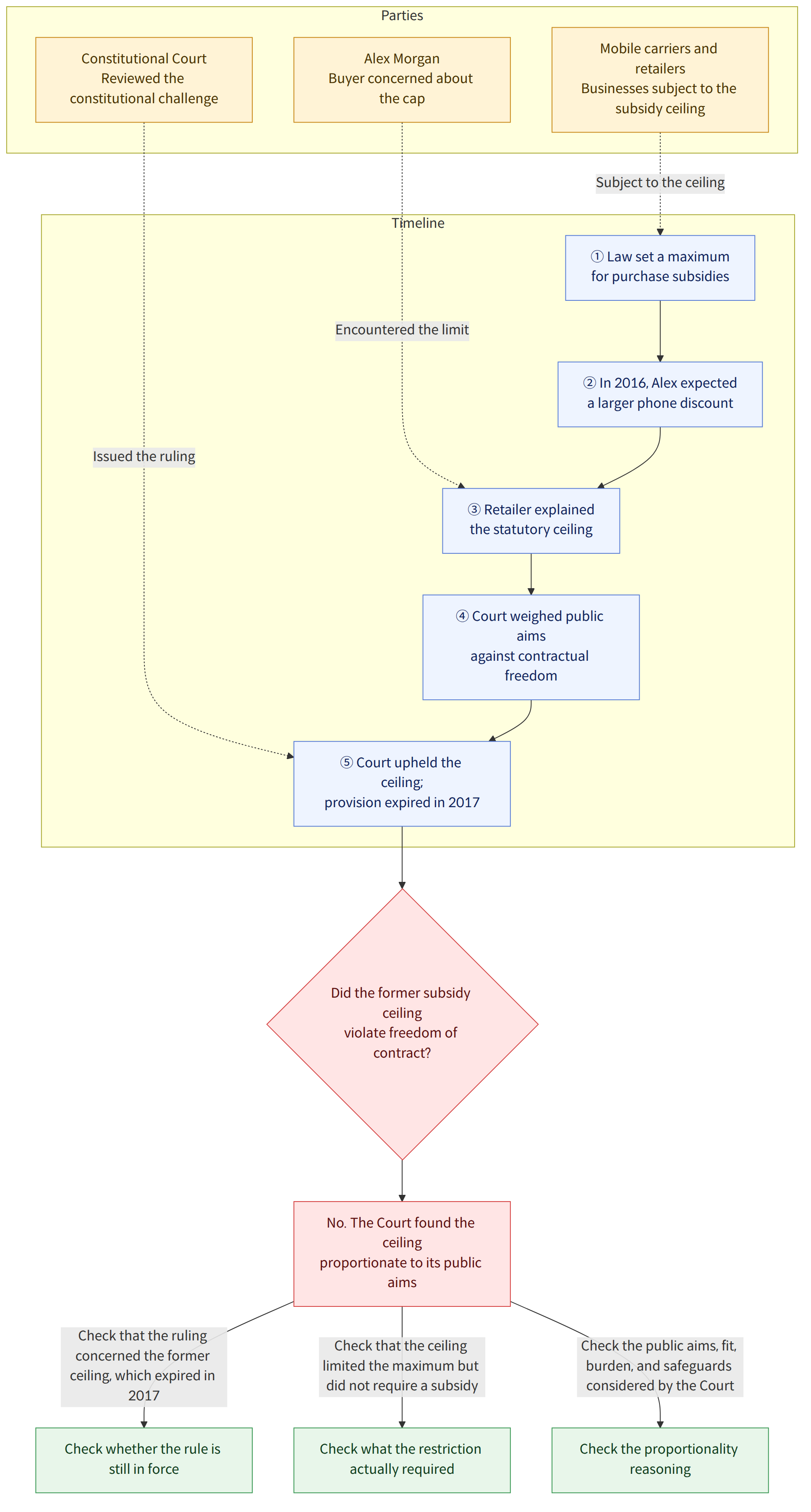
In 2016, Alex Morgan walked into a mobile-phone shop in Seoul ready to replace his aging handset. He had compared prices online and expected that choosing a particular carrier and signing a service contract would bring a substantial discount. Instead, the salesperson explained that the subsidy could not exceed a statutory ceiling.
Alex wondered why he and the retailer could not simply agree on a larger discount. If both sides wanted the deal, he thought, a government limit seemed to interfere with their freedom to contract. He considered challenging the rule—not because he had been denied a phone, but because the law had restricted the price incentive he was allowed to negotiate.
The Legal Question
Did Korea’s former statutory ceiling on subsidies for mobile-phone purchases violate the constitutional freedom of contract by preventing a carrier or retailer from offering, and a customer from accepting, a larger subsidy?
What Korean Law Says
The dispute concerned a provision of Korea’s Act on Improvement of Distribution Structure of Mobile Communication Devices. At the time, the law limited the size of purchase subsidies that mobile carriers and related businesses could offer. The provision did not require a business to give a subsidy; it set an upper boundary on the amount.
The Constitutional Court considered whether that restriction pursued a legitimate public purpose and whether the burden on contractual freedom was excessive. Its reasoning can be summarized this way:
The subsidy ceiling aimed to establish a fair and transparent distribution system, support the sound development of the mobile communications industry, and protect users’ interests. The Court found those aims legitimate and the ceiling suitable for pursuing them.
Although some consumers might receive less than they could have received without the ceiling, the Court concluded that the public benefits outweighed that disadvantage and that the provision did not violate freedom of contract.
The Court’s proportionality analysis focused on three main questions:
- Was the goal legitimate? The Court accepted fairer, more transparent distribution and consumer protection as valid public aims.
- Could the measure advance that goal? It concluded that limiting exceptionally high subsidies could help curb excessive competition over subsidy offers.
- Was the burden excessive compared with the benefit? The ceiling left businesses free to decide whether to offer a subsidy, while restricting only its maximum amount. The Court also considered the consumer protections and other safeguards in the statutory scheme, and found the public interest weightier than the possible loss of a larger individual discount.
The decision concerned the law as it stood at the time. The statutory subsidy-ceiling provision later expired in 2017. The ruling therefore addresses the constitutionality of that former ceiling; it should not be read as saying that the same general ceiling remains in force today.
How Korean Courts Approach This
When a law limits private choices in pursuit of a public objective, Korean constitutional review generally asks whether the objective is legitimate, whether the measure is reasonably connected to it, whether the restriction goes further than necessary, and whether the public benefit is proportionate to the burden on individual rights.
In the subsidy-ceiling dispute, the Constitutional Court treated freedom of contract as important but not absolute. It accepted that a buyer could lose the chance to obtain a larger discount. But it also considered the broader market: unrestrained subsidy competition could produce an uneven or opaque distribution of benefits among consumers. The Court therefore examined the design of the whole statutory scheme, rather than treating the buyer’s preferred bargain as the only relevant interest.
The result was not that every restriction on pricing is automatically constitutional. Rather, the Court found this particular ceiling proportionate in light of its stated aims, its limited scope, and the safeguards surrounding it.
Applying the Law to Alex’s Purchase
Alex’s complaint is understandable: he wanted to negotiate a better price, and the law prevented the retailer from offering more than the permitted maximum. But the Court’s analysis would proceed beyond his individual transaction.
First, the Court would ask what the law was trying to accomplish. The legislature had identified concerns about fairness and transparency in phone distribution, as well as the effects of excessive subsidy competition. The Court accepted these as legitimate public objectives.
Second, it would consider whether a ceiling could help. The Court reasoned that limiting the maximum subsidy was a suitable tool for restraining excessive competition, even if it did not eliminate every difference in price or benefit among customers.
Third, it would assess how much the law restricted Alex’s freedom. The rule did not force a carrier to provide a particular subsidy or dictate every term of the service agreement. It limited the upper amount of the purchase subsidy. The Court also took account of other provisions intended to protect users and of the limits of relying on other measures alone.
Finally, the Court would balance Alex’s possible loss against the public interest. Some customers might receive smaller discounts than they otherwise could have negotiated. Yet the Court considered the objectives of a healthier mobile market and better protection for users sufficiently important to justify that burden. On that reasoning, Alex’s constitutional challenge would not succeed.
For a real purchase dispute, the relevant paperwork would still matter: the written price quotation, the service agreement, and any notice explaining how the discount was calculated. A lawyer could review those documents to help clarify whether the stated subsidy was applied as described and what issue, if any, remains to be addressed; [[lawyer]]
Conclusion: What Happened, and What Should You Do?
Alex could not use freedom of contract to invalidate the subsidy ceiling that applied to his 2016 purchase. The Constitutional Court upheld the former provision, finding that its consumer and market objectives justified the limited restriction on the amount of a subsidy. But the rule later expired, so a buyer facing a phone-price dispute today should not assume that the former ceiling governs the transaction.
If you are comparing or challenging a phone offer, keep these practical points in mind:
- Save the paperwork. Keep the written quote, contract, and any explanation of the price or subsidy.
- Separate the issues. A constitutional challenge to the former ceiling is different from a dispute about whether a particular business accurately described or applied an offer.
- Check the date and terms. The legal framework may depend on when you entered the contract and what the documents actually say.
















