

1. A Human Story
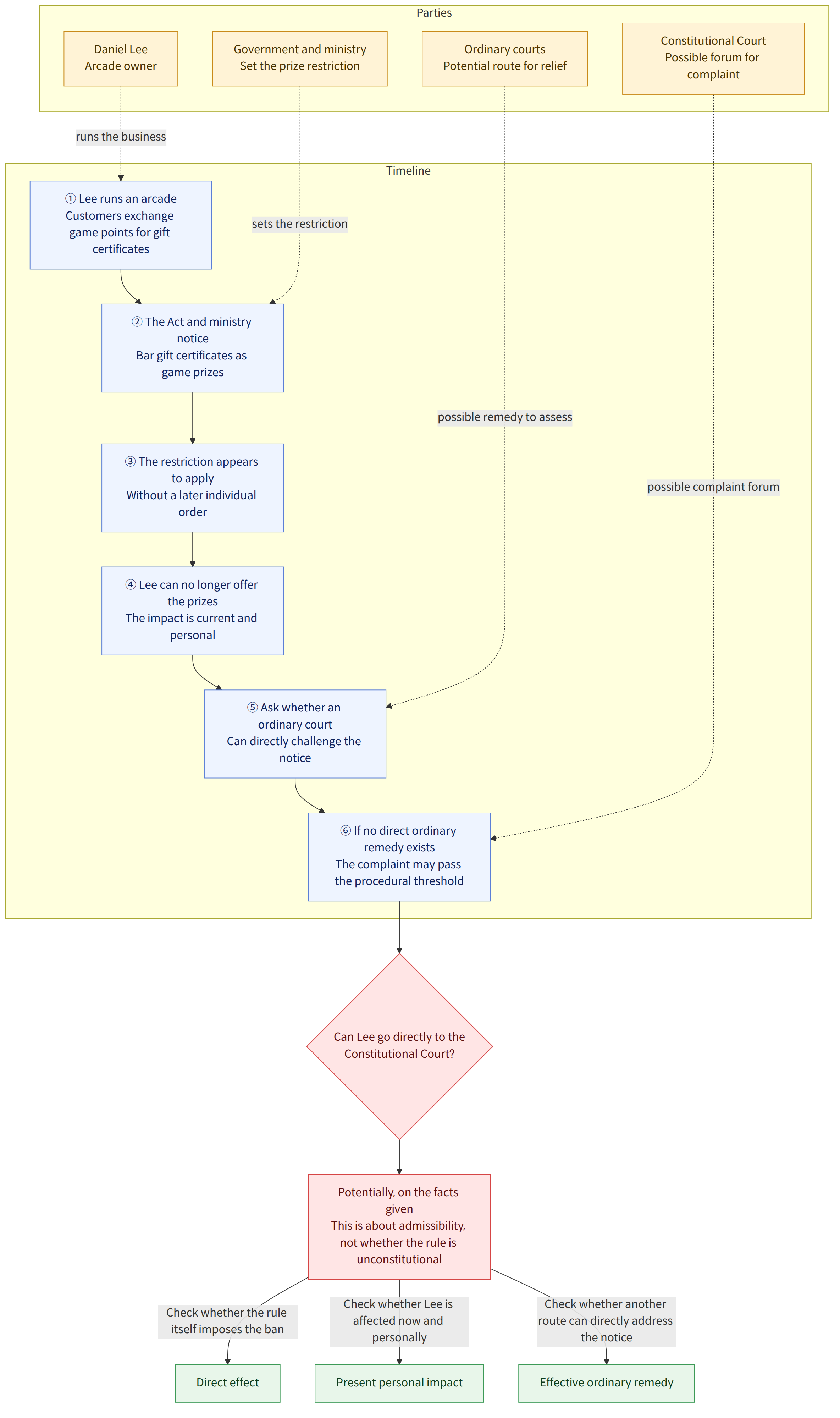
For years, Daniel Lee ran a small game arcade in a busy Seoul neighborhood. Customers could exchange points earned on certain games for gift certificates, and Daniel had built much of his business around that familiar prize system. He knew the rules could change, but he did not expect a government notice to make one of his main attractions unavailable without another official first deciding what he could or could not do.
Then the rules changed. Under the Game Industry Promotion Act and a notice setting standards for prizes at game businesses, gift certificates could no longer be offered as prizes. Daniel’s question was immediate and practical: could he challenge the notice itself in Korea’s Constitutional Court, or did he first have to sue somewhere else?
2. The Legal Question
The central issue is whether the prize restriction affected Daniel’s freedom to conduct his business directly and immediately, without a separate enforcement action, and whether an ordinary court offered a remedy through which he could directly contest the notice itself. If not, could he seek constitutional review without first pursuing another procedure?
3. What Korean Law Says
Korea’s constitutional complaint procedure is generally not a substitute for remedies available through ordinary courts or administrative processes. A person who can obtain relief through another suitable legal procedure is ordinarily expected to use it first. This is known as the principle of subsidiarity.
But that principle has an important limit. A rule may itself alter a person’s legal position as soon as it takes effect. If no additional official decision is needed to impose the restriction, and there is no ordinary court route for directly challenging the rule itself, requiring the person to pursue a different procedure may serve no purpose.
When a legal provision itself directly and presently infringes a basic right, and no ordinary court procedure is available to challenge that provision itself, the requirement to exhaust other remedies may not apply.
For a constitutional complaint based on this principle, the main questions include:
- Direct effect: Does the rule itself impose the restriction, or must an agency or official take another step first?
- Present impact: Is the person’s right affected now, rather than only by a possible future consequence?
- Available remedies: Is there a suitable ordinary procedure that can directly address the challenged rule or provide effective relief?
- Personal connection: Is the complainant personally subject to the rule, rather than raising only an abstract objection to government policy?
Passing this procedural threshold does not establish that the rule is unconstitutional. It means only that the complaint may be considered without first taking a remedy that cannot directly address the alleged injury.
4. How Korean Courts Approach This
Korean courts and the Constitutional Court look at how a rule operates in practice, not just its label. A notice or regulation may have an immediate legal effect even though it is not an individual order addressed by name to a particular business owner. If its terms themselves make a previously permitted activity unavailable, the restriction may be direct.
By contrast, if a rule merely authorizes an agency to act later, and the person’s rights are affected only when that agency issues a separate order or decision, that later action may be the proper subject of a challenge. Where an effective ordinary remedy exists, the usual expectation is that the person will pursue it before turning to constitutional review.
The procedural question is whether another legal route can actually address the alleged rights infringement—not simply whether some other type of lawsuit could be filed.
Courts therefore distinguish between a challenge to a rule that operates on its own and a challenge to a later decision implementing that rule. They also keep the admissibility question separate from the ultimate merits: a complaint may be procedurally eligible yet fail to prove that the restriction violates the Constitution.
5. Applying the Law to Daniel's Situation
Daniel’s situation appears to fit the direct-effect exception described above, based on the facts given.
- The restriction appears to come from the rule itself. The statute and ministry notice together make gift certificates unavailable as prizes for game businesses. The scenario does not describe a later inspection, individualized order, or licensing decision that first applies the ban to Daniel.
- The impact is current and personal. Daniel operates a game business and can no longer offer the prizes that formed part of his business model. This is not merely a concern about a policy that might affect him someday; the restriction applies to his present business activity.
- An ordinary lawsuit may not provide a direct route to challenge the notice itself. If the notice operates automatically and there is no separate administrative decision for Daniel to appeal or sue over, a requirement to pursue another procedure could leave him without a way to challenge the rule itself in an ordinary court.
- That may excuse the usual exhaustion requirement. On those assumptions, Daniel could argue that the rule directly and presently restricts his freedom to conduct his occupation and that no ordinary remedy is available to contest the rule itself. The constitutional complaint would therefore not necessarily be barred for failing to try another remedy first.
The details still matter. If, for example, an authority later issues Daniel a distinct order, or if an ordinary legal action can effectively review the restriction as applied to him, the analysis could change. And even if the Constitutional Court accepts the complaint for review, Daniel would still need to establish that the restriction infringes a protected constitutional right and is not justified under the Constitution.
6. Conclusion: What Happened, and What Should You Do?
On the stated facts, Daniel can argue that he may go directly to the Constitutional Court. The prohibition appears to arise from the notice itself, applies to his current business, and does not depend on a separate enforcement decision. If no ordinary court procedure can directly challenge the notice, the subsidiarity requirement may be excused. That conclusion concerns access to constitutional review—not whether Daniel will ultimately win on the constitutionality of the prize restriction.
For anyone facing a similar rule:
- Keep the complete text of the statute, notice, and any official explanation, and record when each took effect and how it changed your activities.
- Check whether an agency has issued a separate order or decision, and ask whether an ordinary court or administrative procedure can effectively challenge that specific action.
- Seek prompt legal advice about the proper procedure and filing time limits; do not assume that a rule’s general wording means it cannot affect you directly.
A review of the exact notice, its effective date, and any inspection record or individual order could help clarify whether the restriction took effect automatically or through a separate agency action. You could ask attorney Ji-sun Ahn of Ijun Law Firm to review those documents and identify which procedural route the facts may support.
















