

A Human Story
Dr. Hannah Lee had spent years preparing to become a dental specialist. As she studied for her qualification exam, she began imagining the small clinic she hoped to open one day: a welcoming place where patients could receive careful, practical care without first navigating a larger hospital system.
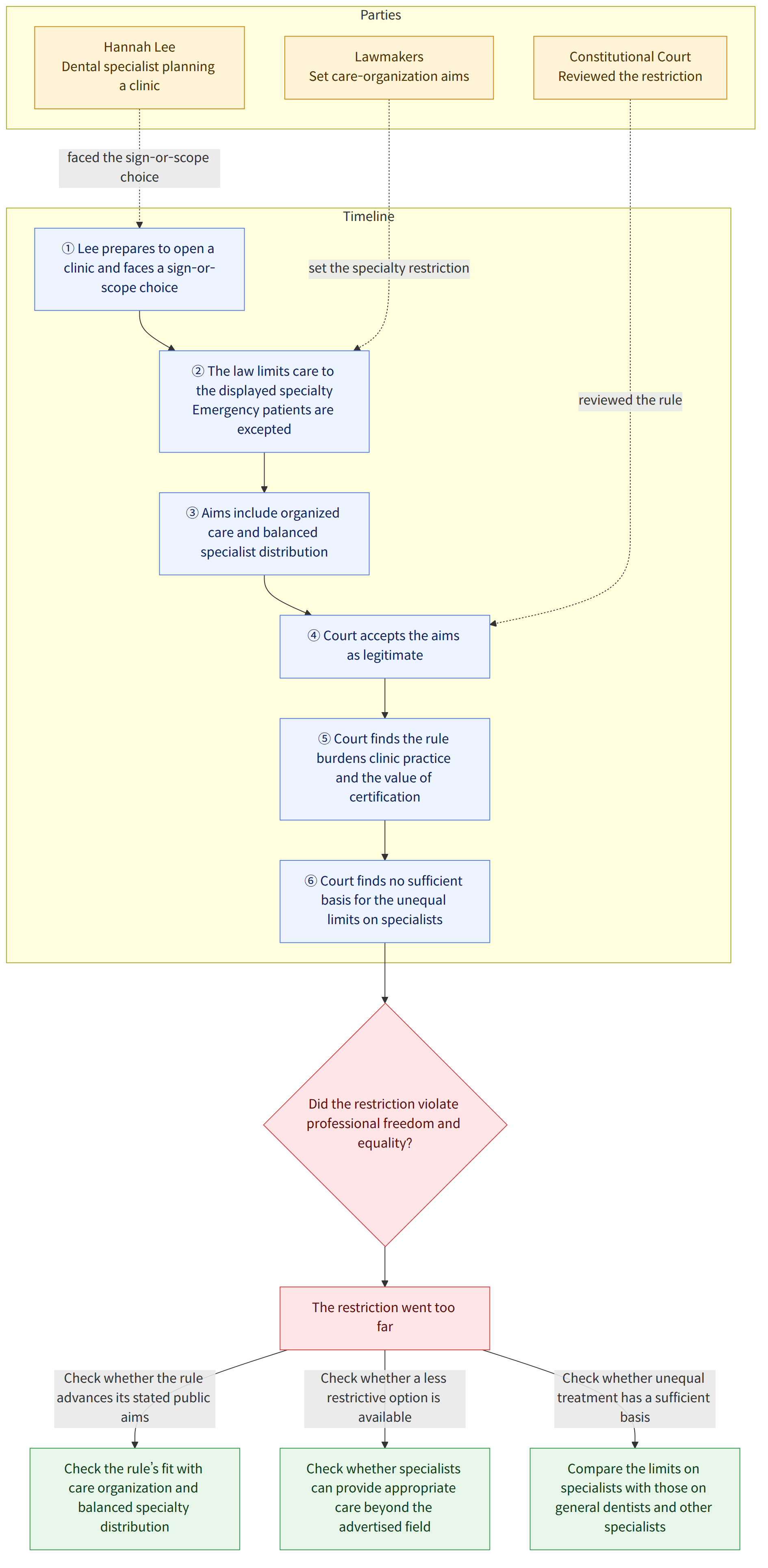
But one rule troubled her. If she displayed her specialty on the clinic sign, she could be restricted to treating only patients within that specialty. A patient with an unrelated dental problem might have to be turned away—even if Hannah was trained and qualified to provide appropriate care. If she left the specialty off the sign, she worried that patients would not know what expertise she offered.
The choice seemed to make her advanced qualification a disadvantage. Hannah wanted to know whether the law could legitimately force a specialist to narrow the care offered in a neighborhood clinic simply because the clinic advertised that specialty.
The Legal Question
Could Korea require a dental clinic that displays a specialist’s field to treat only patients within that field, except in emergencies, without violating the dentist’s freedom to pursue a profession and right to equality?
What Korean Law Says
The Medical Service Act provision at issue said that a dental clinic displaying a specialty had to treat only patients who fell within that specialty. It made an exception for emergency patients.
“A dental clinic that displays a specialty must treat only patients who fall within the displayed specialty. This does not apply to emergency patients.”
The rule was intended to shape how dental care was organized. In broad terms, lawmakers hoped to encourage specialists to work in larger, secondary-care institutions, support a balanced distribution of specialists among fields, and establish an orderly system for patients seeking care.
But constitutional review asks not only whether a government goal is legitimate. It also asks whether the means chosen are proportionate. In this setting, the central questions were:
- Is the goal legitimate? Organizing healthcare delivery and avoiding an excessive concentration of specialists in a few fields can be legitimate public aims.
- Does the restriction meaningfully advance that goal? A rule must be capable of helping achieve its stated purpose, rather than merely imposing a burden.
- Is there a less restrictive way to achieve the same goal? The government should not curtail professional activity more than necessary.
- Is the public benefit worth the private burden? The expected public advantage must be weighed against the loss of professional freedom.
The provision also raised an equality question. General dentists could treat patients across dental fields, while a specialist who displayed a specialty could be prevented from treating patients outside it in a dental clinic. The law therefore risked giving a more highly qualified practitioner a narrower permitted scope of care than a general dentist, without a sufficient reason.
How Korean Courts Approach This
Korea’s Constitutional Court examines restrictions on professional activity through the principle of proportionality. A regulation may serve an important public purpose and still be unconstitutional if it is poorly suited to that purpose, goes further than necessary, or imposes a private burden out of balance with the public benefit.
A legitimate policy goal does not by itself justify a restriction on professional freedom. The chosen measure must be suitable, necessary, and proportionate in its effects.
In its review of the dental rule, the Court accepted that an orderly system of dental care and balanced development among specialties were legitimate aims. But it concluded that the restriction made it difficult for specialists in neighborhood clinics to display their qualifications, could weaken the practical value of specialist certification, and barred them from treating patients outside the advertised specialty even when they could provide appropriate general dental care.
The Court also considered equality. It found no essential difference that justified treating dental specialists more restrictively than medical or traditional Korean medicine specialists in relation to displaying a specialty in a primary-care setting. Nor did it find a reasonable basis for allowing a general dentist to treat patients across fields while restricting a specialist who advertised a field to a much narrower range.
Applying the Law to Hannah’s Clinic
Hannah’s concern was not merely about the wording on a sign. The rule connected that public description of her expertise to a legal limit on whom she could treat.
- The policy goal was valid. The government could reasonably seek a better-organized dental-care system and a more balanced distribution of specialists. The Court did not reject those objectives.
- The restriction imposed a serious professional burden. If Hannah displayed her specialty, she could be prevented from treating patients with other dental needs in her clinic, even where she was otherwise qualified to provide general care. The emergency exception did not solve the ordinary cases she expected to see.
- The rule could undermine the specialty system itself. If advertising a qualification triggered a substantial limit on practice, specialists might choose not to display their fields. That could make the specialist system less useful to patients rather than more useful.
- The link to the stated goals was doubtful. Preventing specialists from treating patients outside their displayed specialty did not necessarily direct them to larger hospitals or ensure an even distribution of specialists. It could instead make primary-care work less attractive or encourage concentration in fields where a specialist could earn enough by seeing only that field’s patients.
- The burden was not justified by the likely benefit. The Court considered the professional disadvantage substantial while questioning how much the rule would actually improve the dental-care system. It also found the different treatment of dental specialists difficult to justify on equality grounds.
The Court therefore held the restriction unconstitutional for violating occupational freedom and equality. For Hannah, the important point was that the specialty label could not be used as the basis for the sweeping treatment restriction the provision had imposed. That did not mean she could disregard other requirements governing safe, competent dental care, professional conduct, or the operation of a clinic.
If your clinic’s proposed specialty sign, patient notices, or an official explanation of permitted treatment resembles Hannah’s situation, attorney Ji-sun Ahn of Ijun Law Firm could review those documents and the specific facts to help clarify how the ruling relates to your circumstances.
Conclusion: What Happened, and What Should You Do?
Hannah learned that she did not have to choose between openly identifying her specialty and being confined to treating only that specialty’s patients under the invalidated rule. The Constitutional Court found that the restriction went too far: its burdens on professional practice and equality outweighed any uncertain benefit to the organization of dental care.
The decision is not a blanket permission to provide any treatment in any circumstances. Dentists remain subject to the broader rules governing professional competence, patient safety, and clinic practice. Anyone making a decision today should also check the current version of the relevant laws and regulations rather than relying on an old statutory text.
For readers facing a similar issue:
- Keep copies of proposed clinic signs, specialty descriptions, patient notices, and any official communication explaining what the clinic may treat.
- Check the current legal rules before changing a clinic’s advertised specialty or treatment policy; a constitutional ruling does not displace every other professional obligation.
- If the answer turns on a particular notice, clinic plan, or set of facts, seek an individual review before acting.

















