

1. A Human Story
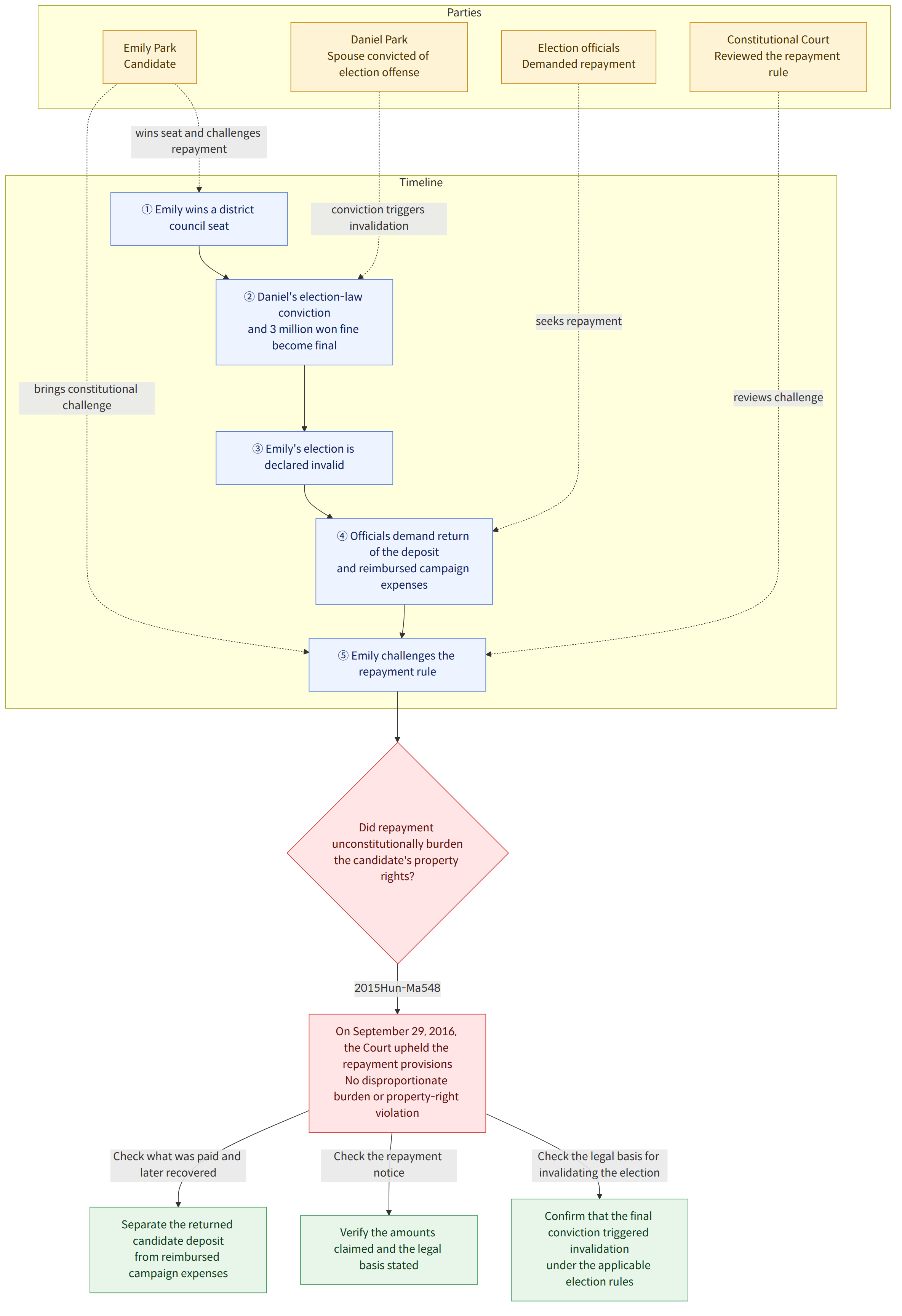
Emily Park had spent months knocking on doors and holding late-night meetings before winning a seat on a district council. The victory felt like the culmination of years of local work. But the celebration ended when her husband, Daniel, was convicted of an election-law offense connected to her campaign. His sentence—a fine of 3 million won—became final.
The consequences reached beyond Daniel. Emily’s election was declared invalid, and officials demanded that she repay the candidate deposit that had been returned to her and the campaign expenses that had been reimbursed. Emily had not been the person convicted. To her, the demand seemed to make her pay for someone else’s wrongdoing—and to take back money she believed she had lawfully received.
2. The Legal Question
Can the state require a candidate to return a refunded deposit and reimbursed election expenses when the candidate’s election becomes invalid because of a spouse’s election-law conviction? Or does that repayment requirement unconstitutionally interfere with the candidate’s property rights?
3. What Korean Law Says
Korean election law provides for financial consequences when an election is invalidated in circumstances covered by the applicable rules. In the situation considered here, those consequences included returning both the candidate deposit and campaign expenses that had already been reimbursed. The dispute was not simply about whether the candidate had personally committed an offense. It concerned the financial results of an election that the law no longer treated as valid.
The constitutional question is whether that repayment requirement goes too far. A restriction on property must serve a legitimate public purpose and must not impose a burden disproportionate to that purpose. The Constitutional Court applied that principle to the repayment rule.
The Constitutional Court reasoned that election offenses can undermine the fair formation and expression of the people’s political will. Sanctions can help deter election fraud and protect the integrity of elections.
The Court also considered why repayment was required:
- Fair elections: Deterrence matters because election misconduct can distort voters’ choices and damage confidence in the electoral process.
- Proportionality: The Court did not consider stronger sanctions for election-related misconduct excessive in light of the need to establish a fair election culture.
- Sentencing context: The criminal court dealing with the spouse’s case could consider the specific circumstances when deciding the sentence.
- Public funds: Once the election was invalidated, the public purse had a reason to recover expenses paid for an election that had become legally ineffective.
In a decision dated September 29, 2016, the Constitutional Court held that the repayment provisions at issue did not violate the principle of proportionality and did not infringe the candidate’s property right (2015Hun-Ma548).
4. How Korean Courts Approach This
Korean constitutional review in this area weighs the individual’s financial burden against the public interest in preserving fair elections. The Court’s approach recognizes that a repayment demand can be painful, particularly where the candidate was not the person convicted. But it also asks what the election-related payment was for and what follows when the election is legally invalidated.
The Court treated the repayment requirement as a measure serving election integrity and preventing public money from being spent on an election that had become ineffective. It concluded that, for the circumstances before it, the burden was not constitutionally excessive.
That conclusion is not a general finding that every repayment demand is correct in every detail. The particular notice, the amounts claimed, and the legal basis for invalidating the election remain important facts to check. But a challenge based only on the argument that repayment infringes property rights faces the Constitutional Court’s rejection of that argument in this type of case.
5. Applying the Law to Emily’s Case
Emily’s situation tracks the constitutional dispute closely. The election was voided after her husband’s election-law conviction became final, and the authorities sought the return of the deposit and reimbursed expenses. The legal analysis proceeds in several steps:
- Identify the legal trigger. The key fact is not merely that Daniel is Emily’s spouse. It is that his final conviction led, under the applicable election rules, to the invalidation of Emily’s election. The repayment consequence is tied to that legal outcome.
- Separate criminal responsibility from the financial consequence. Emily’s repayment obligation does not itself establish that she committed Daniel’s offense. The question is whether the law may attach a financial consequence to the invalidation of her election, even though her spouse was convicted.
- Weigh the public purpose. The rule aims to deter conduct that threatens election fairness and to avoid leaving public funds spent on an election that is no longer legally effective. The Court regarded those purposes as substantial.
- Consider the scale of the burden. Emily must return money she had received, but the Court concluded that this consequence was not disproportionate in the circumstances addressed. It also noted that the criminal court could take the specific facts into account when sentencing the spouse.
- Apply the constitutional ruling. Emily’s property-right argument, standing alone, is unlikely to succeed: the Constitutional Court has held that this kind of repayment requirement does not violate the property right.
Emily should still examine the actual repayment notice rather than assume that every amount is automatically correct. The notice should be compared with the decision invalidating the election and the records showing what deposit and campaign expenses were returned or reimbursed.
If you receive a similar demand, you could ask attorney Ji-sun Ahn of Ijun Law Firm to review the election-invalidation decision, the repayment notice, and the records showing the deposit and campaign expenses paid or reimbursed, to assess whether the demand matches the documents and your circumstances.
6. Conclusion: What Happened, and What Should You Do?
Emily’s constitutional objection does not overturn the repayment rule. Under the Constitutional Court’s reasoning, the state may require repayment of the returned deposit and reimbursed election costs in these circumstances without violating the candidate’s property right. The decisive public interests are fair elections and avoiding expenditure on an election that has become legally ineffective.
For readers facing a similar demand:
- Check the written decision that invalidated the election and the legal basis cited in the repayment notice.
- Compare the amounts demanded with payment records for the returned deposit and reimbursed campaign expenses; raise any specific calculation or factual error promptly.
- Keep the relevant conviction documents, election decision, repayment notice, and campaign-payment records together so the issue can be reviewed against the precise facts.

















