

1. A Human Story
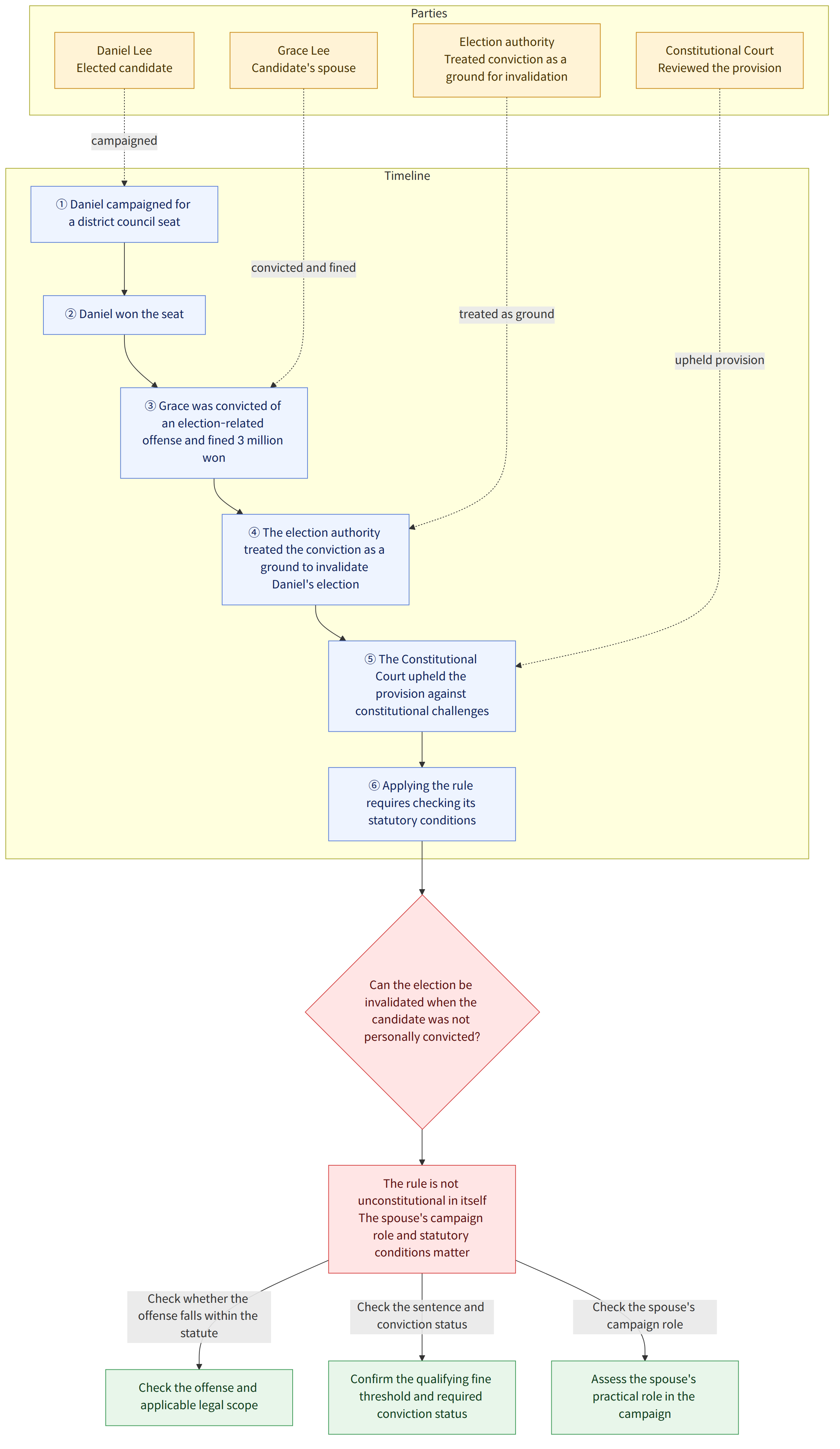
Daniel Lee had spent months walking the neighborhoods of his district, listening to residents and making the case for a seat on the local council. On election night, the votes were counted in his favor. He and his wife, Grace, celebrated the win as the culmination of a campaign they had built together.
The celebration did not last. Grace had been convicted of an election-related offense and fined 3 million won. Daniel had not been convicted of anything, but the election authority treated the conviction as a legal ground to invalidate his election. He faced a question that felt deeply personal: could he lose public office because of what his spouse had done?
2. The Legal Question
Can Korea constitutionally invalidate an elected candidate’s election because their spouse was convicted of a covered election crime and fined at least 3 million won—even when the candidate was not personally convicted?
3. What Korean Law Says
Article 265 of the Public Official Election Act provides for invalidation of an elected candidate’s election when the candidate’s spouse, among other specified close associates, receives a qualifying sentence for certain election crimes. The provision sets a threshold of a fine of 3 million won or more for a spouse. The exact offense, sentence, and procedural status of the conviction must be checked against the statute.
The rule is not simply that one person automatically loses rights because of a relative’s wrongdoing. It links the consequence to a spouse’s role in the candidate’s election campaign and to a conviction for an offense covered by the law.
Two constitutional principles are central to the challenge:
- Personal responsibility: A person should not ordinarily bear a legal penalty for another person’s conduct.
- The constitutional ban on guilt by association: Article 13(3) of the Constitution prohibits imposing disadvantage on a citizen merely because of the acts of a relative.
The constitutional question is whether the election-invalidating rule punishes the candidate solely for being married to the offender, or whether the law reasonably addresses the spouse’s substantive role in the campaign and the integrity of the election.
4. How Korean Courts Approach This
The Constitutional Court has upheld this provision against challenges based on guilt by association, personal responsibility, and the right to hold public office. Its reasoning is that a spouse may be more than a relative in the background: spouses can be closely involved in campaign activity and may, in practice, form part of a shared electoral effort.
The constitutional concern is not answered by family status alone. The Court has treated the spouse’s practical position and role in the campaign as relevant to whether the candidate and spouse formed an election partnership in which responsibility for serious unlawful campaigning may be shared.
The Court has also weighed the public interest in clean and fair elections. It has reasoned that serious election offenses can undermine the legitimacy of the result, and that unlawful campaigning may be carried out by people working behind the scenes as well as by the candidate personally. On that basis, it has concluded that the rule does not, in itself, violate the constitutional protections at issue.
That conclusion does not mean every relative’s misconduct invalidates an election. The statutory conditions still matter: the person’s relationship to the candidate, the nature of the offense, the sentence imposed, and whether the case falls within the law’s scope.
5. Applying the Law to Daniel's Case
Daniel’s case turns on the connection between Grace’s conviction and the statutory requirements—not simply on the fact that they are married.
- Was Grace within the category covered by the statute? As Daniel’s spouse, she falls within the relationship category described in Article 265.
- Was the offense one covered by the provision? The conviction must be for an election crime included in the statute’s scope. The label “election-related” alone is not enough; the judgment and the applicable statutory provisions matter.
- Did the sentence meet the threshold? Grace received a fine of 3 million won, which reaches the threshold stated for a spouse. The legal effect also depends on the conviction having the status required for the provision to operate.
- Does Daniel’s lack of a personal conviction decide the constitutional issue? No. Under the Constitutional Court’s approach, the rule is not unconstitutional merely because the candidate was not the person convicted. The Court considers the spouse’s practical role in the campaign and the public interest in preventing serious unlawful conduct from tainting an election.
On the stated facts, if Grace’s offense and conviction satisfy Article 265’s requirements, Daniel’s election can be invalidated even though he himself was not convicted. The constitutional challenge based only on personal responsibility or guilt by association is unlikely to succeed under the Court’s established reasoning.
6. Conclusion: What Happened, and What Should You Do?
Daniel’s seat was lost—not because Korean law treats spouses as automatically guilty of each other’s conduct, but because the statute attaches a consequence to a spouse’s qualifying election-crime conviction, and the Constitutional Court has found that rule constitutionally permissible. The decisive issue in any real case is whether the conviction and sentence actually meet the statutory conditions.
If you face a similar situation:
- Read the criminal judgment carefully. Confirm the precise offense, the legal provisions applied, the sentence, and the status of any appeal.
- Check the invalidation decision against Article 265. Do not assume that every offense connected to a campaign triggers the same consequence.
- Keep the relevant election and court documents together. The judgment and the notice or decision invalidating the election are essential to assessing how the rule applies.
A review of the criminal judgment and the election-invalidation notice can help establish whether the offense, sentence, and conviction status meet Article 265’s requirements. A reader could ask attorney Ji-sun Ahn of Ijun Law Firm to review those documents and explain how the statutory conditions apply to the particular facts.

















