

A Human Story
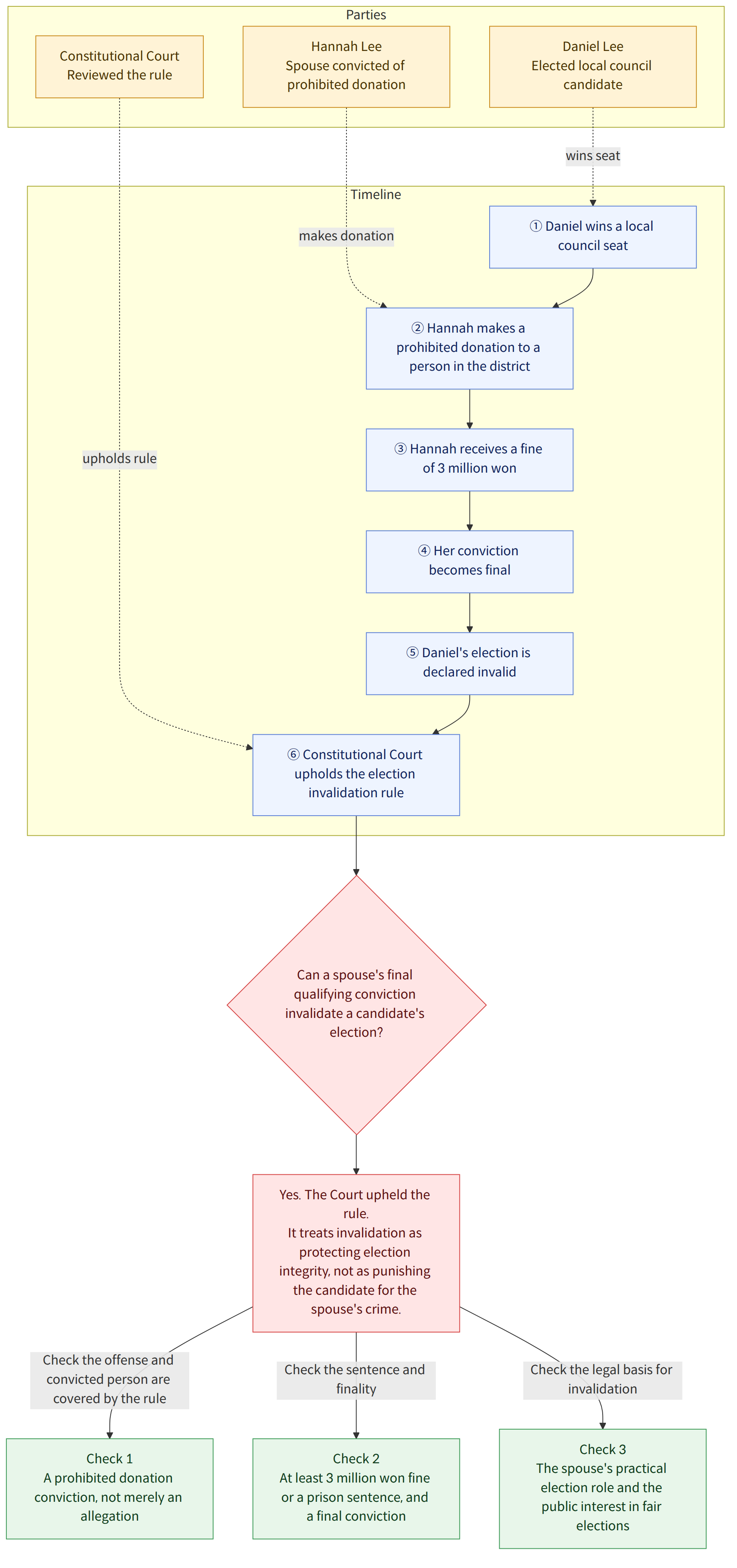
Daniel Lee spent election night on the steps of the district office, shaking hands with supporters who had helped him win a seat on the local council. His wife, Hannah, had campaigned beside him for months. Weeks later, Daniel received devastating news: Hannah had been convicted of making a prohibited donation to a person in the electoral district. The court imposed a fine of 3 million won, and the judgment became final.
Daniel had not been convicted of any election offense himself. He insisted that he had not authorized the donation and had not known about it. Yet under the election-law provision applied to his case, his election was declared invalid. The seat he had just won was gone, and he was left asking whether the law could constitutionally make him bear the consequences of his spouse’s conduct.
The Legal Question
Can a candidate’s election be invalidated because the candidate’s spouse is finally convicted of a prohibited election donation and receives a fine of at least 3 million won, even if the candidate was not personally convicted? Or does that consequence violate the constitutional bans on guilt by association and collective punishment, or the candidate’s right to hold public office?
What Korean Law Says
The Public Official Election Act contains a rule under which an elected candidate’s election can be invalidated when certain close family members, including a spouse, are convicted of specified serious election offenses. The offenses covered include the prohibited donation conduct addressed by Article 257(1). For the relevant spouse-related trigger, the conviction must result in a prison sentence or a fine of at least 3 million won and become final.
The rule does not make every allegation against a candidate’s spouse enough to undo an election. The offense, the person convicted, the sentence, and the finality of the judgment all matter.
The constitutional objections usually focus on three principles:
- The ban on guilt by association: Article 13(3) of the Korean Constitution prohibits imposing punishment or disadvantage on a person because of a relative’s act when that person did not commit it.
- The principle of personal responsibility: In general, a person should bear legal consequences for that person’s own conduct, rather than be held responsible simply for another person’s wrongdoing.
- The right to hold public office: Article 25 protects citizens’ right to hold public office under the conditions set by law. An invalidation rule therefore affects a constitutionally important interest.
The Constitutional Court has nevertheless upheld this election-invalidating rule. Its reasoning is that the rule is not based solely on the fact of marriage. A spouse may have a substantial and closely connected role in a candidate’s election campaign, making the candidate and spouse part of what the Court described as an inseparable election partnership. The rule is also intended to protect fair elections from serious, organized wrongdoing that might otherwise be carried out indirectly through people close to a candidate.
The Court has treated the consequence as a measure protecting the integrity of the election—not as a criminal sentence imposed on the candidate for the spouse’s crime.
How Korean Courts Approach This
The Constitutional Court has rejected the argument that invalidating a candidate’s election in these circumstances is unconstitutional guilt by association. In its view, the law does not impose a disadvantage merely because the convicted person happens to be the candidate’s spouse. It relies instead on the spouse’s practical position and potential role in the election effort, and on the close connection between that role and the candidate’s electoral success.
The Court has also found no violation of the personal-responsibility principle. Its reasoning recognizes that election-related family members may participate in campaigning, sometimes in ways that are difficult to observe publicly. If serious election offenses could be insulated from consequences whenever the candidate was not personally the offender, the rules governing clean elections could be undermined.
Finally, the Court weighs the impact on the candidate’s right to public office against the public interest in fair and honest elections. It has considered that the rule applies to serious election crimes, that unlawful conduct can affect an election’s legitimacy, and that clean elections are central to democracy. On that balance, the Court has concluded that the restriction is constitutionally permissible.
Applying the Law to Daniel’s Case
Daniel’s situation meets the central conditions described in the law and the Court’s approach:
- The convicted person was his spouse. Hannah’s relationship to Daniel falls within the family relationship covered by the rule.
- The offense was a prohibited donation. The conviction concerned donation conduct under Article 257(1), rather than an unrelated offense.
- The sentence reached the statutory threshold. Hannah received a fine of exactly 3 million won, which meets the stated minimum.
- The conviction became final. The legal consequence followed after the judgment was no longer open to ordinary appeal.
Daniel’s claim that he did not know about or approve the donation may be important to how he understands his own conduct, but it does not, by itself, remove the statutory consequence once the required conditions are satisfied. The constitutional challenge also faces a settled obstacle: the Constitutional Court has upheld the rule against substantially the same objections.
For anyone in a similar position, the documents still need careful checking. The final judgment, the precise offense of conviction, the sentence, and the notice declaring the election invalid are all relevant to whether the statutory trigger was actually met.
If a similar notice has arrived, attorney Ji-sun Ahn of Ijun Law Firm could review the final criminal judgment and the election authority’s invalidation notice to check whether the offense, sentence, relationship, and finality requirements match the statutory trigger.
Conclusion: What Happened, and What Should You Do?
Daniel’s constitutional argument does not succeed under the approach Korean courts have adopted. Because Hannah’s final conviction involved a prohibited donation under Article 257(1), and the fine was 3 million won, the statutory conditions for invalidating Daniel’s election were met. The law does not require a separate finding that Daniel personally committed the donation offense before this election consequence can apply.
If you are facing a similar situation, consider these practical steps:
- Keep the final criminal judgment and the election authority’s invalidation notice, and compare their dates, wording, offense description, and sentence.
- Check whether the conviction is final and whether it concerns the specific election offense and family relationship covered by the statute.
- Get the documents reviewed promptly if a required element appears misstated or unclear; do not assume that lack of personal involvement alone will resolve the issue.

















