
1. A Human Story
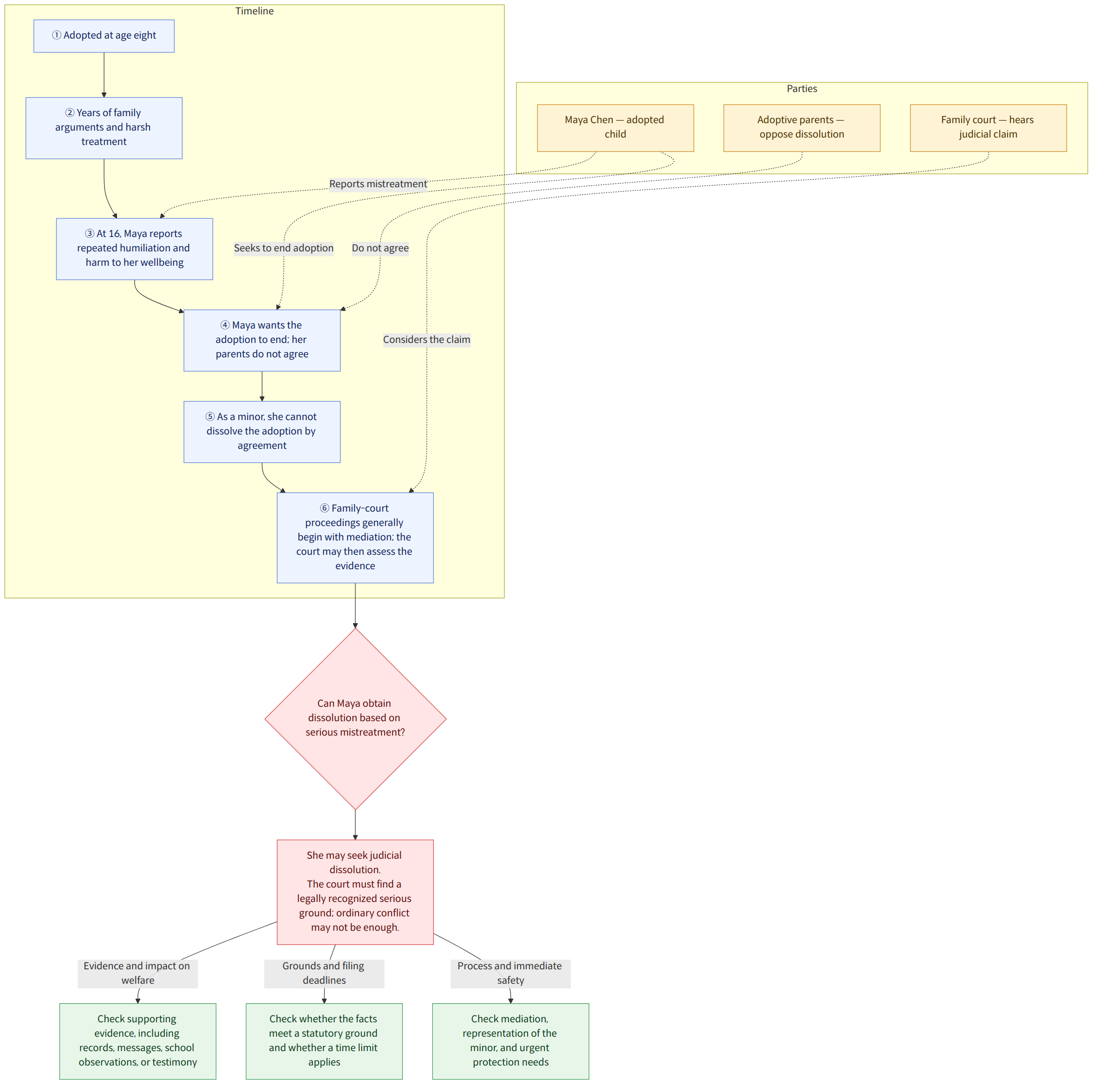
When Maya Chen was eight, she was adopted by a couple who promised her a stable home. For years, she tried to believe that the family’s frequent arguments and harsh treatment were temporary. By 16, however, she says she had endured repeated humiliation and unfair treatment that left her anxious about returning home.
Maya wants the adoption to end. Her adoptive parents do not agree, and she wonders whether she can simply sign a document ending the relationship. The answer matters: because she is still a minor, Korean law does not let her and her parents dissolve the adoption by mutual agreement. If Maya is to be legally separated from them as her adoptive parents, she must seek a court decision.
2. The Legal Question
Can a 16-year-old adopted child ask a Korean court to dissolve the adoption because of mistreatment, and what legal grounds and procedures apply?
3. What Korean Law Says
Korean Civil Act rules distinguish between an agreed dissolution and a court-ordered one. Where the adopted child is a minor, the parties cannot use the ordinary agreement-based route. Instead, dissolution must be sought through judicial proceedings.
The Civil Act recognizes grounds for judicial dissolution where, for example, an adoptive parent abuses or abandons the adopted child, or otherwise seriously harms the child’s welfare. It also recognizes other serious circumstances that make it difficult to continue the adoptive parent-child relationship.
In substance, the Civil Act allows a court to dissolve an adoption when an adoptive parent’s conduct seriously harms the child’s welfare, or when another sufficiently serious reason makes continuation of the relationship untenable.
The key points are:
- A minor cannot dissolve the adoption by agreement. A court decision is necessary.
- There must be a legally recognized reason. Ordinary disagreements or a difficult period at home may not be enough. The court considers the seriousness and context of the conduct and its effect on the child.
- A family-court case is required. Judicial dissolution is a family matter, and the process generally requires an attempt at mediation before the court proceeds to decide the case.
- A child may bring a claim. The adopted child is among those entitled to seek judicial dissolution. Because the child is a minor, questions about representation and safeguarding the child’s interests may also arise in the proceedings.
- Time limits can matter. For certain grounds, the claim must be filed within six months after the claimant learns of the relevant reason and within three years after that reason arose. A situation in which a person’s life or death has been unknown for at least three years is treated differently under the law. Anyone considering a claim should get advice promptly rather than assume there is unlimited time.
A report to the family court is not a substitute for urgent protection. If a child faces immediate danger, safety and contacting the appropriate authorities should come first.
4. How Korean Courts Approach This
Korean courts do not treat adoption as a relationship that can be ended merely because the parties are unhappy with one another. A court will examine whether the facts reach the seriousness required by the statute, with particular attention to the adopted child’s welfare. The question is not simply whether the family relationship is strained, but whether the alleged conduct or circumstances make continuing that legal relationship unacceptable or seriously harmful.
The court will look at the evidence and the history of the relationship, not just the label attached to the conduct. Relevant material may include messages, records of medical or counselling visits, school observations, reports to child-protection authorities, and testimony about what happened and how it affected the child. The court must also consider the child’s circumstances and views in an appropriate way.
Because the law generally requires mediation first, the court process may begin with an effort to resolve the dispute. Mediation does not mean that a child must accept an unsafe situation or that a claim will automatically be dismissed if the adults cannot agree. If the matter is not resolved, the court can consider the evidence and decide whether the legal requirements for dissolution have been met.
5. Applying the Law to the Case
Maya’s situation must be assessed in several steps.
- She is a minor. At 16, she cannot end the adoption simply by reaching an agreement with her adoptive parents. The route available to her is a judicial claim in the family court.
- She must show more than ordinary family conflict. Maya says the treatment was repeated and seriously affected her wellbeing. If the evidence supports that account and shows abuse, abandonment, or serious harm to her welfare, the court may find a statutory ground for dissolution. If the facts show only disagreements or isolated friction, the legal threshold may not be met.
- The court will consider the whole picture. Maya should record what happened, when it happened, and who witnessed it. Messages, school or counselling records, medical documents, and reports to relevant authorities may help establish both the conduct and its effect. She should not put herself at risk to collect evidence.
- The case proceeds through the family-court process. The claim would ordinarily be subject to the required mediation stage. If no resolution is reached, the court can decide whether the relationship should be dissolved. As Maya is under 18, she should seek help from a trusted adult, a qualified lawyer, or an appropriate child-support service to address filing and representation issues.
- Timing should be checked immediately. Where a statutory deadline applies, Maya should not delay while hoping the situation will improve. A lawyer or legal-aid provider can identify which ground fits the facts and calculate any applicable deadline.
In Maya’s fictional case, she produces a consistent record of repeated mistreatment, including contemporaneous messages and observations from a school counsellor. Mediation does not resolve the dispute. After considering the evidence and Maya’s welfare, the family court finds that the treatment seriously harmed her and grants judicial dissolution. The result follows not merely because Maya wants distance from her adoptive parents, but because the court finds the legal threshold has been met.
If you are dealing with a similar issue, attorney Ji-sun Ahn of Ijun Law Firm can review the birth and family registration records, any adoption order or consent, and the child’s current living arrangements with you. These details can help clarify which options apply to your situation.
6. Conclusion: What Happened, and What Should You Do?
Maya’s adoption ends only after the family court orders its dissolution; she cannot end it by private agreement while she is a minor. Her case succeeds because the court finds credible evidence of conduct serious enough to harm her welfare. For another young person, the outcome will depend on the particular facts and the evidence, not on age alone or on the existence of family conflict.
If you or someone you know is in a similar situation:
- Put safety first. If there is immediate danger, contact emergency services or child-protection authorities and seek help from a trusted adult.
- Preserve relevant records safely. Keep a dated account of incidents and retain messages or documents, but do not take risks to obtain evidence.
- Get prompt legal guidance. A family-law lawyer or legal-aid service can assess the grounds, mediation process, representation needs, and any filing deadline.

















