
1. A Human Story
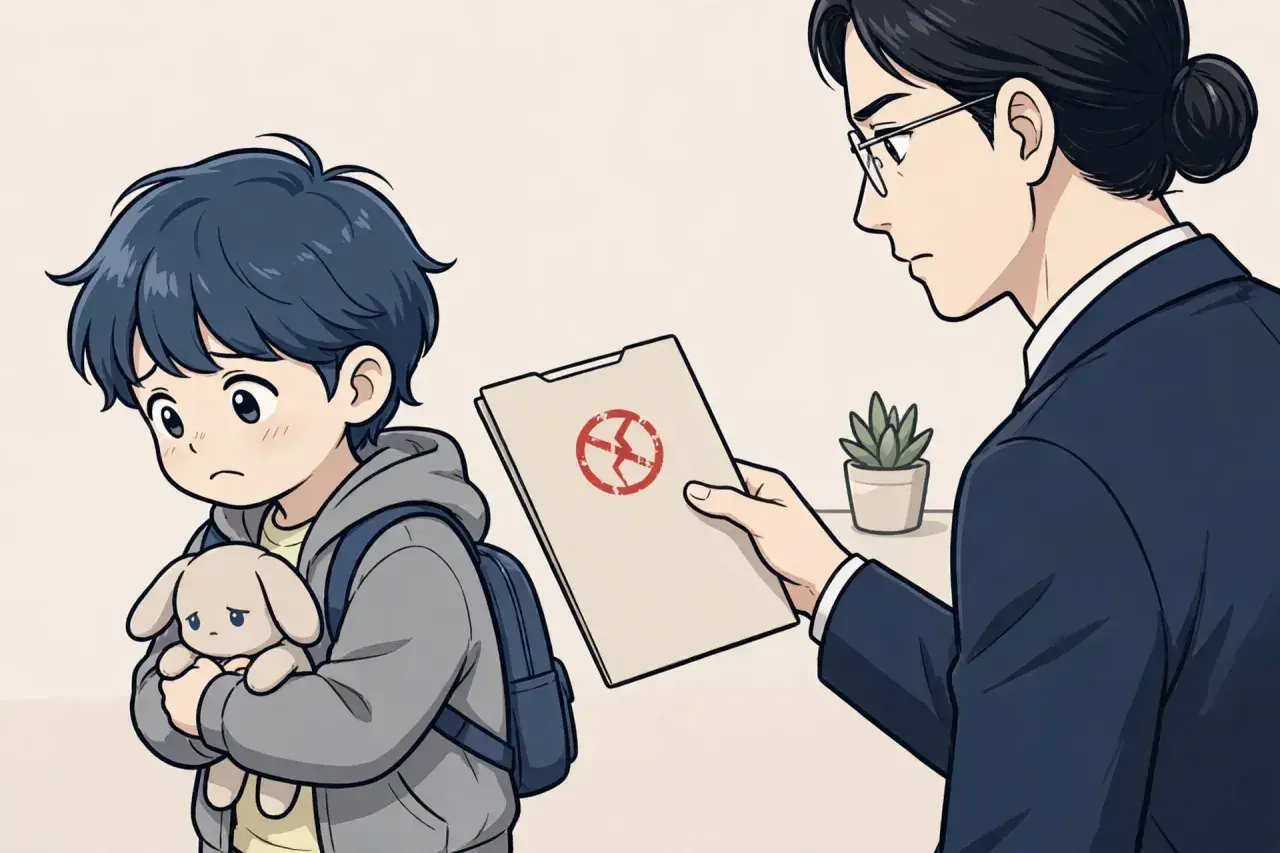
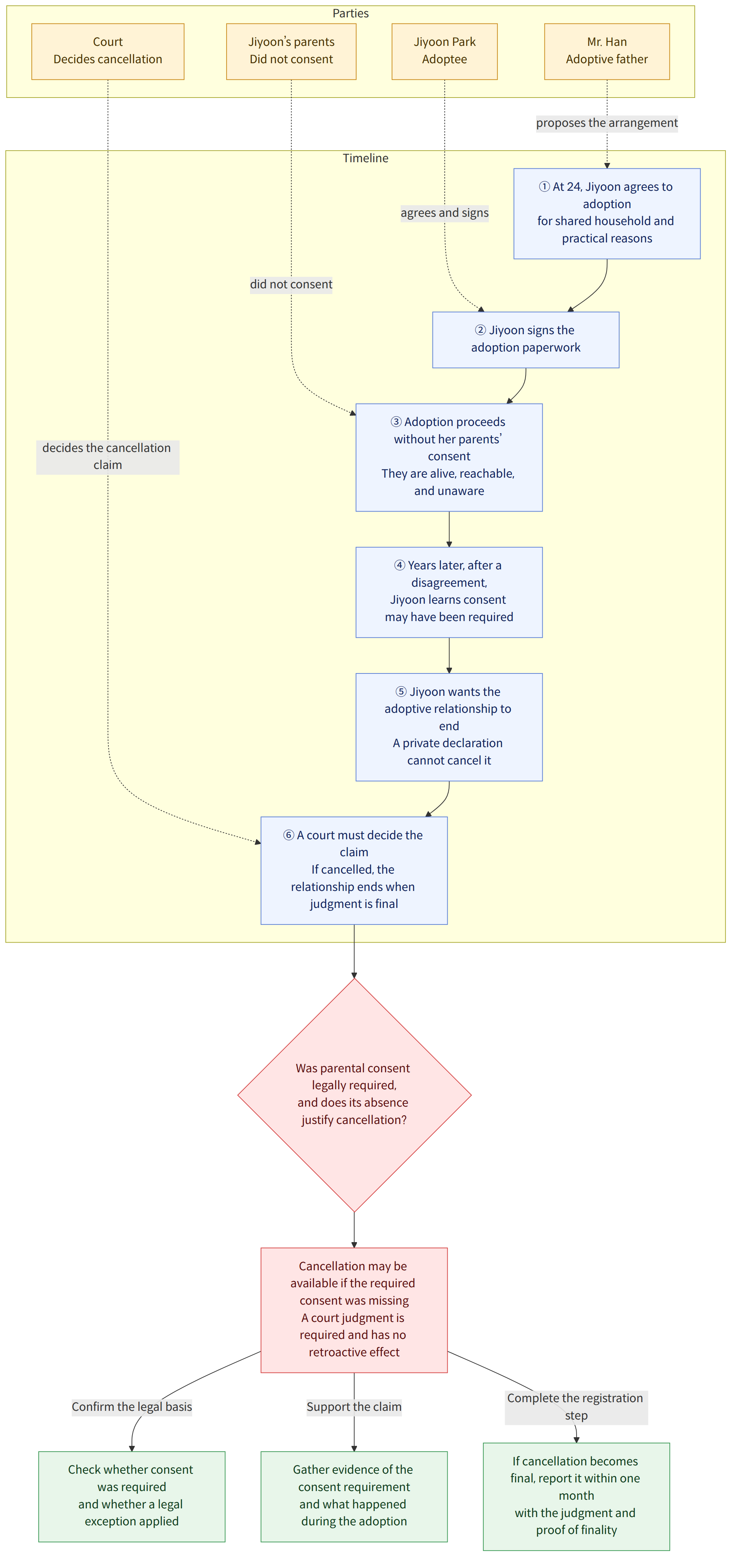
When Jiyoon Park was 24, she agreed to be adopted by Mr. Han, a longtime family friend who had supported her since her university days. He told her the arrangement would make it easier for them to share a household and handle practical matters. Jiyoon signed the paperwork, trusting that the formalities had been taken care of.
Her parents, however, had not consented. They were alive, reachable, and unaware that the adoption had gone ahead. Years later, after a disagreement with Mr. Han, Jiyoon learned that their consent was legally required in her circumstances. She wanted the family relationship created by the adoption to end—but she could not simply withdraw her signature and treat the adoption as if it had never happened.
2. The Legal Question
Can Jiyoon have the adoption cancelled because it was completed without her parents’ required consent, and what legal steps must she take to end the adoptive relationship?
3. What Korean Law Says
Korean law distinguishes between cancelling an adoption because of a defect in how it was made and ending an otherwise valid adoption through a separate process. Cancellation is available only on legally recognized grounds and only through a court proceeding; a person cannot cancel an adoption by making a private declaration.
The Civil Act identifies a number of potential grounds, including situations in which:
- An adult was adopted without the consent of a parent when that consent was legally required.
- A minor was adopted without a legally required parental consent or representative’s approval.
- A person under adult guardianship adopted someone or was adopted without the guardian’s required consent.
- A spouse adopted alone, or was adopted, in circumstances where the other spouse’s consent was required.
- An adoption was brought about by fraud or coercion, or there was another serious legal ground for cancellation.
Whether a particular consent was required can depend on the circumstances and on whether a legal exception applied. A claim should therefore identify the precise defect and support it with evidence, rather than assume that every missing family member’s approval automatically invalidates an adoption.
Under the Civil Act, kinship created by adoption ends when the adoption is cancelled or dissolved. Cancellation itself must be obtained through a court judgment.
A key consequence is that cancellation does not operate retroactively. The adoption is treated as ending when the cancellation judgment becomes final—not as though it never existed.
The Civil Act provides that cancellation has no retroactive effect: the adoptive relationship ends from the point at which the judgment becomes final.
If a court cancels an adoption, the person who brought the case must also take a registration step. Under the Family Relations Registration Act, that person must report that the cancellation judgment has become final within one month of finality, attaching a copy of the judgment and a certificate confirming that it is final.
4. How Korean Courts Approach This
Korean courts examine whether the facts fit one of the grounds the law recognizes. They will look at the circumstances surrounding the adoption, including what consent was required, whether it was actually given, and whether a legal exception applied. Evidence such as family records, communications, and documents from the adoption process may be important.
For an adoption involving a minor, the law gives the Family Court a specific power to refuse cancellation if it considers that keeping the adoption in place would better protect the child’s welfare. That safeguard reflects the principle that a child’s interests cannot always be reduced to whether a procedural defect occurred.
When the adopted person is a minor, the Family Court may reject a cancellation claim if preserving the adoption is better for that child’s welfare.
That special welfare rule is not the central issue in Jiyoon’s case because she was an adult when adopted. Her case turns instead on whether parental consent was legally required and, if so, whether its absence establishes a valid ground for cancellation. Even then, the court must decide the claim through the proper judicial process; the parties cannot make the adoption disappear by agreement alone.
5. Applying the Law to the Case
Jiyoon’s situation can be analyzed in several steps.
- Identify the alleged defect. Jiyoon is not arguing merely that she regrets the adoption. She says it was completed without her parents’ consent, which may be a statutory ground when an adult is adopted without consent that the law requires.
- Check whether consent was required in these circumstances. The court would need to determine whether her parents’ consent was legally necessary and whether any exception applied. The fact that her parents were alive, reachable, and did not consent supports her account, but the legal requirement must still be established under the applicable rules.
- Bring a court case and prove the relevant facts. Jiyoon cannot cancel the adoption by notifying Mr. Han or changing her family records herself. She must seek cancellation through the Family Court and provide evidence of the adoption and the missing consent. She should also obtain advice about who is entitled to bring the claim and any filing deadlines that may apply to her specific ground.
- Wait for the judgment to become final. Even if the court grants cancellation, the adoptive relationship does not end on the day the claim is filed or when the court first announces its decision. It ends when the judgment becomes final. Nor does cancellation erase the relationship for the past: it operates from finality onward.
- Complete the registration report. Once the judgment is final, Jiyoon, as the person who brought the case, must report the cancellation within one month. She must submit a copy of the judgment and proof that it is final. This final step records the court’s decision in the family registration system.
If you are dealing with a similar issue, attorney Ji-sun Ahn of Ijun Law Firm can review the birth and family registration records, any adoption order or consent, and the child’s current living arrangements with you. These details can help clarify which options apply to your situation.
6. Conclusion: What Happened, and What Should You Do?
In Jiyoon’s fictional case, the court finds that her parents’ consent was legally required, that they were able to give it, and that they never did. It therefore grants her cancellation claim. The adoption ends only when that judgment becomes final, not retroactively to the date of the adoption. Jiyoon then reports the final judgment within one month, attaching the required court documents.
For anyone facing a similar situation:
- Pin down the exact legal ground. A missing signature matters only if the law required that person’s consent and no exception applied.
- Keep the evidence. Preserve adoption documents, family records, messages, and any proof about whether consent was requested or given.
- Act through the court and complete the follow-up. Seek advice on the proper claimant and any applicable deadline, then remember the one-month registration-report requirement after the judgment becomes final.

















