

1. A Human Story
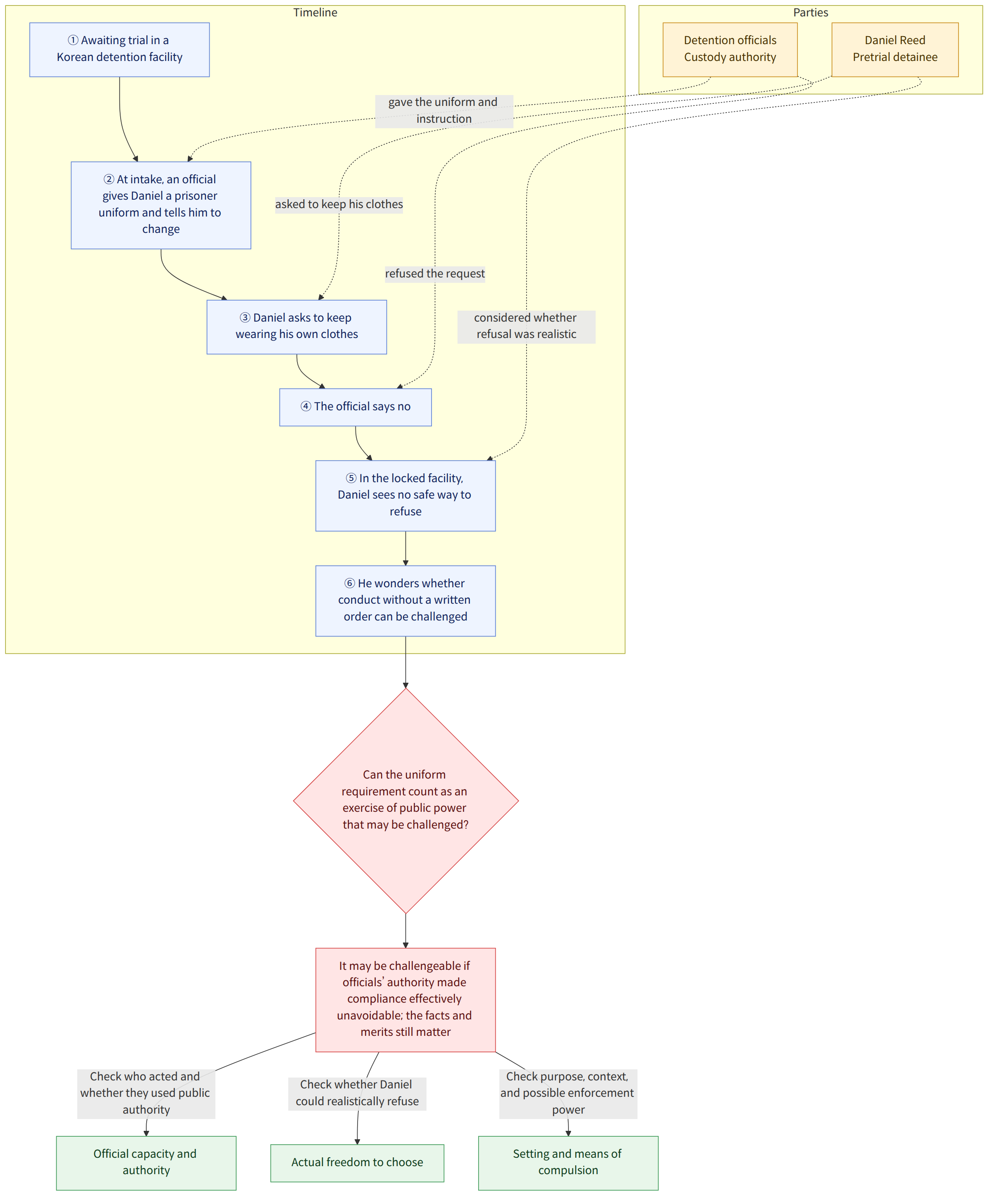
Daniel Reed was awaiting trial in a Korean detention facility. He had not been convicted, and he understood that his case was still undecided. But at intake, an officer handed him the clothing worn by prisoners and told him to change. Daniel asked whether he could keep wearing his own clothes. The answer was no.
The uniform was not simply uncomfortable. To Daniel, it made the distinction between an accused person and a convicted prisoner feel as if it had disappeared before a court had ruled. He considered refusing, then looked around the locked facility and realized that the instruction did not feel like a request he could safely decline. He wondered whether an act carried out without a formal written order could still be challenged under Korea’s Constitution.
2. The Legal Question
Can a person bring a constitutional complaint in Korea over a government action that is physical or practical rather than a formal legal order—such as requiring a pretrial detainee to wear clothing issued to prisoners?
The key issue is whether the conduct amounts to a power-based factual act: an exercise of public authority that, in its real-world setting, effectively compels the person affected.
3. What Korean Law Says
A government action does not need to take the form of a written decision to matter constitutionally. Public authorities can exercise power through conduct, instructions, or recommendations. If a person is effectively unable to refuse because the action is backed by the authority’s institutional power, the conduct may be treated as an exercise of public power for constitutional-complaint purposes.
The Constitutional Court’s approach is to assess the circumstances as a whole. Relevant considerations include the relationship between the public authority and the person affected, that person’s wishes and degree of involvement, the purpose and background of the conduct, and whether legal means of command or compulsion could be used.
That means the label attached to an act is not decisive. A statement described as “guidance” may, in context, operate like a command; conversely, an official interaction is not automatically coercive simply because it comes from a government body.
In practical terms, the inquiry may include:
- Who acted: Was the conduct carried out by a public authority in an official capacity?
- How much choice existed: Could the person realistically refuse, or was compliance effectively unavoidable?
- What stood behind the instruction: Could officials enforce it through their legal or institutional powers?
- What happened in context: What was the action’s purpose, how was it communicated, and what were the surrounding circumstances?
The principle is that a power-based factual act may be challenged through a constitutional complaint. That does not mean every official act is eligible, or that a complaint will succeed on the merits. The particular conduct and its effects must be examined closely.
4. How Korean Courts Approach This
Korean courts and the Constitutional Court generally look beyond formal wording to the practical reality of the relationship. They ask whether the person was facing a genuine choice or whether the government’s power made the apparent choice illusory. The inquiry is specific to the facts at the time of the conduct, rather than controlled by a general label such as “recommendation,” “instruction,” or “administrative practice.”
The Constitutional Court has recognized that certain administrative acts can have a coercive effect even without a conventional order. A government recommendation or direction may be functionally equivalent to an exercise of public power when the authority behind it means the recipient cannot realistically disregard it. The dissolution direction in the historical International Group matter is often cited as an illustration of how an apparently administrative act can carry that kind of force.
At the same time, the question is not simply whether the person felt pressured. The authority’s relationship with the person, the person’s ability to participate or object, the action’s purpose and setting, and the availability of enforcement measures all help determine whether the conduct crossed the line into an exercise of public power.
5. Applying the Law to Daniel’s Case
Daniel’s situation has several features that support treating the uniform requirement as a power-based factual act.
- The instruction came from officials exercising public authority. Daniel was in a detention facility, where staff controlled the conditions of his custody. This is not the same as receiving advice from a private person or an official speaking in an informal setting.
- His ability to refuse appears limited. Daniel asked whether he could wear his own clothes and was told he could not. In a locked facility, the practical consequences of resisting an instruction from staff may be significant, even if no written order was handed to him.
- The circumstances may show institutional compulsion. If the uniform rule was applied as a mandatory condition of detention, and officials had the ability to enforce it, the conduct may be more than a routine request. The absence of a formal document would not, by itself, settle the issue.
- The full context still matters. Daniel would need to establish what staff said, whether any alternative clothing was permitted, how the rule was applied, and what officials indicated would happen if he refused. Those details help distinguish a genuinely compulsory practice from a nonbinding request.
On these facts, Daniel has a substantial argument that the requirement should be examined as an exercise of public power, rather than dismissed merely because it was carried out through conduct instead of a written decision. Whether a constitutional complaint is admissible and whether the underlying claim succeeds are separate questions; the evidence and the precise circumstances will matter.
6. Conclusion: What Happened, and What Should You Do?
Daniel decided not to treat the absence of paperwork as the end of the matter. He recorded, as accurately as he could, when the instruction was given, who delivered it, what response he received when he asked to wear his own clothes, and whether any consequences were mentioned. Those facts gave him a clearer basis to ask whether the uniform requirement was effectively compulsory.
For readers in a similar situation:
- Keep any written notice, facility rule, or communication, and make a dated account of verbal instructions and responses.
- Record whether refusal was realistically possible and whether staff described or imposed consequences.
- Before filing, organize the evidence around the authority involved, the lack of meaningful choice, and the circumstances in which the conduct occurred.
A review of any facility rule or notice, together with Daniel’s account of the instruction and what staff said about refusing, could help clarify whether the practice was effectively compulsory. A reader in a similar situation could ask attorney Ji-sun Ahn of Ijun Law Firm to review those documents and facts in connection with a possible constitutional complaint.

















