
1. A Human Story
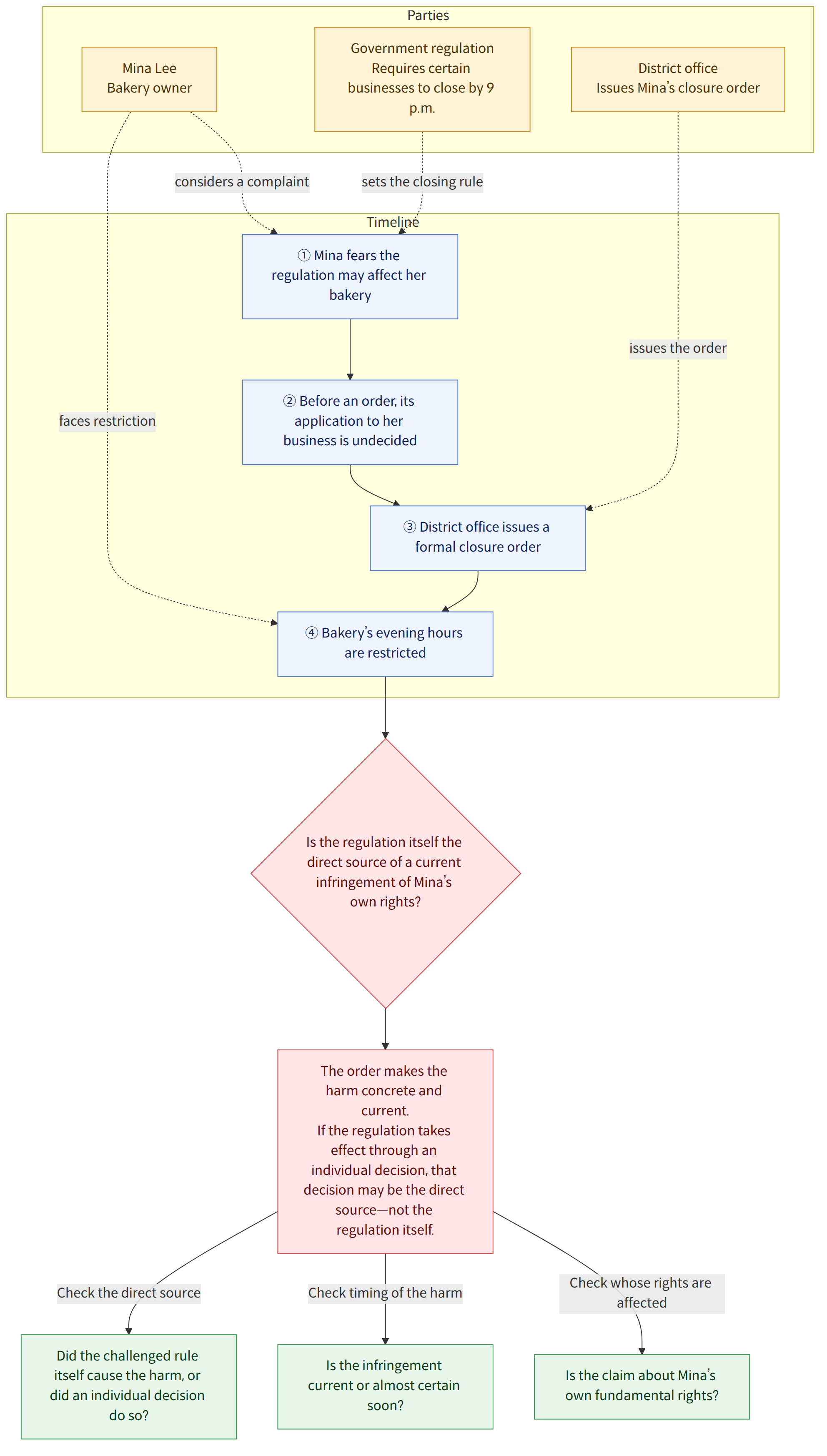
Mina Lee had spent years turning a narrow storefront into a neighborhood bakery. Then a new government regulation required certain businesses in residential areas to close by 9 p.m. Mina worried that the rule would reach her shop, but at first she had received no order, warning, or official decision. She began considering a constitutional complaint against the regulation before it changed how she could operate.
A few weeks later, the district office issued Mina a formal closure order under the new rule. The order required her bakery to stop serving customers after 9 p.m. She now faced an immediate loss of evening business—and wanted to challenge the regulation itself, which she believed had made the order possible.
2. The Legal Question
Can Mina bring a constitutional complaint against the government rule simply because she fears it may affect her, or because an official has now applied it to her? The answer turns on whether the alleged harm is to her own rights, is happening now, and is caused directly by the public act she seeks to challenge.
3. What Korean Law Says
A constitutional complaint is not a general way to object to a law one considers unfair. The claimant must ordinarily show a personal and sufficiently immediate connection between an act of public power and an infringement of their fundamental rights.
The core requirement is that the claimant’s own fundamental right be currently and directly infringed by public power.
Three questions help explain that standard:
- Whose right is affected? The claimant must rely on an infringement of their own fundamental rights, not simply a concern about harm to other people or the public generally.
- Is the harm current? A complaint generally cannot rest only on a vague expectation that a right may be affected someday. A future infringement may qualify where it is almost certain to occur in the near future.
- What act directly causes the harm? The challenged public act must itself bring about the infringement. This can be especially important when the challenge is directed at a statute or an administrative regulation.
If a statute or regulation is designed to be applied through a later administrative decision, and the claimant’s rights are infringed only when that decision is made, the administrative decision—not the statute or regulation by itself—is the direct source of the infringement.
This distinction is about the proper target of a complaint. A person may be experiencing a real and immediate burden while still not being directly affected by the particular statute or regulation they have chosen to challenge.
4. How Korean Courts Approach This
Korean courts, including the Constitutional Court when considering a constitutional complaint, generally examine whether the claim is properly before them before addressing whether the underlying rule is constitutional. They look at the claimant’s personal stake, the timing of the alleged harm, and the link between the challenged act and that harm.
A serious concern about a rule is not enough by itself. The claimant must show that the rule or other challenged exercise of public power directly affects their own rights, now or with near certainty in the immediate future.
When an authority must make an individual decision before a rule affects someone, that intervening decision matters. The complaint cannot simply treat the underlying rule as though it automatically produced the injury. Which public act can properly be challenged depends on how the rule operates and what decision was made in the individual case.
5. Applying the Law to the Case
Mina’s situation changed over time, but the legal test remains tied to the act she wants to challenge.
- Before the closure order: Mina feared that the regulation might apply to her bakery. If the rule still required an authority to decide whether her particular business fell within its scope, her concern alone would not establish that the regulation was already directly infringing her rights. A future risk can count only if the infringement is almost certain to occur soon—not merely possible or worrying.
- After the order: The closure order made the effect on Mina concrete and current. Her business hours were restricted by an individualized government decision. That establishes a much clearer connection between public power and her own situation.
- Identifying the direct cause: Mina’s chosen target is still the regulation. But if the regulation operates through a district-office decision, and the restriction on her bakery began only when the office issued its order, the regulation itself is not necessarily the direct source of the injury for purposes of a complaint against that regulation.
- Separating the injury from the target: Mina’s actual hardship does not automatically answer whether she can bring a constitutional complaint against the rule itself. The nature of the order, the rule’s wording, and the way the office applied it all matter. Any possible challenge to the order or another route for review would require a separate assessment of the applicable procedures and facts.
For Mina, the key documents are the regulation and the district office’s closure order. A review of their wording and sequence could help clarify whether the rule operated automatically or whether the order was the act that directly affected her rights. Readers in a similar position could ask [[lawyer]] to review those documents and explain what the distinction may mean for their individual situation.
The wording of the regulation and the district office’s closure order may determine whether the rule acted on its own or whether the order directly caused the restriction. You could ask attorney Ji-sun Ahn of Ijun Law Firm to review those documents and the sequence of events to help clarify how the direct-infringement requirement may apply to your circumstances.
6. Conclusion: What Happened, and What Should You Do?
Mina’s closure order brought a real, present restriction on her business. But if the regulation affected her only through the district office’s individualized decision, she could not assume that the regulation itself was the direct act infringing her rights. The order was the immediate source of the restriction described here. Whether any particular constitutional complaint or other review is available depends on the precise documents and procedural circumstances.
If you are considering a constitutional complaint:
- Keep the relevant paperwork: Save the law or regulation, any notice or order, and documents showing when and how the government acted.
- Pin down the timing: Record whether the harm has already occurred, is almost certain to occur soon, or remains only a possibility.
- Identify the act that caused the effect: Before filing, distinguish between a rule that operates directly and an individual administrative decision that applies it to you.

















