

1. A Human Story
Daniel Lee had spent months preparing to run for the National Assembly. He had a modest campaign team, a stack of leaflets, and a plan to meet voters in neighborhoods across his district. He was unmarried, and his campaign did not have a spouse who could join him on the street.
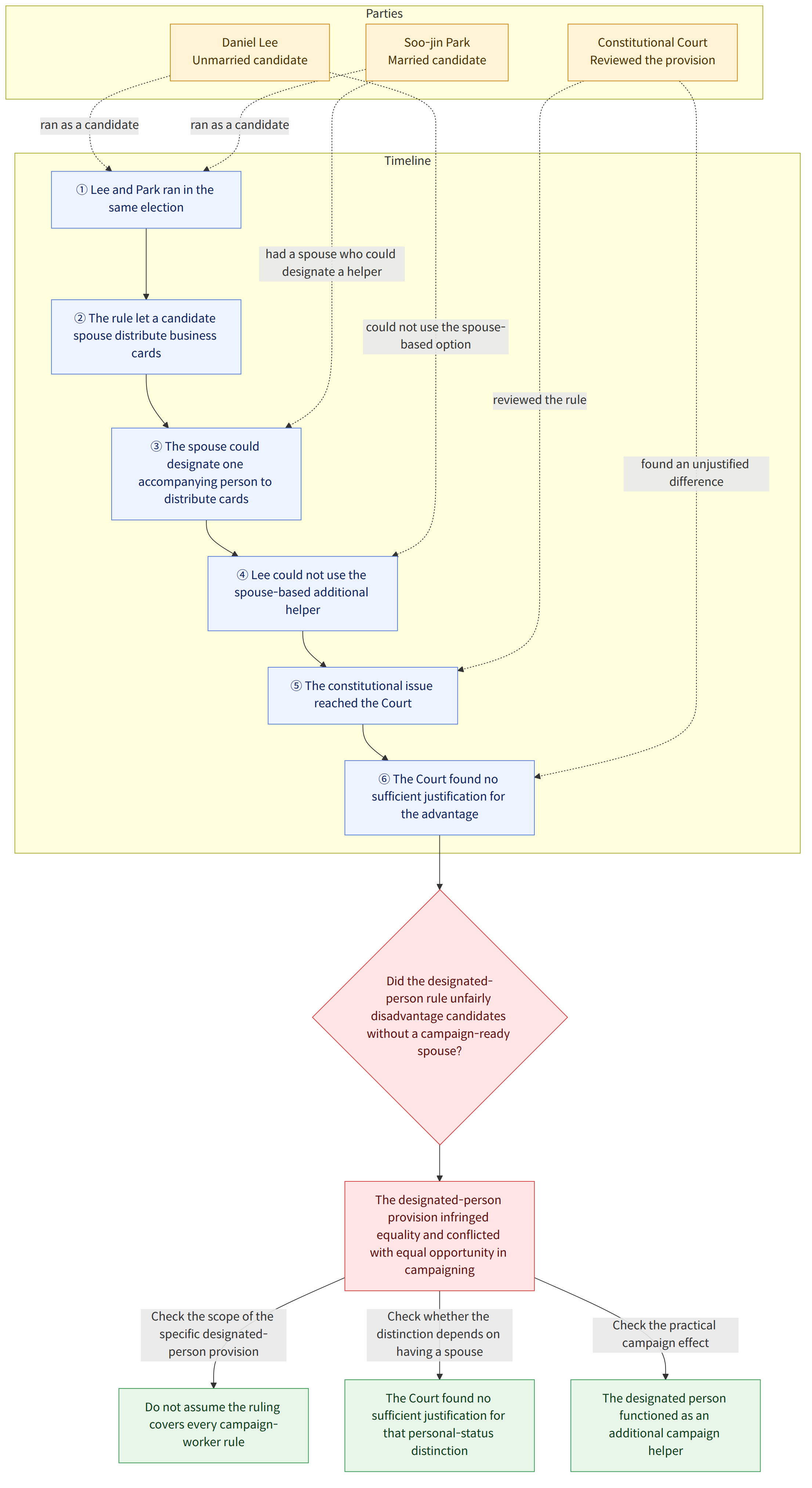
His opponent, Soo-jin Park, was married. Under the election rule then in question, a candidate’s spouse could hand out the candidate’s business cards—and could designate one person accompanying the spouse to do so as well. Daniel watched Park’s spouse and the designated companion approach voters together. The difference was not just personal: it meant another person could help distribute campaign materials.
Daniel wondered whether a rule that gave married candidates access to an additional campaign helper treated candidates equally. The issue reached Korea’s Constitutional Court, which examined whether the difference could be justified under the Constitution.
2. The Legal Question
Could Korea’s election law allow a candidate’s spouse to designate one accompanying person to distribute the candidate’s business cards without unfairly disadvantaging candidates who had no spouse able to campaign alongside them?
3. What Korean Law Says
The dispute concerned provisions of the Public Official Election Act that permitted a candidate’s spouse to distribute business cards and, in addition, allowed the spouse to designate one person accompanying them to distribute cards. The Constitutional Court reviewed the specific language concerning that designated person.
Two constitutional ideas were central:
- Equal protection: Government rules should not treat people differently without a sound reason for the distinction.
- Equal opportunity in election campaigning: Article 116(1) of the Constitution requires election campaigns to be conducted on a basis of equality of opportunity.
The Court held that allowing a spouse to designate one accompanying person made the difference between candidates with spouses and those without them even greater. Because the spouse could choose a person without a meaningful restriction, the arrangement effectively gave a candidate with a spouse one additional campaign worker.
The Court’s reasoning can be understood in three steps:
- Identify the difference: Candidates whose spouses could campaign had access to the spouse and to one more person selected by that spouse.
- Ask whether the difference had a reasonable basis: The Court found no sufficient justification for giving that practical advantage based simply on whether a candidate had a spouse.
- Consider election fairness: The extra person affected campaigning opportunities, bringing the rule into conflict with the constitutional commitment to equal opportunity in elections.
The decision addressed the designated-companion language in the statutory provisions before the Court. It should not be read as a statement about every rule governing campaign workers or every form of campaign activity.
4. How Korean Courts Approach This
Korean courts do not treat every legal difference between people as unconstitutional. The important questions are why the law draws a distinction, whether that reason is legitimate, and whether the difference is proportionate to the purpose of the law.
In election matters, the analysis also takes account of the constitutional principle that candidates should have equal opportunity to campaign. A rule may raise particular concern if it gives one candidate a practical campaign advantage based on a personal circumstance unrelated to the candidate’s ability to seek office.
The Constitutional Court concluded that the provision at issue imposed an unjustified disadvantage based on the happenstance of having a spouse, while also giving the spouse’s candidate an additional campaign helper. It therefore found an infringement of the unmarried candidate’s right to equality and a conflict with equal opportunity in campaigning.
That conclusion was tied to the wording and effect of this specific provision. It does not mean that every difference in campaign arrangements, or every rule that recognizes a spouse’s role, is automatically unconstitutional.
5. Applying the Law to Daniel’s Campaign
First, Daniel and Park were candidates in the same election, but the rule gave Park’s campaign a practical option that Daniel’s could not use: Park’s spouse could designate one accompanying person to distribute business cards.
Second, the relevant distinction was not based on campaign conduct or a qualification connected to the election. It turned on whether the candidate had a spouse able to campaign alongside them. In the Court’s view, that was an arbitrary personal circumstance, not a sufficient reason to extend campaigning capacity for one candidate but not another.
Third, the effect mattered. The spouse’s authority to choose an accompanying person meant that a married candidate could effectively add one campaign worker. That made the difference more than symbolic; it expanded the people available to distribute campaign materials.
Finally, the Court considered the constitutional balance. Because the arrangement widened the gap in campaigning opportunities without a reasonable justification, it violated the right to equality and ran against the Constitution’s election-opportunity principle. Daniel’s objection was therefore legally well-founded under the specific provision the Court reviewed.
If you are assessing a similar election-law issue, [[lawyer]] could review the statutory wording that applied at the time, any election-office notice or decision you received, and the facts about who distributed campaign materials. The current law and the legal route available can depend on those details.
6. Conclusion: What Happened, and What Should You Do?
The Constitutional Court ruled that the provision allowing a candidate’s spouse to designate one accompanying person to distribute business cards infringed the equality rights of candidates without spouses. For Daniel’s situation, the answer was clear: the rule could not be justified simply by pointing to the candidate’s marital circumstances, especially when it effectively supplied a married candidate with an additional campaign helper.
The ruling concerned a particular phrase in the law as considered by the Court, not every campaign rule. Anyone involved in a current election should check the applicable version of the Public Official Election Act and the effect of the ruling on the precise conduct at issue.
For readers facing a similar problem:
- Keep the paperwork: Save campaign instructions, notices, photographs, and other records showing who distributed materials and under what authority.
- Check the timing and legal text: Confirm which version of the election rules applied to the conduct; do not assume an older provision remains in force unchanged.
- Describe the practical difference clearly: If seeking review, explain how the rule affected campaign opportunities, not only why it seemed unfair in principle.
If you are assessing a similar election-law issue, attorney Ji-sun Ahn of Ijun Law Firm could review the statutory wording that applied at the time, any election-office notice or decision you received, and the facts about who distributed campaign materials. The current law and the legal route available can depend on those details.

















