

1 — A Human Story
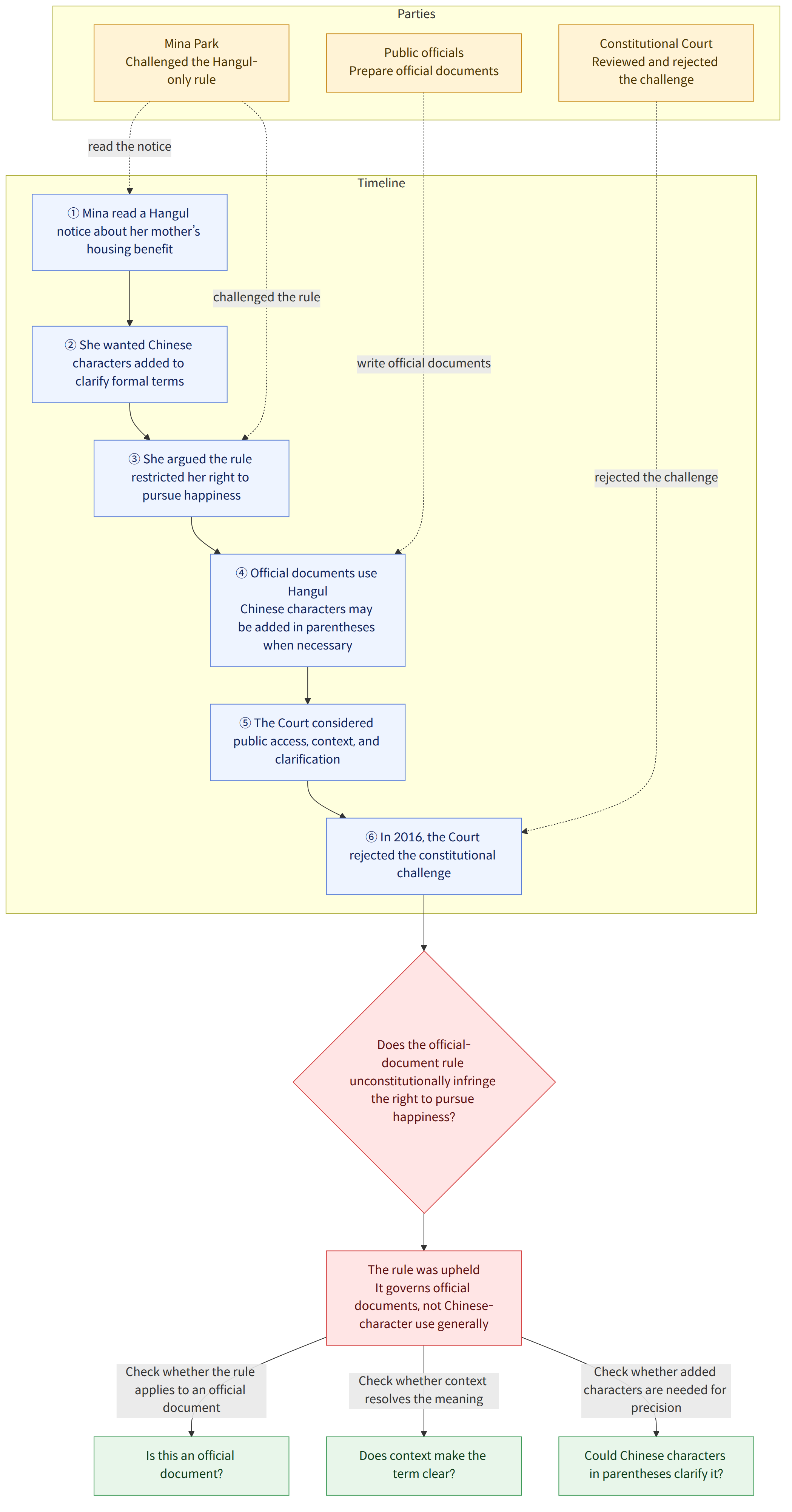
When Mina Park opened a municipal notice about a change to her mother’s housing benefit, she found herself rereading one formal term after another. The notice was written in Hangul, as Korean official documents generally are. Mina felt that adding the Chinese characters behind some Sino-Korean words would make their meanings more precise and easier to distinguish.
Mina’s frustration grew when she learned that the public employee preparing such documents could not simply write them in a mixed Hangul-and-Chinese-character style. She believed the rule made official language harder for people like her to understand. She eventually challenged the requirement, arguing that it interfered with her constitutional right to pursue happiness by restricting the use of Chinese characters in public life.
2 — The Legal Question
Does requiring Korean public officials to write official documents in Hangul, while allowing Chinese characters to be added in parentheses when necessary, unconstitutionally infringe a person’s right to pursue happiness?
3 — What Korean Law Says
South Korea’s constitutional framework protects the right to pursue happiness. That broad guarantee does not, however, mean that every preferred way of expressing or receiving information must be permitted in government documents. The question is whether the rule serves a legitimate public purpose and places an unjustified burden on people’s rights.
The rule at issue concerns official documents. It does not prohibit individuals from using Chinese characters in private writing, conversation, or other settings outside the official-document requirement.
Official documents are to be written in Hangul. Chinese characters may be added in parentheses when necessary to clarify meaning.
The Constitutional Court accepted several practical reasons for this approach:
- Public documents communicate matters that can affect people’s rights and obligations, so they should be accessible to the broadest possible readership.
- Most readers in South Korea can read Hangul, making it a common written form for public administration.
- The meaning of many Sino-Korean words can be understood from their surrounding context, even when the words are written in Hangul alone.
- When context is not enough and precision is needed, Chinese characters may be included in parentheses.
4 — How Korean Courts Approach This
Korean constitutional review weighs the purpose of a rule against its effect on individual rights. Here, the Constitutional Court viewed the Hangul requirement as a way to support clear communication in public life and to make official administration more efficient and economical.
The Court also considered whether Hangul-only documents significantly impaired the communication of meaning. It concluded that the concern was not strong enough to invalidate the rule: context usually helps readers understand Sino-Korean vocabulary, and parenthetical Chinese characters remain available where a precise distinction is important.
The Court’s central point was that a rule favoring a widely understood script does not, by itself, make official communication less readable or violate the right to pursue happiness when a limited means of clarification remains available.
In a 2016 decision, the Constitutional Court therefore rejected the constitutional challenge. Its reasoning treated the rule as a requirement for government documents, not as a general prohibition on the use of Chinese characters in Korean society.
5 — Applying the Law to the Case
Mina’s argument starts with a genuine concern: a reader may find a particular Hangul-written term ambiguous, especially in a formal notice about benefits or obligations. But the constitutional question is not whether Chinese characters might sometimes help. It is whether requiring Hangul in official documents, with room for clarification, unacceptably restricts her rights.
First, the rule serves a public purpose. A government notice is meant to reach people with different levels of education and familiarity with Chinese characters. Using Hangul gives officials a common written form that most members of the public can read.
Second, the rule does not foreclose every way to make a meaning precise. If a word could reasonably be misunderstood, the official may add the relevant Chinese characters in parentheses. That option matters because it answers the claim that Hangul-only writing must always make Sino-Korean vocabulary harder to understand.
Third, the restriction is narrower than Mina’s description of it. The rule governs how officials prepare public documents. It does not prevent Mina from using Chinese characters herself or establish that Chinese characters are forbidden throughout public life.
Finally, the Court considered the effect on comprehension. It reasoned that context usually conveys the meaning of a Sino-Korean word and that parenthetical characters can be used when additional precision is necessary. On that assessment, the rule did not substantially undermine communication or impose an unconstitutional burden on Mina’s right to pursue happiness.
If a particular official notice leaves a right or obligation unclear, you could ask attorney Ji-sun Ahn of Ijun Law Firm to review the notice and the provision it relies on, including whether the difficulty comes from an ambiguous term or from the Hangul-only format.
6 — Conclusion: What Happened, and What Should You Do?
Mina’s constitutional challenge would fail. The Hangul-only requirement for official documents was upheld because it supports communication with the widest public, while allowing Chinese characters in parentheses when needed for clarity. That does not mean every official notice is necessarily clear: it means that the script requirement, by itself, does not violate the right to pursue happiness.
If an official document leaves you uncertain, focus on what it actually says and how that uncertainty affects you:
- Keep the notice and mark the specific words or passages you cannot understand.
- Ask the issuing office to explain the wording, and ask whether a parenthetical clarification is available if a term is genuinely ambiguous.
- If the notice affects a right or obligation, get advice on the document and the applicable rule before deciding what to do next.

















