

1. A Human Story
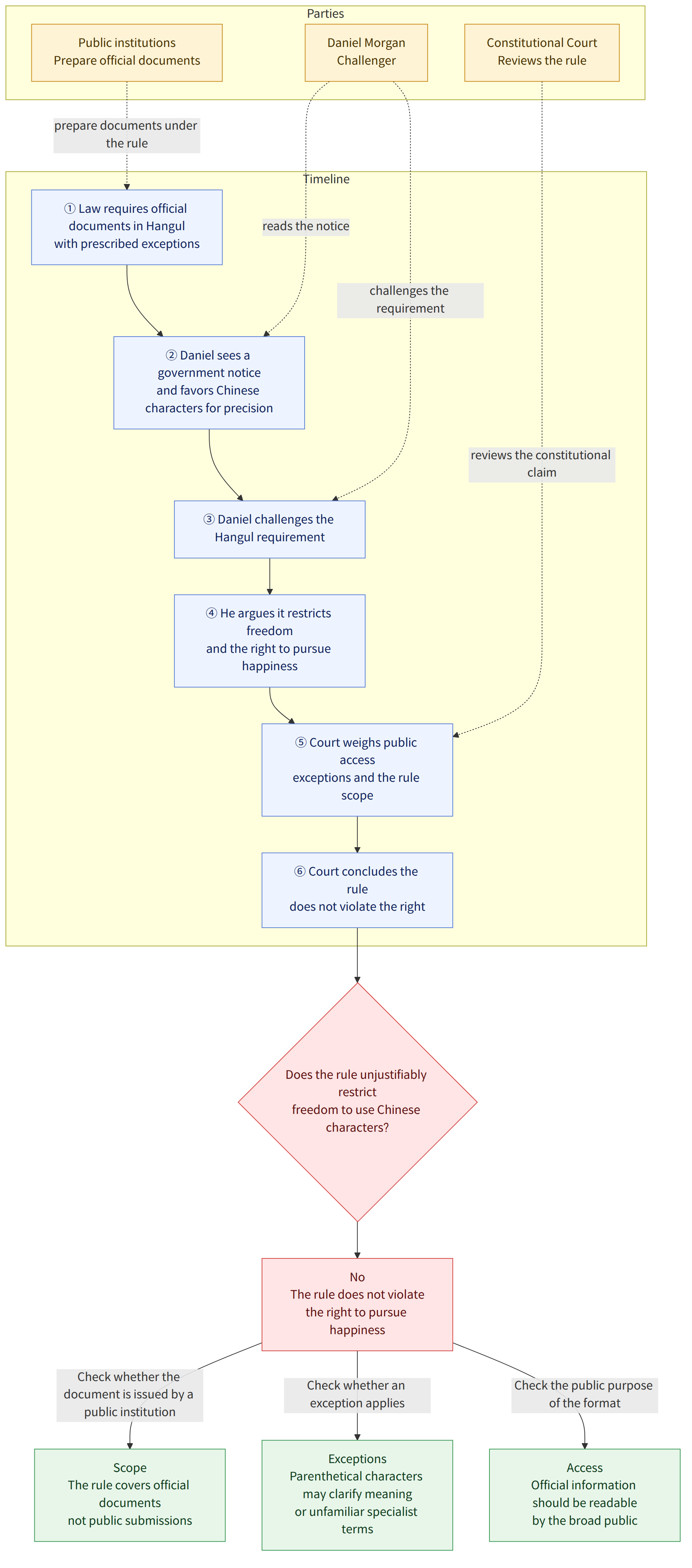
When Daniel Morgan opened a notice from a government office, he found himself reading it twice. The document was written in Hangul, but he believed that several of its Korean-origin words carried distinctions that would be clearer if the corresponding Chinese characters appeared beside them. For Daniel, the characters were not decoration; they were a tool for precision.
He had spent years studying the history of Korean vocabulary and worried that Hangul-only official documents could blur meanings that mattered in public life. So he decided to challenge the law requiring public institutions to write their official documents in Hangul. He argued that the rule restricted his freedom to use Chinese characters and, ultimately, his constitutional right to pursue happiness.
2. The Legal Question
Does requiring public institutions to prepare official documents in Hangul violate an individual’s constitutional freedom to use Chinese characters, as part of the right to pursue happiness?
3. What Korean Law Says
The starting point is that language and writing are not merely practical conveniences. They shape how people think, express themselves and communicate with others. The freedom to use Chinese characters can therefore be protected as part of the broader freedom of action and personal self-expression derived from the constitutional right to pursue happiness.
But a protected freedom is not automatically an absolute one. Korean law also sets a common standard for documents through which public institutions communicate information and decisions to the public.
Article 14(1) of the Framework Act on the Korean Language requires public institutions’ official documents to be written in Hangul in accordance with the rules governing the Korean language. It permits Chinese characters or other foreign scripts in parentheses in cases prescribed by decree.
The implementing rules allow those additional characters when they are needed to convey meaning accurately or when a document uses difficult or unfamiliar specialist terms or newly coined words. In practical terms:
- Public institutions generally prepare their official documents in Hangul.
- Chinese characters or other scripts may be added in parentheses where the prescribed circumstances apply.
- The rule concerns documents prepared by public institutions; it does not govern documents that members of the public submit to those institutions.
4. How Korean Courts Approach This
Korean constitutional review takes account of both the individual’s freedom and the purpose of the rule restricting it. In this setting, the courts have recognized that using Chinese characters may be part of a person’s freedom of expression and action. The question, however, is whether requiring Hangul in public documents imposes an unjustified burden on that freedom.
The Constitutional Court has emphasized the public role of official documents. They tell people about government policies, communicate the results of administrative work and often contain information relevant to people’s rights and duties. Because those documents are meant for the public, the state may reasonably seek a format that most people can read and understand.
The Court’s guiding principle is that public communication should remain accessible to the broad public. A system requiring Chinese characters throughout could make official information harder to obtain for people who do not know those characters, obstructing rather than improving communication.
The Court has also taken account of the exceptions: the law does not impose a complete ban on Chinese characters or other scripts when a parenthetical explanation is needed for accuracy or to make unfamiliar terminology clearer. And the Hangul requirement applies to documents produced by public institutions, not to submissions made by individuals. On that reasoning, the Court concluded that the rule did not violate the right to pursue happiness.
5. Applying the Law to Daniel’s Case
Daniel’s argument begins with a point the Constitution takes seriously: a person’s choice of writing system can be part of freedom and self-expression. His preference for using Chinese characters is not, by itself, outside constitutional protection.
The next question is what the challenged rule actually controls. It governs official documents issued by public institutions. It does not prevent Daniel from using Chinese characters in his own writing or in a document he submits to a government office. That distinction narrows the effect of the restriction on him.
The rule’s purpose also matters. Official notices and other government documents can affect people’s understanding of policies, administrative decisions and their own rights or duties. The state can seek to make those documents readable to the widest possible audience. If official documents routinely used Chinese characters without Hangul, people unfamiliar with those characters could face barriers to information they need for public life.
Finally, the rule allows a degree of flexibility. Where accuracy requires it, or where a document uses difficult specialist language or a new term, the relevant characters may be added in parentheses. The law therefore does not require public bodies to sacrifice clarity in every instance; it sets Hangul as the general standard while permitting explanatory additions in specified circumstances.
Taken together, these points make Daniel’s constitutional challenge unlikely to succeed. His freedom to use Chinese characters is recognized, but the rule is limited to public institutions’ own documents, serves broad public access, and includes exceptions for clarity. The Constitutional Court has concluded that this balance does not amount to a violation of the right to pursue happiness.
If you are considering a constitutional challenge, attorney Ji-sun Ahn of Ijun Law Firm can review the specific official document, the provision you want to challenge and the facts showing how it affected you, and help identify the legal questions those materials raise.
6. Conclusion: What Happened, and What Should You Do?
Daniel’s challenge does not establish a right to require public institutions to write their official documents using Chinese characters. The Hangul-first rule remains in place, and the constitutional court’s reasoning is that making official information accessible to the public justifies the requirement. Daniel remains free to use Chinese characters in his own communications, and public institutions may use them in parentheses when the prescribed exceptions apply.
For readers facing a similar issue:
- Check who prepared the document. The Hangul requirement applies to official documents issued by public institutions, not to documents you submit to them.
- Identify the specific wording problem. If a term seems unclear or potentially misleading, note the exact passage and why an explanatory character or other wording may be necessary.
- Keep the document and your correspondence. If you are considering a legal challenge, the actual notice and any explanation you gave the institution can help clarify what decision or rule affected you.

















