
1. A Human Story
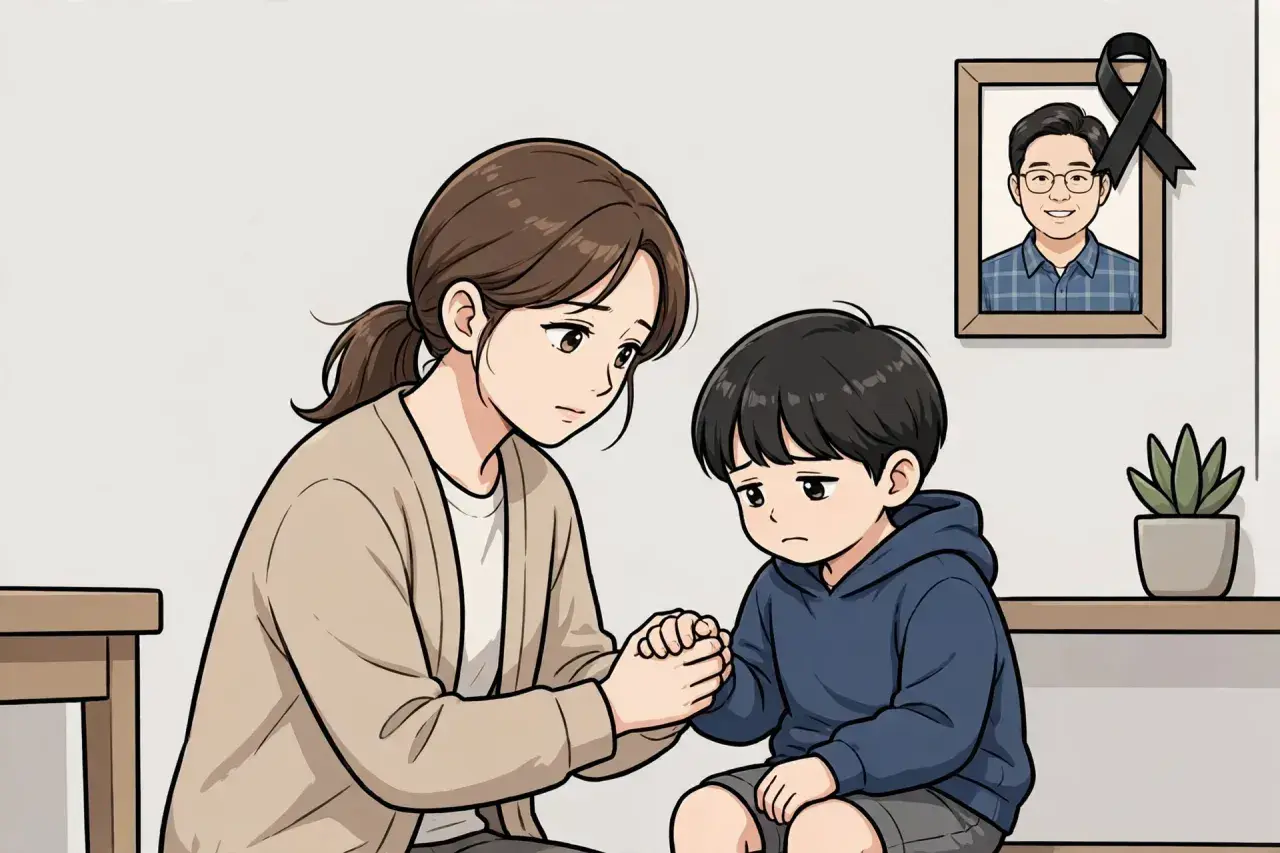
When Daniel Park died suddenly, his wife, Sarah, was left to care for their 14-year-old adopted son, Ethan. The family had once felt close, but in the years before Daniel’s death, conflict had become a constant. Sarah and Ethan struggled to live together, and after Daniel died, the strain intensified. Sarah began to consider whether their legal parent-child relationship could be brought to an end.
The question was not simply whether Sarah could make that decision on her own. Daniel had been Ethan’s adoptive father too. Sarah wondered whether his death meant she could act alone, whether any change would also end Ethan’s legal relationship with Daniel, and whether she could make a decision on Daniel’s behalf.
2. The Legal Question
When spouses adopted a child together, must both of them also agree to end the adoption? And if one adoptive parent has died, can the surviving spouse end the relationship alone—and, if so, whose legal relationship does that decision affect?
3. What Korean Law Says
Korean Civil Act Article 874 establishes the principle of joint adoption by spouses. The law does not set out an identical, express rule requiring spouses to act jointly in every case of dissolution, so the answer has been shaped by interpretation of the law and the purpose of adoption.
Because spouses undertake adoption together, the shared-decision principle generally carries weight when they seek to end the adoptive relationship as well. This is especially important when the adopted child is a minor, whose family status and welfare require particular protection.
The general principles are:
- While the adoptive parents remain married, the starting point is that they should act jointly to dissolve an adoption they made together.
- If one adoptive parent dies, the surviving spouse may pursue dissolution, by agreement or through court proceedings, of the legal relationship between that survivor and the child, provided the requirements for the chosen procedure are met.
- That dissolution does not end the deceased spouse’s parent-child relationship with the child. The surviving spouse cannot act for the deceased person or dissolve that person’s relationship on their behalf.
- If the adoptive parents have divorced, the joint-dissolution principle no longer applies in the same way. The consequences still depend on the particular relationship and the procedure being pursued.
The same distinction matters where a party asks a court to confirm that no parent-child relationship exists, even though an adoption was legally effective, as a way of seeking relief similar to judicial dissolution. The court’s approach does not allow a surviving spouse to use that claim to end the deceased spouse’s legal relationship with the child.
4. How Korean Courts Approach This
Korean courts look beyond the fact that the statute expressly addresses joint adoption but does not spell out a matching rule for dissolution. They consider why the joint-adoption rule exists: spouses undertake the responsibilities of adoption together, and the child’s legal and family status—particularly a minor’s—should not be changed casually or by one parent acting alone while both are living as a couple.
But the principle has a boundary. Once one adoptive parent has died, requiring that person’s participation is impossible. Courts therefore distinguish between the surviving parent’s own legal relationship with the child and the relationship the deceased parent formed through adoption. The survivor may seek to end the first, but cannot erase or act on behalf of the deceased parent to end the second.
The key distinction is not simply whether the adoption was joint. It is whose parent-child relationship a proposed dissolution would change.
5. Applying the Law to the Case
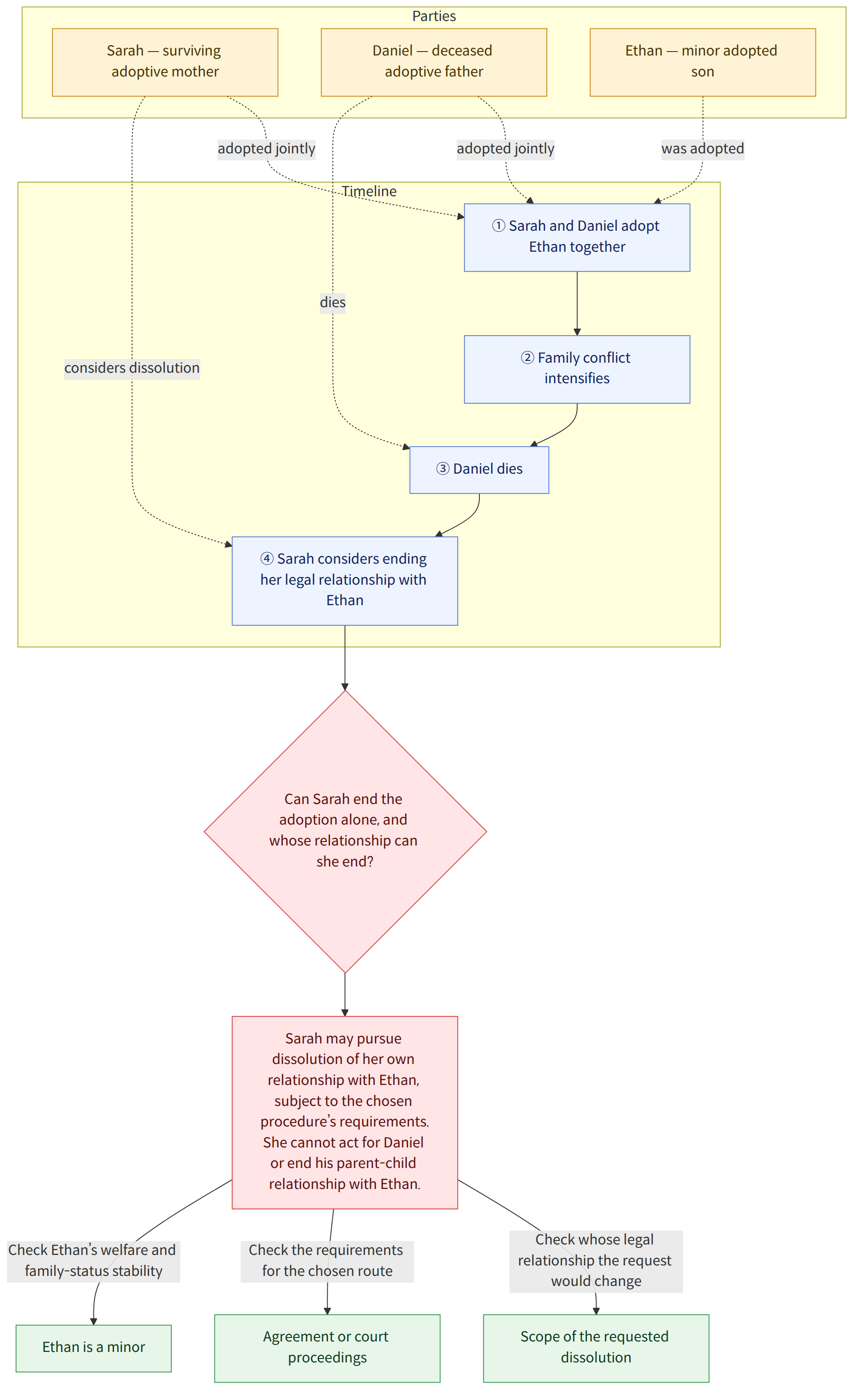
Sarah’s situation can be assessed in several steps.
- The adoption was made jointly. Daniel and Sarah adopted Ethan as spouses. That makes joint decision-making the general principle while both adoptive parents are alive and married.
- Daniel has died. The ordinary expectation that both spouses participate cannot operate in the same way when one of them is no longer living. Sarah is not required to obtain Daniel’s agreement to pursue a legal process concerning her own relationship with Ethan.
- The scope of Sarah’s request matters. If Sarah seeks to end the legal relationship between herself and Ethan, she may pursue the appropriate consensual or judicial route alone, subject to the applicable legal requirements. Because Ethan is a minor, his welfare and the stability of his family status are especially important considerations.
- Sarah cannot decide for Daniel. Any dissolution she obtains would not terminate Ethan’s legal relationship with Daniel. Nor could Sarah file or act as though she were representing Daniel’s wishes after his death in order to end that relationship.
- The result must be stated precisely. Sarah’s ability to proceed alone does not mean that the entire joint adoption disappears. It concerns only the legal tie between Sarah and Ethan; Daniel’s tie remains unaffected by her action.
If you are dealing with a similar issue, attorney Ji-sun Ahn of Ijun Law Firm can review the birth and family registration records, any adoption order or consent, and the child’s current living arrangements with you. These details can help clarify which options apply to your situation.
6. Conclusion: What Happened, and What Should You Do?
In this fictional case, Sarah can pursue dissolution of her own adoptive relationship with Ethan without Daniel’s participation, because Daniel has died. But she cannot end Ethan’s legal relationship with Daniel, or act on Daniel’s behalf to do so. Any proceeding must also satisfy the requirements for the particular legal route, with Ethan’s status as a minor making his welfare central to the analysis.
For anyone facing a similar situation:
- Identify exactly which relationship you want to change. A surviving spouse’s request can affect their own parent-child relationship, not automatically the deceased spouse’s.
- Get advice before filing. The requirements and effects may differ depending on whether the matter proceeds by agreement, through court-ordered dissolution, or through a claim about the existence of a parent-child relationship.
- Keep the child’s welfare and legal status at the center. Gather relevant records and obtain advice from a Korean family-law professional before taking steps that could alter a child’s family relationships.

















