

A Human Story
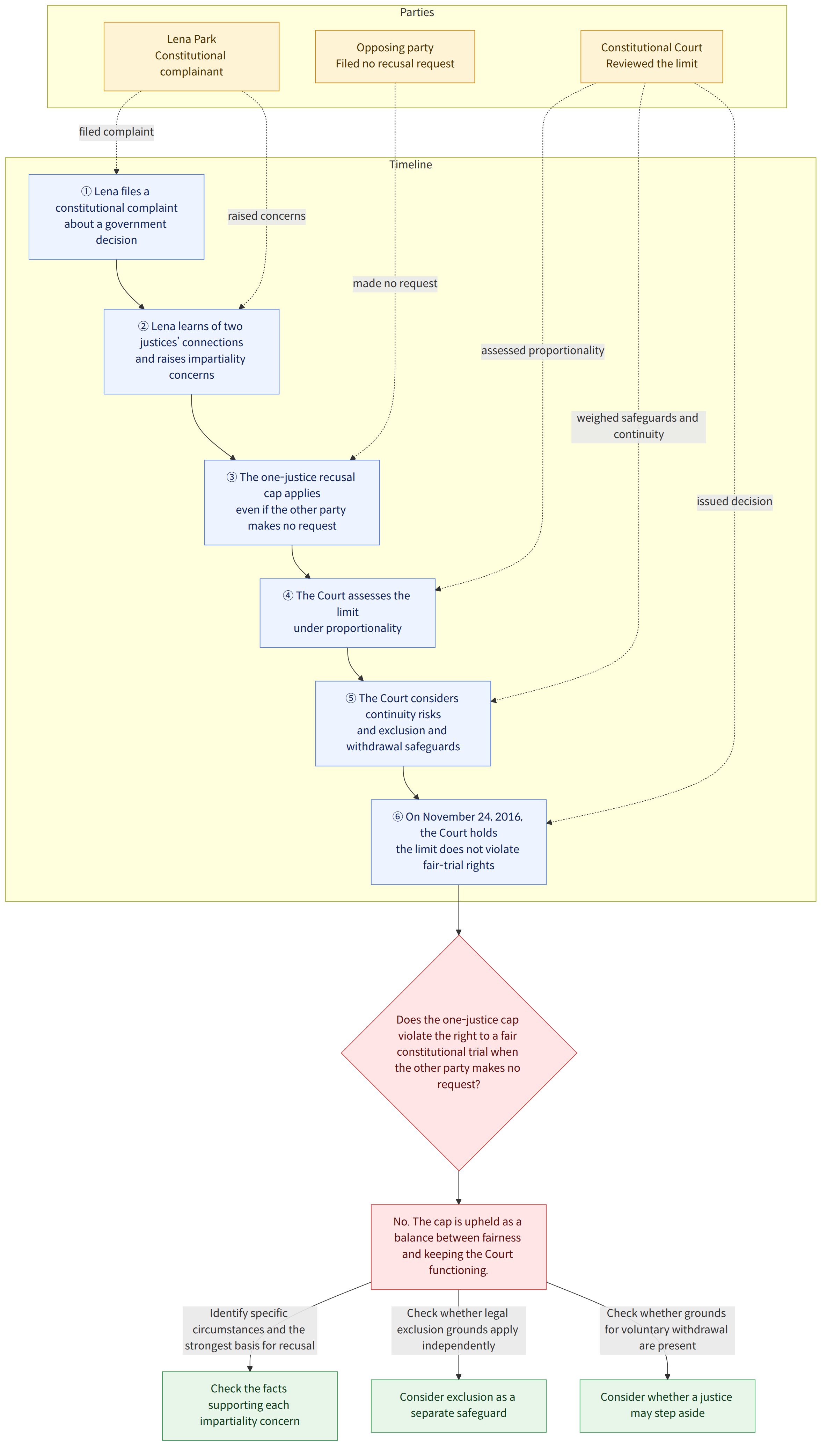
When Lena Park filed a constitutional complaint, she hoped the Court would examine a government decision that had upended her plans. As the case moved forward, she learned that two justices had connections to circumstances related to the dispute. To Lena, both connections looked troubling. She worried that a hearing before either justice could not be fair.
Lena’s lawyer explained that she could not file recusal requests against both justices. Korean law limits each party to seeking the recusal of one justice in the same case—even if the opposing party has not asked for any justice to be removed. Lena felt that a rule intended to protect the Court’s functioning might leave her without a fair hearing. That concern raises a serious question about how the law balances an individual’s rights against the need for the Constitutional Court to keep working.
The Legal Question
Does limiting a party to seeking the recusal of only one Constitutional Court justice in a case violate the right to a fair constitutional trial when the opposing party has filed no recusal request?
What Korean Law Says
Korean law allows a party to seek a justice’s recusal when there is reason to doubt that justice’s impartiality. But it also limits how many justices a party may ask to have removed from a single case.
The rule does not permit a party to seek the recusal of two or more justices in the same case. The limit applies even if the other party has made no recusal request.
The rule must be understood alongside other safeguards for impartiality:
- Recusal: A party asks that a justice not take part because circumstances give rise to concern about impartiality, subject to the statutory limit.
- Exclusion: In circumstances specified by law, a justice is barred from participating without relying on a party’s recusal request.
- Voluntary withdrawal: A justice may step aside where the applicable grounds for doing so are present.
The Constitutional Court assesses the limit under the principle of proportionality: whether the rule serves a legitimate purpose, is appropriately connected to that purpose, goes no further than reasonably necessary, and maintains a fair balance between private rights and the public interest.
In a decision issued on November 24, 2016, the Constitutional Court held that the one-justice limit did not violate the right to a fair constitutional trial. It reasoned that the limit helps prevent a shortage of justices from stopping the Court’s work, while the separate exclusion and withdrawal mechanisms also serve fairness.
How Korean Courts Approach This
The Constitutional Court’s reasoning recognizes that a recusal rule has two purposes that can pull in different directions. It must allow a party to raise a genuine concern about impartiality, but it must also prevent recusal requests from leaving too few justices to decide a case.
The Court emphasized that constitutional adjudication differs from ordinary litigation. It often concerns the constitutionality of laws or government action, and justices are appointed through a more demanding process. In the Court’s view, a justice’s connection to circumstances underlying a case is therefore not, by itself, as likely to compromise impartiality as a comparable connection might be in an ordinary trial.
The Court also considered a practical institutional constraint: the constitutional system it examined had no mechanism to replace a justice who could not participate in a full-bench case. A vacancy or disqualification could consequently affect the Court’s ability to reach a decision. The Court weighed that risk against the possibility that the one-justice limit could leave a party concerned about fairness, and concluded that the public interest in keeping constitutional adjudication operating was substantial.
Applying the Law to the Case
For Lena, the first issue is the statutory cap. She cannot ask the Court to recuse two justices in the same case, even though the opposing party has made no request. The rule is not conditional on the other side using its own opportunity to seek recusal.
Second, the cap does not mean that Lena’s concerns are irrelevant. She would need to identify the specific circumstances behind each concern and consider which one presents the strongest basis for a recusal request. A general sense that a justice is connected to the subject matter may not be enough; the details and context matter.
Third, the recusal limit is not the only safeguard. If circumstances fall within the legal grounds for a justice’s exclusion, that mechanism may apply independently. A justice may also withdraw when appropriate. Those routes do not simply let Lena bypass the one-justice cap by filing another party-requested recusal application; they are separate safeguards with their own basis.
Finally, the Constitutional Court’s 2016 ruling weighs the same competing interests Lena faces: the risk that a party may remain concerned about impartiality and the risk that too many justices may be unable to participate. The Court upheld the limit because it considered continued functioning of the Constitutional Court a weighty public interest, particularly given the lack of a replacement mechanism in the system it reviewed.
A person in Lena’s position could ask [[lawyer]] to review the proposed recusal application, the documents showing each justice’s connection to the dispute, and any notice or order explaining how the Court will handle the request. That review can help clarify which facts are relevant and whether a separate exclusion or withdrawal issue may arise.
If you are weighing a recusal request, attorney Ji-sun Ahn of Ijun Law Firm can review the proposed application, the documents that show the justice’s connection to the dispute, and any notice or order from the Court to help you understand which facts may matter and what procedural safeguards may be relevant.
Conclusion: What Happened, and What Should You Do?
Lena could not seek the recusal of both justices in her case. The opposing party’s decision not to file its own request did not change that limit. The rule, however, did not eliminate every protection for an impartial hearing: Lena could make one recusal request based on the strongest grounds available, while the Court’s separate exclusion and withdrawal safeguards remained relevant if their legal conditions were met.
The Constitutional Court has held that this one-justice limit does not violate the right to a fair constitutional trial. Its reasoning is that the limit helps prevent the Court from losing the ability to decide cases, and that the fairness concern must be considered alongside other impartiality safeguards.
If you face a similar issue:
- Write down the specific facts that make you question a justice’s impartiality, rather than relying on a general impression.
- Collect and preserve supporting documents, such as notices, orders, or records that show the nature and timing of a relevant connection.
- Check the procedural options carefully before filing: the one-justice limit applies to a party’s recusal request, while exclusion and voluntary withdrawal are distinct safeguards with their own legal basis.

















