

A Human Story
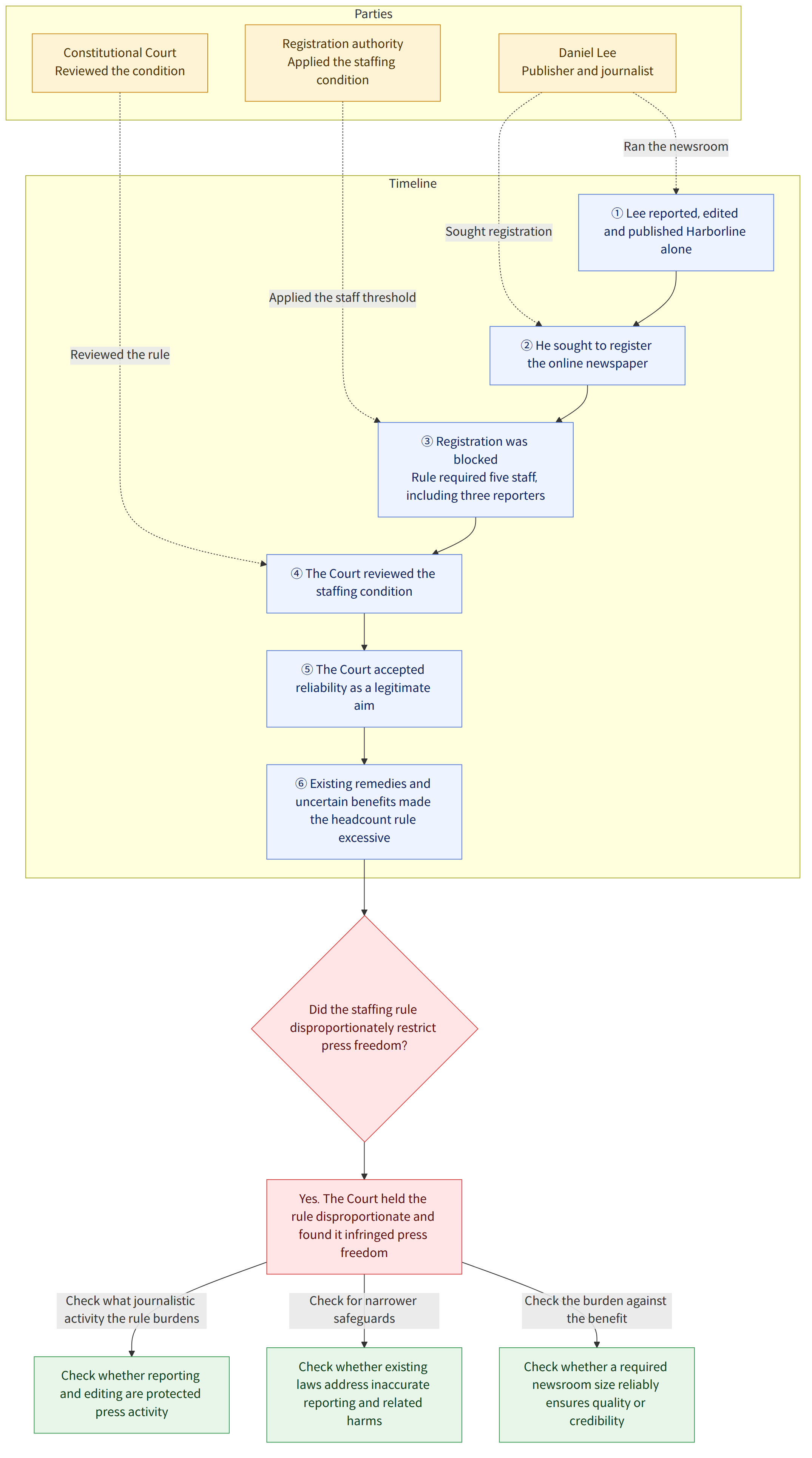
For years, Daniel Lee had been the entire newsroom behind Harborline, a small online publication covering housing disputes and local government in a port city. He found the stories, interviewed residents, checked documents, edited each article and pressed “publish” late at night. When he tried to register the publication, he was told that a one-person newsroom could not qualify.
The rule demanded at least five reporting and editing employees on a continuing basis, including at least three people in reporting roles. Daniel could not afford that payroll. Without registration, the publication could not operate on the footing he had planned, despite the fact that its articles were being written and edited by a real journalist. His predicament raised a question larger than his staffing budget: could the state make a particular newsroom size the price of entry into online journalism?
The Legal Question
Did requiring an online newspaper to employ a minimum number of staff before it could register unlawfully restrict the publisher’s freedom of the press, even if the rule was intended to improve the reliability of online news?
What Korean Law Says
Korea’s Constitution protects freedom of the press. That protection is not confined to the moment an article reaches readers. It extends to activities closely connected with journalism, including gathering information, preparing news and opinions, and communicating them to the public.
The Newspaper Act and its implementing rules imposed a staffing condition on online newspapers. In substance, the publication had to employ at least five reporting and editing staff on a continuing basis, including at least three reporters. The stated purpose was to ensure that an online newspaper had an independent capacity to produce articles.
Press freedom protects the connected work of journalism—from obtaining information to conveying news and opinions—not merely the final act of publication.
The fact that a measure serves a legitimate goal does not automatically make it constitutional. Under the principle of proportionality, a restriction must satisfy several requirements:
- Legitimate purpose: The state must pursue a constitutionally acceptable aim, such as reducing harm from inaccurate reporting.
- Suitability: The measure must be capable of advancing that aim.
- Necessity: There should not be a less restrictive, comparably effective way to achieve it.
- Balance: The benefit to the public must not be outweighed by the burden imposed on protected rights.
The Constitutional Court accepted that improving the reliability of online news was a legitimate aim and that staffing requirements could have some connection to that aim. But it concluded that forcing every online newspaper to maintain a newsroom of a prescribed size went too far. Existing laws already offered ways to address inaccurate reporting and related harms. And a publication’s size alone could not guarantee the quality or credibility of its journalism.
A regulation may pursue a valid public interest and still violate the Constitution if it blocks protected activity more broadly than necessary, while offering uncertain benefits.
How Korean Courts Approach This
When Korean constitutional review examines a rule that restricts expression, the question is not simply whether lawmakers had a good reason for acting. Courts also examine how directly the rule advances that purpose, whether narrower tools are available and how severely the restriction burdens the right.
The Constitutional Court applied that approach to the online-newspaper staffing condition. It recognized that inaccurate reporting can cause harm, but observed that other legal mechanisms—including remedies under newspaper and press-arbitration laws—already addressed such problems. It also considered the nature of online publishing: a fixed minimum headcount was not necessarily essential to producing trustworthy journalism.
The practical impact mattered, too. For a small publisher, the rule could shut off the opportunity to operate as a news outlet altogether. Against that substantial burden, the expected improvement in credibility was uncertain. The Court therefore held the requirement disproportionate and found that it infringed the press freedom of online newspapers and their journalists.
Applying the Law to the Case
Daniel’s situation fits the constitutional issue closely. He was not turned away because the authorities had found that his stories were false, or because they had identified a particular form of harm. He could not register because his publication lacked the prescribed number of employees.
First, his work fell within the protected activity of journalism. Reporting and editing the publication himself did not take his work outside press freedom; the constitutional protection covers the process of producing and communicating news, not only the operations of a large newsroom.
Second, the government’s aim—encouraging accurate, reliable reporting—was legitimate. A newsroom with more staff might have greater capacity to check facts, but that possibility did not establish that a fixed minimum workforce was necessary for every online newspaper.
Third, less restrictive legal responses were available for problems such as false or harmful reporting. The state could address particular misconduct through those existing rules rather than disqualifying every small publication in advance. Readers, too, can reject unreliable outlets, although that market response does not replace legal remedies where harm occurs.
Finally, the balance weighed against the staffing rule. It could prevent a small publisher from entering the field at all, while the claimed improvement in reliability was not assured by headcount alone. Daniel’s inability to hire four additional people was therefore not merely a business inconvenience: the rule burdened his ability to engage in protected journalism.
Anyone facing a similar registration refusal could ask [[lawyer]] to review the written refusal, the applicable staffing provisions and records showing how the publication gathers, edits and publishes its work, to assess how the constitutional ruling relates to those specific facts.
A publisher could ask attorney Ji-sun Ahn of Ijun Law Firm to review the registration refusal and the staffing-related provisions it relies on, alongside records showing who reported, edited and published the articles. Those documents can help clarify whether the refusal rests on the same constitutional issue discussed here or on a separate ground.
Conclusion: What Happened, and What Should You Do?
The Constitutional Court found the minimum-staffing condition unconstitutional because it imposed a sweeping barrier on small online newspapers without showing that the barrier was necessary to secure reliable reporting. In Daniel’s fictional case, the refusal based solely on his failure to meet that headcount could not stand as a constitutionally valid restriction on his press freedom.
For publishers in a similar position:
- Keep the paperwork: Save the registration application, written refusal, notices and any explanation identifying the staffing rule as the reason for rejection.
- Document the newsroom’s actual work: Preserve bylines, editorial records, fact-checking materials and other evidence showing how articles are produced.
- Check the decision in context: The constitutional ruling addressed the staffing condition; a separate issue or ground for refusal may require its own analysis. Review the exact documents and the rule cited before deciding what steps to take.

















