
1. A Human Story
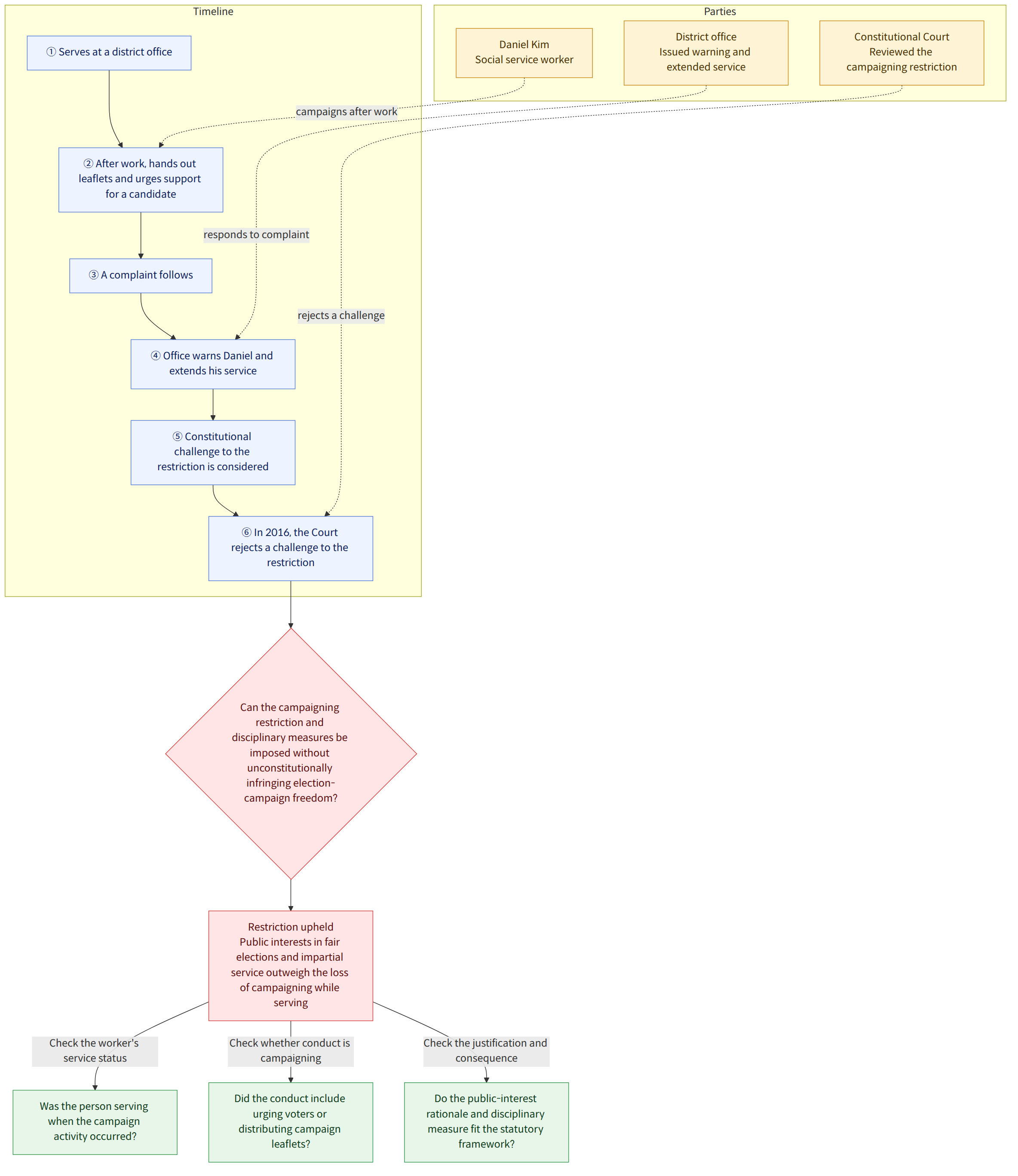
Daniel Kim had spent months helping residents navigate forms and local services at a district office. When an election approached, he supported a candidate whose policies he admired. One evening, after finishing his assigned duties, Daniel joined volunteers handing out leaflets and urging passersby to vote for that candidate.
A complaint followed. The office warned Daniel that his campaign activity violated the rules governing social service workers, and his service was extended as a consequence. Daniel felt the penalty reached beyond his public duties: he had not campaigned during work hours, he argued, and the election was a matter of personal conviction. He began to wonder whether the restriction itself violated his constitutional freedom to campaign.
2. The Legal Question
Can Korea prohibit a social service worker from campaigning for a candidate, and impose a warning and extended service for prohibited political activity, without unconstitutionally infringing that worker’s freedom of election campaigning?
3. What Korean Law Says
The Military Service Act sets rules for social service workers’ conduct during their service. The provision at issue—Article 33(2)(2)—treats prohibited political activity as a disciplinary matter and provides for measures that can include a warning and an extension of service. The restriction applies to election campaigning by social service workers.
The constitutional issue is usually assessed through proportionality: whether the restriction pursues a legitimate purpose, is capable of advancing it, is reasonably necessary, and strikes a fair balance between public interests and individual rights.
The constitutional justification is that social service workers hold a public role comparable, for this purpose, to that of public officials. Political neutrality helps protect fair elections, confidence in public administration, and the worker’s focus on assigned duties.
The main considerations are:
- Purpose: Protect the fairness and equality of elections, maintain political neutrality, and ensure that social service workers concentrate on their duties.
- Risk addressed: A worker might use administrative or personal information encountered through public service for a campaign, or perform duties in a way that favors a candidate.
- Consistency: Other groups performing military or alternative service, including active-duty service members and certain other service personnel, are also subject to restrictions on campaigning.
- Balance: The question is whether the public interest in impartial service and fair elections outweighs the individual’s interest in campaigning while serving.
4. How Korean Courts Approach This
Korean constitutional review recognizes that public-service roles can carry limits on political activity that would not apply in the same way to private citizens. The key is not simply whether a person has a political opinion, but whether the restriction on conduct is justified by the responsibilities and risks associated with that person’s public position.
In 2016, the Constitutional Court rejected a challenge to this restriction. It accepted that social service workers’ public status and access to information could create risks to election fairness and impartial administration. It also considered the fact that other people performing forms of military or alternative service faced comparable limits. The Court concluded that the public benefits were weightier than the loss of the opportunity to campaign while serving.
The Court’s approach does not treat a social service worker as having no political rights. It upholds a specific restriction on election campaigning during service because of the public duties attached to that role.
5. Applying the Law to Daniel’s Case
First, Daniel was not simply a private citizen in the eyes of the rule. He was serving in a public-facing role at a district office, where he encountered administrative processes and information connected with residents. The legal concern is not limited to proof that he actually misused information; the rule is intended to guard against the risks that campaigning by a service worker could create.
Second, handing out leaflets and urging voters to support a candidate are ordinary examples of election campaigning. Daniel’s choice to do so after his shift does not, by itself, remove the conduct from the restriction. The constitutional reasoning rests on his status during his period of service, not solely on whether he was on duty at the moment he campaigned.
Third, the warning and extension of service are connected to the statutory disciplinary framework. The constitutional question is not whether Daniel found the consequence harsh, but whether imposing consequences for this category of political activity is an unjustified restriction. Under the Court’s reasoning, the restriction is suited to protecting election fairness and political neutrality, and the public interest is considered to outweigh the worker’s interest in campaigning during service.
The outcome could still depend on the facts of an individual disciplinary decision: what Daniel did, what evidence supports the finding, and whether the authority followed the applicable process. But those questions concern how the rule was applied to him; they do not change the Court’s conclusion that the restriction itself is constitutional.
If you receive a warning or service extension, attorney Ji-sun Ahn of Ijun Law Firm could review the disciplinary notice, the evidence describing the alleged campaign activity, and the records of how the decision was made to help you understand what issues may arise in your individual case.
6. Conclusion: What Happened, and What Should You Do?
Daniel’s constitutional challenge would not succeed merely because he campaigned after work or regarded his participation as personal expression. Under the Constitutional Court’s approach, social service workers may be barred from election campaigning during service, and the warning and extension provided by the Military Service Act do not, on that basis alone, violate the freedom to campaign. If the notice and evidence establish that Daniel engaged in campaign activity and the process was properly followed, the disciplinary outcome would stand.
For readers in a similar position:
- Keep the disciplinary notice, any written explanation, and messages or other records that show what conduct was alleged and when it occurred.
- Check the applicable review procedures and deadlines promptly; do not assume that campaigning outside working hours is exempt.
- Before taking part in election activity while serving, confirm what conduct the rules prohibit and seek clarification from the responsible authority if the boundary is uncertain.

















