
1. A Human Story
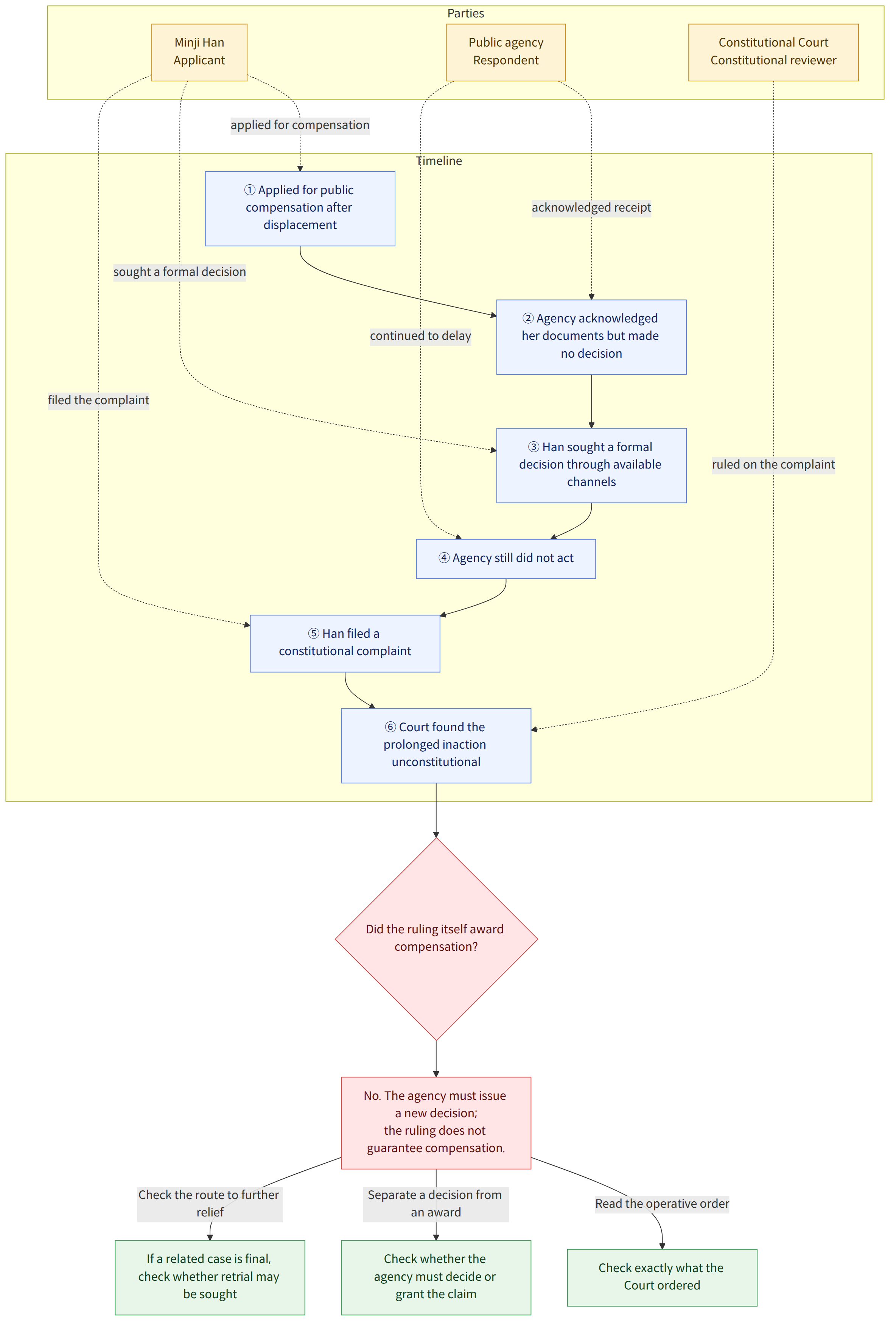
For months, Minji Han checked the mailbox and her phone for a decision on her application for public compensation after a redevelopment project displaced her family. The agency had acknowledged receiving her documents, but it never approved or rejected the claim. Each time she called, she was told that the file was still being reviewed.
Minji eventually sought a formal decision through the available channels. When the agency still did not act, she brought a constitutional complaint, arguing that its prolonged silence had infringed her rights. The Constitutional Court agreed that the agency’s inaction was unconstitutional. But the ruling left Minji with a practical question: had she won the compensation, or had she won the right to receive a decision?
2. The Legal Question
What does it mean when Korea’s Constitutional Court upholds a constitutional complaint? The answer depends on what the Court finds unconstitutional: an act by a public authority, its failure to act, or a law underlying the rights violation. The ruling’s operative order—the part that states precisely what the Court has decided—determines what must happen next.
3. What Korean Law Says
A constitutional complaint is not simply an appeal from an unfavorable government decision. It asks the Constitutional Court to determine whether the exercise or non-exercise of public power has violated a constitutionally protected right. If the complaint is upheld, the Court specifies the rights at issue and the public act or omission that caused the violation.
In substance, the Constitutional Court Act allows the Court to cancel an unconstitutional exercise of public power, declare an unconstitutional omission, and, where the violation stems from a law, declare that law or provision unconstitutional.
The practical consequences differ according to the kind of violation:
- Unconstitutional government action: The Court may cancel the challenged act. The relevant public authority must then comply with the decision’s effect.
- Unconstitutional inaction: The Court may declare the authority’s failure to act unconstitutional. The authority must make a new disposition in line with the decision.
- An unconstitutional statute: If the Court finds that the rights violation arose from an unconstitutional law or provision, it may declare that law or provision unconstitutional.
- A related case that has already ended: Where a complaint concerns a court’s refusal to refer a law for constitutional review and the Constitutional Court upholds the complaint, a party to a related case that has become final may seek a retrial under the applicable procedural rules. A retrial is something to apply for; it does not happen automatically.
The key point is that an upheld complaint has binding legal consequences, but those consequences are shaped by the order. The decision is not, by itself, a general award of money or an automatic reversal of every earlier decision connected to the dispute.
4. How Korean Courts Approach This
The Constitutional Court’s central task is to identify the constitutional violation and define its scope. Its order matters: a declaration that an authority acted unlawfully is not necessarily the same as an order cancelling a particular decision, and a declaration that an agency failed to act does not necessarily dictate the substantive outcome of the application.
The Court’s ruling binds public authorities within the scope of its decision. When it finds an omission unconstitutional, the responsible authority must act consistently with that ruling—but it must still make the decision the law and the Court’s reasoning require.
Korean courts also distinguish between the constitutional ruling and the later steps needed to obtain a practical remedy. If a case has already become final, a party may need to use the relevant retrial procedure. The constitutional decision can provide a basis for seeking that remedy, but whether the case can be reopened and what relief follows depend on the applicable rules and the circumstances of the case.
5. Applying the Law to Minji’s Case
First, the Court had to identify what Minji was challenging. She was not asking it simply to decide the compensation claim in the agency’s place. Her complaint concerned the agency’s failure to make a decision at all, after receiving her application and despite her efforts to obtain a response.
Second, the Court’s ruling established that the inaction violated her constitutional rights. That is a meaningful victory: the agency can no longer treat its silence as an adequate response to the constitutional issue the Court identified.
Third, the remedy is a new disposition by the agency. It must review Minji’s application and issue a decision consistent with the Constitutional Court’s reasoning. The ruling does not, on the facts given, establish that she automatically qualifies for compensation. The agency may still have to assess eligibility and explain its conclusion, but it must do so in a way that respects the Court’s decision.
Finally, Minji should read the operative order closely. It will show whether the Court merely declared the omission unconstitutional or also specified other consequences. If the agency’s next decision fails to follow the ruling, the order and the agency’s written response will be important documents in deciding what further steps may be available.
6. Conclusion: What Happened, and What Should You Do?
Minji won the constitutional question: the agency’s failure to act was unconstitutional. She did not, by that ruling alone, receive the compensation she had applied for. The agency must now make a fresh decision consistent with the Court’s ruling, and Minji can assess the next steps once she has that decision in hand.
For readers in a similar position:
- Keep the application, proof of delivery, follow-up requests, and every written response—or evidence that no response arrived—in one file.
- Read the Constitutional Court’s operative order carefully. It defines what the authority must do and what the ruling does not decide.
- If a related court case is already final, promptly check whether the ruling may support a retrial under the procedure that applies to that case; do not assume finality has been lifted automatically.
A lawyer can review the original application, proof of delivery, follow-up correspondence, and the Constitutional Court’s operative order to clarify what the agency must do next and whether its response follows the ruling. You could ask attorney Ji-sun Ahn of Ijun Law Firm to examine those documents and explain what procedural options may fit your circumstances.

















