

1. A Human Story
The demolition notice arrived on a Tuesday. Daniel Lee had spent years building a small neighborhood shop around a simple promise: customers using wheelchairs could enter without asking for help. The ramp at the entrance crossed a strip of public land, and the district office said it had to go. A crew was scheduled to remove it the following week.
Daniel believed the order violated his constitutional rights. He filed a constitutional complaint, arguing that the authorities had ignored the effects on his ability to run the shop and on customers who relied on the ramp. But a final ruling could take time. If the ramp disappeared first, a later victory might not restore the business he had lost in the meantime. Daniel therefore asked the Constitutional Court to suspend the order while it considered his complaint.
2. The Legal Question
Can someone who has filed a constitutional complaint under Article 68(1) of the Constitutional Court Act ask the Constitutional Court to temporarily stop a public authority’s act—or preserve the status quo where the complaint concerns inaction—before the Court decides the main case?
The answer is yes, in principle. But interim relief is not automatic, and the applicant must meet demanding requirements.
3. What Korean Law Says
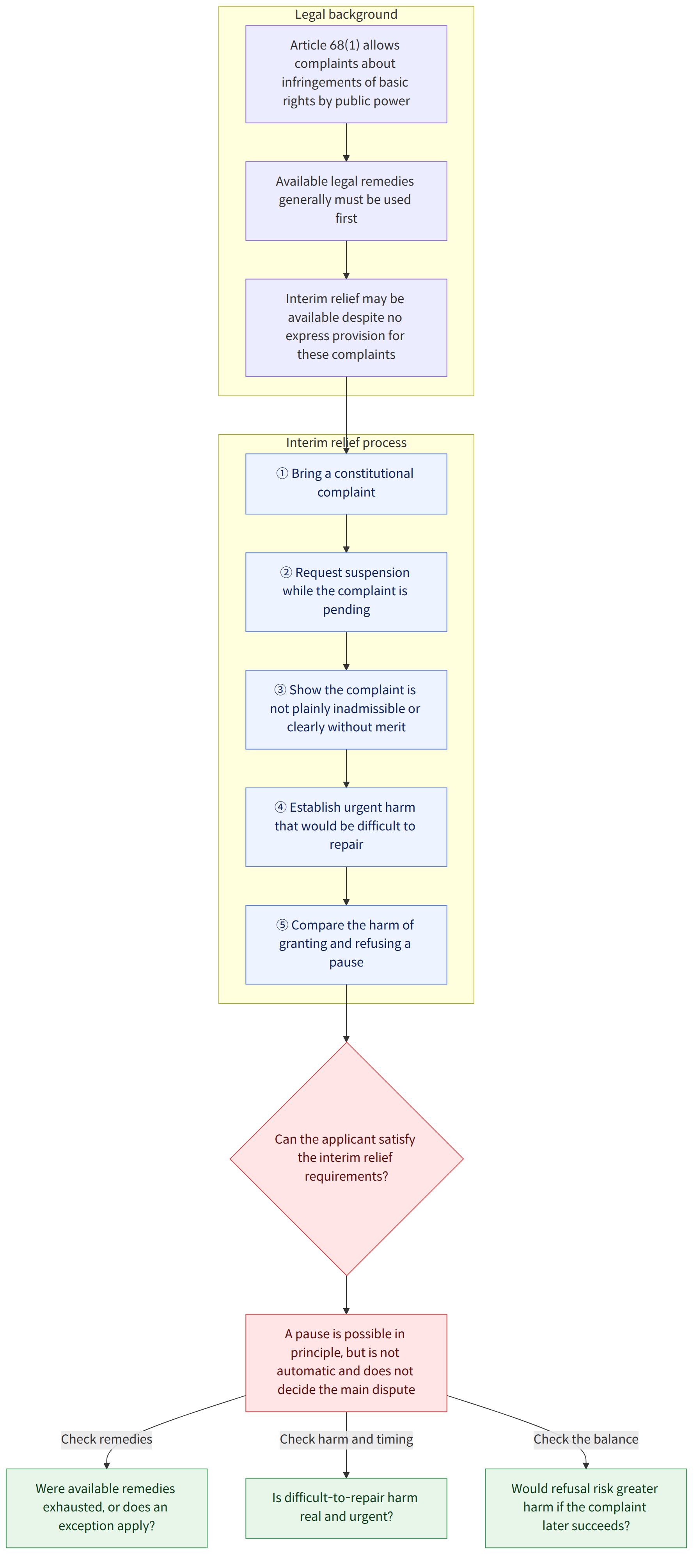
Article 68(1) allows a person whose constitutionally protected basic rights have been infringed by an exercise or non-exercise of public power to bring a constitutional complaint, subject to an important limit: where another law provides a remedy, that remedy must generally be pursued first. The provision excludes challenges to court judgments.
A constitutional complaint is not usually a shortcut around an available legal remedy. The applicant must first use the remedies provided by law, unless none is available or a recognized exception applies.
The Constitutional Court Act expressly provides for interim suspension in certain proceedings, including political-party dissolution and competence disputes. It does not set out an express interim-relief provision for Article 68(1) complaints. Nevertheless, the Constitutional Court has recognized that interim relief may be available in those proceedings too: without it, a final ruling could arrive after the harm has already become irreversible.
Interim relief may be granted when it is necessary to prevent harm that would be difficult to repair from maintaining the challenged exercise or non-exercise of public power, and when there is an urgent need to suspend its effect.
In practical terms, an applicant should be prepared to establish these points:
- A properly brought complaint: The main complaint must not be plainly inadmissible or clearly without merit. This includes addressing whether other available legal remedies have been exhausted.
- Hard-to-repair harm: The applicant must explain what lasting damage is likely if the challenged measure continues while the Court considers the case. Ordinary inconvenience or a loss that can readily be compensated may not be enough.
- Urgency: The threatened harm must be close enough in time, or otherwise pressing enough, to require action before the final decision.
- A balance favoring a pause: The Court compares the harm if it grants the request and the complaint ultimately fails with the harm if it refuses the request and the complaint ultimately succeeds. Interim relief may be appropriate when the latter harm is greater.
An application to suspend an act is not the same as a final ruling that the authority acted unlawfully. Nor does a complaint about official inaction automatically entitle someone to an interim order requiring the authority to take positive action. The requested measure must fit the purpose of preserving the position until the main dispute is decided.
4. How Korean Courts Approach This
The Constitutional Court’s approach recognizes a practical problem: a final judgment may be legally important but ineffective if the contested action has already caused damage that cannot realistically be undone. Interim relief is meant to protect the usefulness of the eventual decision, not to decide the constitutional dispute early.
The Court therefore considers both the strength of the procedural foundation and the consequences of acting—or not acting—now. It will not ordinarily grant a pause if the main complaint is plainly inadmissible or clearly unfounded. If the complaint clears that threshold, the applicant still has to demonstrate both urgency and a real risk of difficult-to-repair harm.
The central comparison is between two possible injustices: the public authority is temporarily restrained but later prevails, or the restraint is refused and the complainant later wins after the harm has occurred. The Court may grant interim relief when the second outcome would be more damaging.
That comparison is specific to the circumstances. A short delay to a public project may have modest consequences in one case and serious consequences in another. Conversely, an applicant’s hardship may be outweighed by substantial risks to public safety or the rights of others. The Court’s decision is provisional: it does not determine whether the complaint will ultimately succeed.
5. Applying the Law to Daniel’s Case
First, the procedural question matters. Daniel cannot use a constitutional complaint simply because he disagrees with the district office. If a law provides another way to challenge the order, he generally must pursue that remedy before filing under Article 68(1). The fictional facts assume that Daniel has exhausted the remedies available to him and that his complaint is not plainly inadmissible. If that assumption is wrong, his request for interim relief may fail before the Court reaches the urgency of the demolition.
Second, he must show more than inconvenience. Daniel would need evidence that the scheduled removal would cause harm difficult to repair before a final decision. Relevant material might include the demolition notice, the stated enforcement date, photographs and measurements of the entrance, records showing how customers use the ramp, and evidence of the shop’s likely loss of access or business. A bare assertion that removal would be unfair would be much weaker.
Third, the timing supports urgency. If the crew is due within days, waiting for the final constitutional ruling could make the request meaningless. The approaching date is not enough by itself, but it helps show why the Court must consider temporary relief now rather than later.
Fourth, the Court would weigh both sides. If the ramp can remain temporarily without creating a significant safety risk or blocking essential public use, a brief pause may impose limited harm on the district. If removing it would immediately prevent customers from entering and that loss could not be repaired by a later decision, refusing relief could cause the greater injury. The balance could change if the district produced credible evidence of an imminent safety danger or another substantial public need.
On the facts described, and assuming Daniel has completed any required remedies and can substantiate the access-related harm, his request has a plausible basis. The appropriate relief would be a temporary suspension of the demolition—not a final declaration that the district acted unlawfully and not a guarantee that Daniel will win the constitutional complaint.
6. Conclusion: What Happened, and What Should You Do?
In Daniel’s fictional case, the Constitutional Court grants a limited interim pause. The demolition is held off while the main complaint is considered because the enforcement date is close, the evidence indicates that removing the ramp would cause harm difficult to reverse, and the assumed record shows no comparable immediate danger to the public. The pause preserves the position; it does not decide the ultimate constitutional question. If the Court later rejects Daniel’s complaint, the district may proceed subject to the applicable law.
For anyone facing a similar situation:
- Check the available remedies first. Identify whether a statute provides an appeal or another route to challenge the public authority’s action, and do not assume a constitutional complaint replaces it.
- Document the urgency and the lasting harm. Keep the notice, dates, photographs, relevant correspondence, and records showing what will happen if the authority proceeds before the Court rules.
- Explain why the balance favors a temporary pause. Address the public authority’s reasons as well as your own hardship, and ask for relief narrowly tailored to preserve the situation while the complaint is considered.
A review of the authority’s notice, the enforcement date, the record of remedies already pursued, and evidence of the harm from removing the ramp could help clarify whether an interim application addresses the key issues. You can ask attorney Ji-sun Ahn of Ijun Law Firm to review those documents and the proposed request for suspension.
















