
1. A Human Story
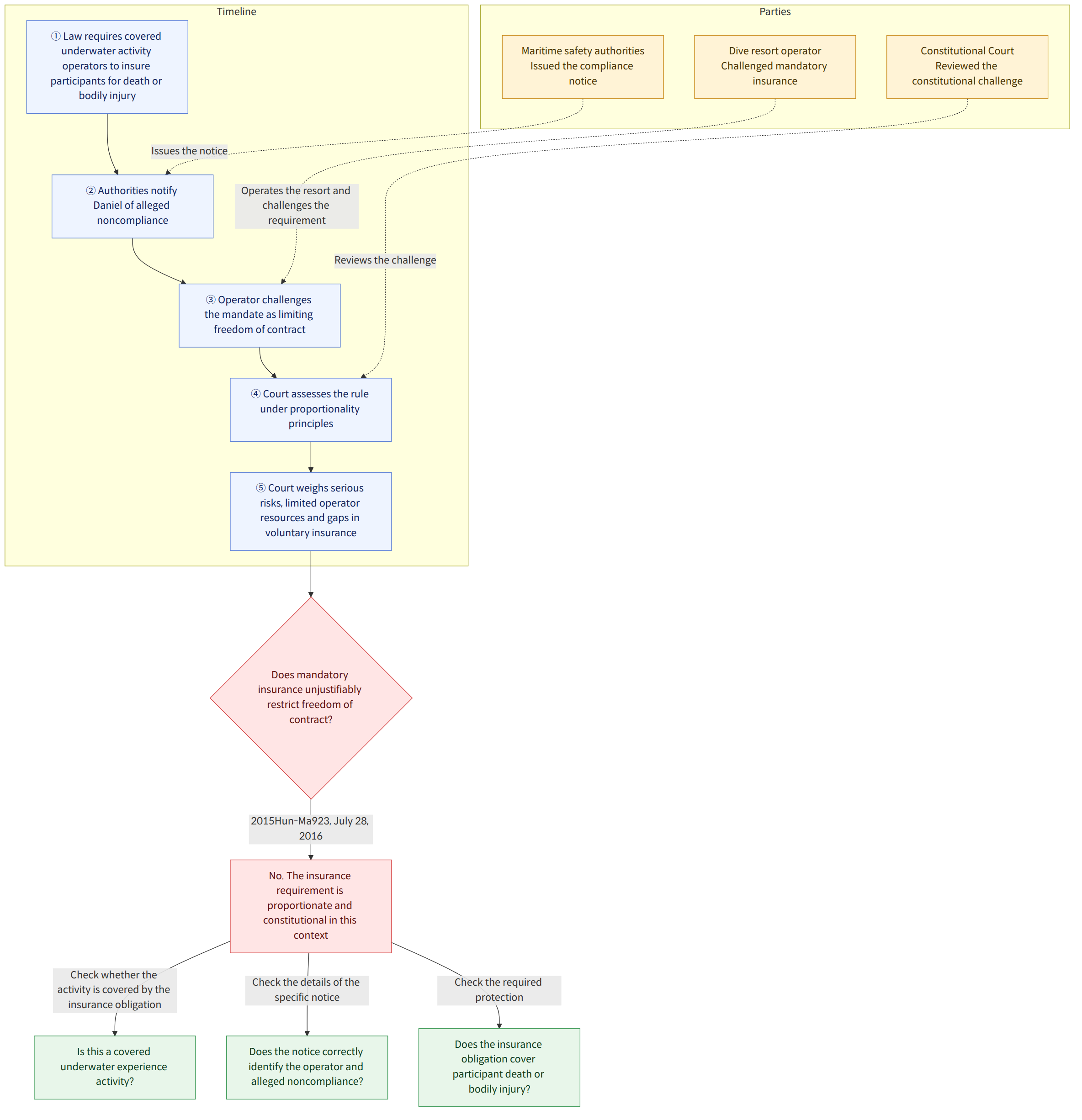
Daniel Lee had built his scuba resort on a quiet stretch of Korea’s southern coast one careful season at a time. He knew many of his customers by name, kept a close eye on the weather, and believed that a small business should be free to choose which contracts it entered into. When an official notice arrived from the maritime safety authorities saying he had failed to meet an insurance requirement, he felt that choice had been taken from him.
Daniel was not dismissing the danger of diving. He simply saw the required policy as another fixed cost in a business with thin margins, and wondered why the government could compel him to sign an insurance contract. If a customer was injured, he thought, liability should be decided under the ordinary rules—not through a policy the state required him to purchase. The notice left him with a practical question as well as a constitutional one: could he refuse to insure on the ground that the mandate violated his freedom to contract?
2. The Legal Question
Can Korea require an operator of underwater experience activities, such as a scuba-diving resort, to carry insurance for participants’ death or bodily injury without unconstitutionally infringing the operator’s freedom of contract?
3. What Korean Law Says
Korean law imposes an insurance obligation on operators of covered underwater experience activities. The purpose is to make a source of compensation available if a participant suffers death or bodily injury during an activity. The central constitutional issue is whether requiring an operator to enter an insurance contract goes too far in restricting private choice.
The Constitutional Court answered that question in a challenge to the insurance requirement. It assessed the restriction under the familiar principles of proportionality: whether the rule pursues a legitimate aim, is suited to that aim, avoids an excessive restriction, and preserves a fair balance between private and public interests.
The Court held that the insurance requirement serves the legitimate purpose of enabling prompt compensation for participants who suffer death or bodily injury. It also found the requirement suitable for that purpose because premiums paid by operators can fund compensation for victims.
The Court also considered why leaving insurance entirely to each operator’s choice could be inadequate:
- Underwater activities can lead to serious injury or loss of life when an accident occurs.
- Many operators are small businesses and may not have enough resources to compensate victims without insurance.
- If insurance is optional, some operators may decide not to buy it—whether because they underestimate the risk or for other reasons—leaving victims without a dependable source of compensation.
The constitutional balance, therefore, is not simply between an operator’s preferred business arrangement and government regulation. It weighs that restriction against the public interest in protecting people who take part in a risky activity.
4. How Korean Courts Approach This
Korean constitutional review does not treat freedom of contract as absolute. The state may regulate private contracts where it has a legitimate public purpose, but the restriction must still be proportionate to that purpose. Courts look at the seriousness of the risk, the effectiveness of the measure, whether a less restrictive approach would adequately protect the public, and the importance of the interests on both sides.
In its decision of July 28, 2016, in case 2015Hun-Ma923, the Constitutional Court applied that framework to the insurance obligation for underwater experience activity operators. It accepted that the requirement limits an operator’s freedom to decide whether to enter an insurance contract. But it concluded that the limit was justified: the activity can involve grave harm, operators may be too small to meet substantial claims on their own, and an insurance system that depends only on voluntary participation may fail to protect the very people it is intended to help.
The Court concluded that requiring insurance was a necessary and proportionate measure, and did not violate the operator’s freedom of contract.
That ruling does not mean every insurance notice is automatically correct in every detail. It does mean that the general constitutional argument—“the government cannot make me buy insurance because contracts must be voluntary”—has already been rejected in this context.
5. Applying the Law to Daniel’s Situation
Daniel’s case follows the same constitutional pattern. The authorities have told him that he must comply with an insurance obligation because he operates a scuba-diving resort. The core question is not whether the requirement limits his freedom: it plainly does. The question is whether the limit is justified under the proportionality principles the Court applied.
First, the purpose is substantial. A diving accident may cause death or serious bodily injury, and compensation matters most when a victim and family face immediate needs. Requiring insurance is directed at making funds available to meet those losses.
Second, the measure is suited to that purpose. A policy backed by premiums from operators can provide a source of payment when a covered injury occurs. It does not prevent every accident, but the aim of this rule is to address the financial consequences for participants when harm does occur.
Third, the Court considered whether voluntary insurance or another less restrictive approach would be enough. It reasoned that many operators are small, while potential injuries may be severe. If each operator could simply decide whether to participate in the insurance system, some might opt out, leaving injured participants exposed. On that reasoning, a mandatory rule is not an unnecessary intrusion merely because it requires a business expense.
Finally, the balance favors participant protection. Daniel bears the burden of entering an insurance contract and paying its premium. The public interest on the other side is protecting participants’ lives and physical well-being by supporting compensation after an accident. The Court regarded that interest as weighty enough to justify the restriction.
For Daniel, the constitutional challenge is therefore unlikely to excuse noncompliance. He should still check the notice and the rules it relies on: the required coverage, the relevant activity, and any stated steps for demonstrating compliance. The constitutional validity of the general obligation and whether a particular notice correctly applies it are separate questions.
6. Conclusion: What Happened, and What Should You Do?
Daniel’s objection does not succeed on the ground that compulsory insurance, by itself, violates freedom of contract. The Constitutional Court has upheld this kind of requirement for underwater experience operators because the risks are serious, many businesses may be unable to pay large claims, and voluntary insurance may leave victims unprotected. Daniel should treat the notice as requiring attention, verify the precise compliance terms, and arrange appropriate coverage if the obligation applies to his operation.
For operators facing a similar notice:
- Read the notice carefully and identify the legal provision, activity, coverage requirement, and any response or compliance instructions it specifies.
- Keep written records of your insurance inquiry, policy documents, and communications with the authorities.
- If you believe the notice misidentifies your activity or applies the requirement incorrectly, get the underlying documents reviewed before deciding how to respond.
If you have received a similar notice, attorney Ji-sun Ahn of Ijun Law Firm can review the notice, the documents describing your operation, and any proposed or existing policy to help you understand what the authorities are asking you to do. The key question is whether the stated insurance requirement applies to your particular activity and whether the notice accurately sets out the compliance steps.

















