

A Human Story
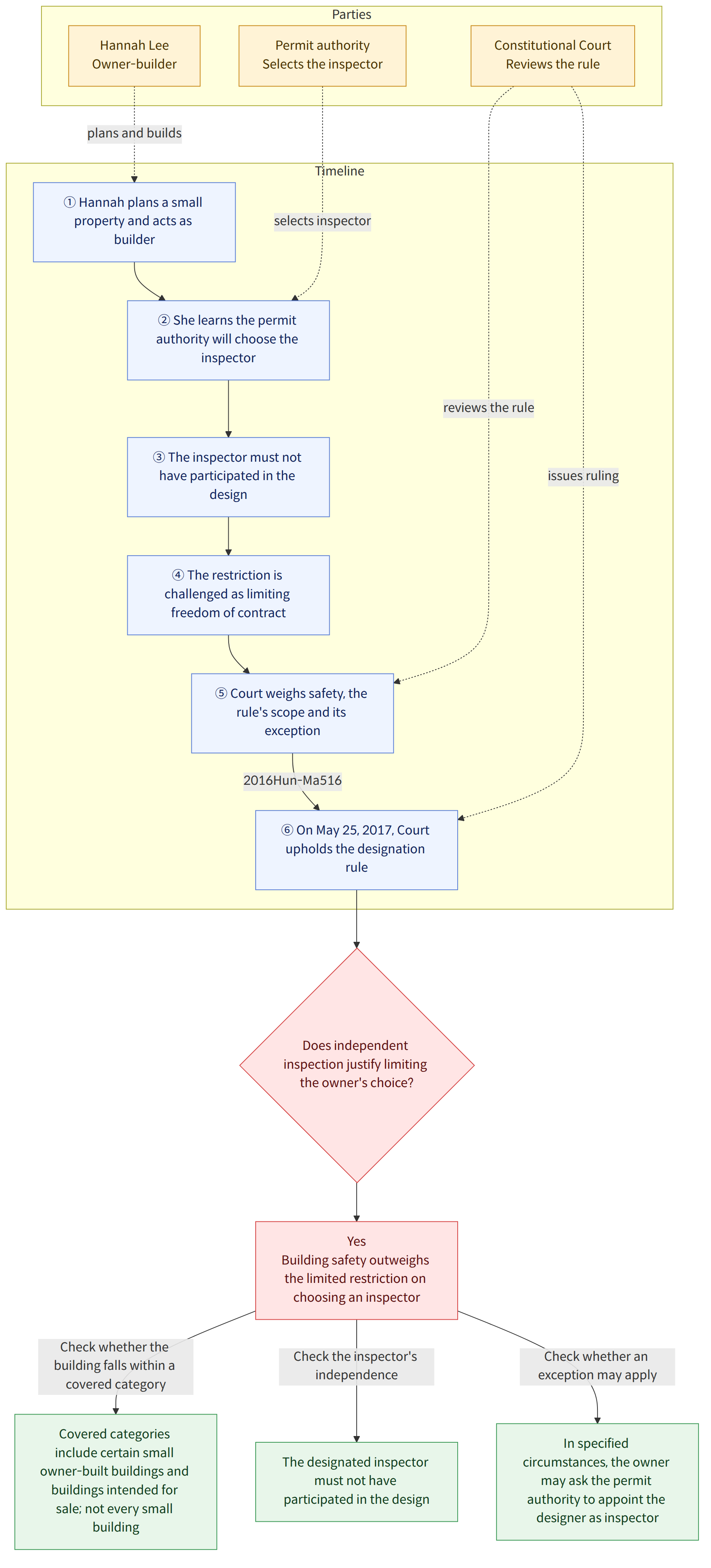
Hannah Lee had saved for years to build a modest workshop with a small apartment above it. The project was small enough for her to act as the builder herself. She had worked closely with an architect on the design and hoped to choose an inspector she trusted to understand the plans and keep the project moving.
Then Hannah learned that, for a building in her category, the permit authority would designate the construction inspector—and that person could not have participated in the design. Hannah worried that she had lost control over an important contract and wondered why she could not simply hire someone of her own choosing.
The Legal Question
Can the government require the permit authority to appoint an independent construction inspector for certain small, owner-built buildings, even though the building owner cannot choose that inspector? Or does that restriction violate the owner’s freedom of contract under the Korean Constitution?
What Korean Law Says
Korean building rules provide for permit authorities to designate a construction inspector for certain small buildings where the owner is also the builder. The designated inspector must be someone who did not take part in the building’s design. The rule is intended to make oversight independent of the person paying for and carrying out the construction.
The Constitutional Court upheld this designation rule in its decision of May 25, 2017 (2016Hun-Ma516). It reasoned that the public interest in preventing defective construction and protecting people and property justified the limited restriction on an owner’s choice of contracting partner.
The Court considered independent inspection a suitable way to prevent poor construction and protect the public, particularly where the owner is also the builder.
The Court’s reasoning can be understood through several points:
- The rule applies to specified categories, including certain small buildings built by their owners and buildings intended for sale; it does not cover every small building.
- The inspector is selected by the permit authority from people who did not participate in the design, helping separate design from inspection.
- The law allows an exception in specified circumstances under which an owner may apply to the permit authority to have the designer serve as inspector.
- The owner’s freedom is restricted, but the Court noted that owners were not free to decide whether required inspection would take place; the choice at issue was principally who would provide it.
The Court found that the serious public interest in building safety outweighed the limited impact on an owner’s freedom to choose the other party to the inspection contract.
How Korean Courts Approach This
When a constitutional challenge alleges that a regulation interferes with freedom of contract, the Court considers both the purpose of the restriction and how it operates in practice. It asks whether the rule serves a legitimate public purpose, whether the chosen method can advance that purpose, and whether the burden on individual choice is excessive in relation to the public benefit.
In the inspector-designation dispute, the Court emphasized the practical risks of leaving selection to the owner in the categories covered. Inspection may run against the economic interests of the person responsible for construction. The Court also considered that small projects can involve limited financial and technical capacity, while inspectors are not necessarily required to remain continuously at the site. In that setting, it accepted that an inspector selected independently could make oversight more meaningful.
The Court also looked at the rule’s scope and exceptions. Because the requirement did not reach every small building and allowed a route for an owner to request the designer’s appointment in specified cases, the restriction was not treated as an unlimited government takeover of private contracting.
Applying the Law to Hannah’s Project
- Hannah’s project falls within the kind of situation the rule addresses. She is building a small property and is acting as the builder. If the project is legally within the category covered by the designation provision, the permit authority may select the inspector rather than leaving that choice to her.
- The inspector’s independence is central. The appointee must not have participated in the design. That separation is intended to reduce the risk that the person checking the work will be too closely tied to the design or the owner-builder’s interests.
- The restriction concerns the choice of inspector, not the existence of oversight. Hannah may feel that choosing her own inspector would be more convenient, but the Court viewed the owner’s loss of choice as limited because the required inspection itself was not something the owner could simply opt out of.
- The safety purpose carries substantial weight. An inspection that is independent of the owner-builder may help identify deficient work and protect the people who will use the building, as well as their property. The Court regarded those public interests as significant.
- The rule is not without limits. Hannah should check whether her building actually falls within the specified category and whether the law’s exception for requesting the designer applies to her circumstances. The ruling does not mean that the permit authority can appoint an inspector for every small building without regard to the statutory conditions.
If you are unsure whether a designation notice applies to your building or whether an exception is relevant, you could ask attorney Ji-sun Ahn of Ijun Law Firm to review the notice together with your permit and design documents and help clarify what questions they raise under the rule.
Conclusion: What Happened, and What Should You Do?
Hannah could not defeat the designation rule simply by arguing that she should be free to choose every party to her construction contracts. The Constitutional Court held that the rule does not violate freedom of contract: independent oversight for certain owner-built small buildings is a proportionate way to pursue the important goals of preventing defective construction and protecting life, safety, and property. Her next step is to confirm that her project is covered and whether she can use an exception; if it is covered and no exception applies, the permit authority’s designation stands.
For anyone facing a similar situation:
- Read the designation notice and confirm which category of building it says applies to your project.
- Check the relevant project documents and ask the permit authority whether an exception may be available in your circumstances.
- Keep copies of the design, permit documents, and communications about the inspector’s appointment so the basis for the decision is clear.

















