

1. A Human Story
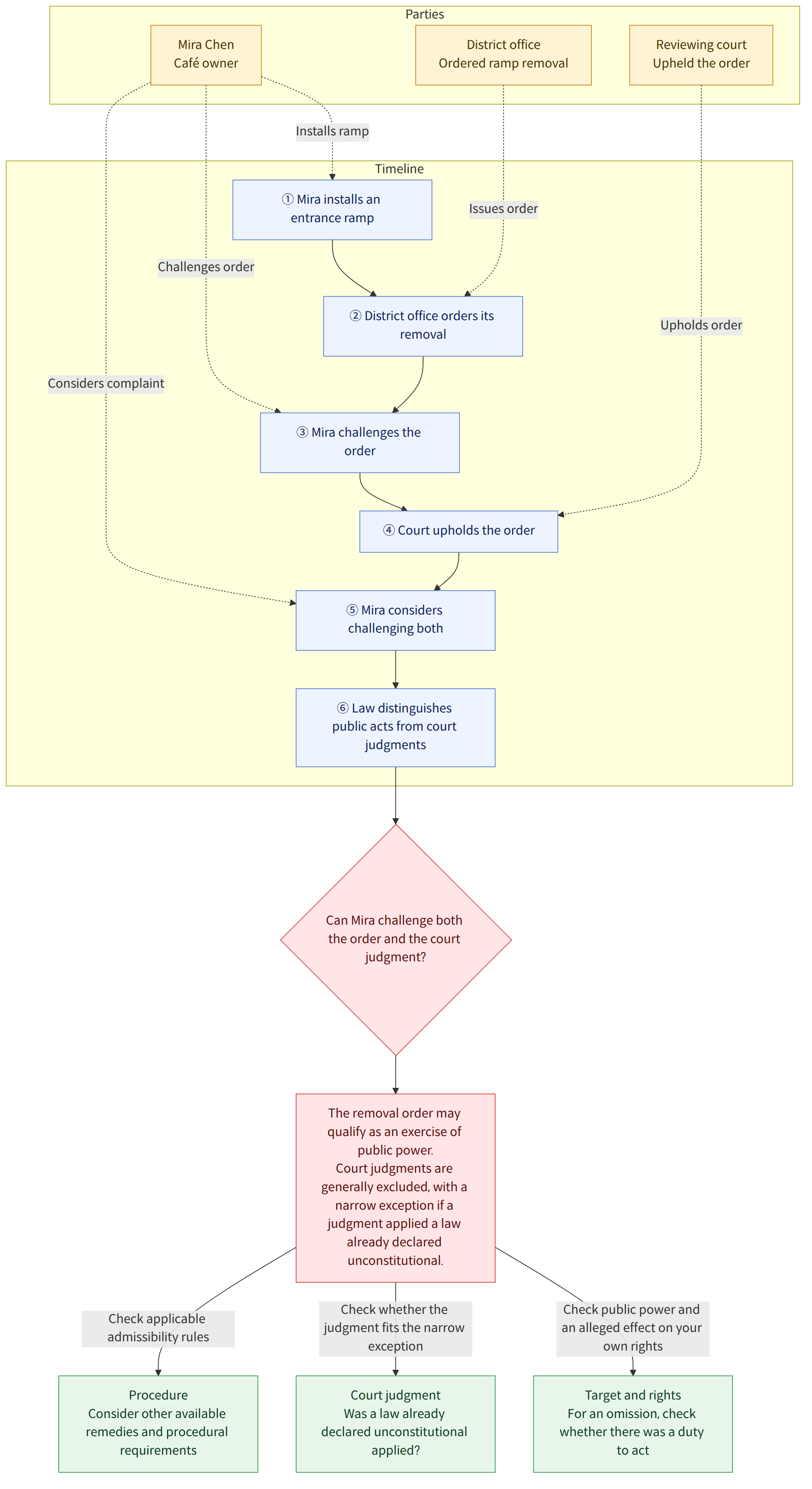
When Mira Chen opened her small café in Seoul, she wanted its entrance to be accessible to everyone. She arranged for a short wheelchair ramp to be installed at the doorway. Months later, the district office ordered her to remove it, saying the structure encroached on the sidewalk. Mira believed the order treated accessibility as an afterthought and left some of her customers unable to enter safely.
Mira challenged the order through the courts. The court upheld the district office’s decision, relying on the applicable rules. Still convinced that her rights had been overlooked, she considered filing a constitutional complaint. She wanted to challenge both the district’s order and the court judgment that had left it in place.
2. The Legal Question
What can a person challenge in a Korean constitutional complaint: a government authority’s order or failure to act, a court’s judgment, or both? The answer turns on whether the challenged conduct is an exercise of public power—and on the special rule that generally excludes ordinary court judgments.
3. What Korean Law Says
A constitutional complaint can concern the exercise or non-exercise of public power. Public power is the authority the state or a local government uses to impose obligations or compel compliance under law. It can appear in legislation, administrative decisions, or other acts by public institutions.
In general, a constitutional complaint may target an act of public authority that infringes a person’s fundamental rights, as well as a failure to act where a public authority had a duty to do so.
That means both action and inaction can matter. A binding order requiring someone to remove a structure is an example of an affirmative government act. A failure to perform a legally required protective duty may, in suitable circumstances, be an omission. Mere dissatisfaction with what an authority did—or did not do—is not enough: the complaint must concern public power and an alleged infringement of the complainant’s own fundamental rights.
The key distinction is between an official act and a court’s decision about that act:
- Government and local-government acts: A statute, administrative order, or other exercise of public authority may be a potential target.
- Government inaction: An omission may be a potential target when the authority had a duty to act and its failure is alleged to infringe a fundamental right.
- Court judgments: Korean law generally excludes court judgments themselves from constitutional complaints.
- Narrow exception: A complaint may be available against a judgment that applied a law the Constitutional Court had already declared unconstitutional.
A constitutional complaint is not ordinarily a further appeal from a court judgment. The exception for a judgment applying a law already declared unconstitutional is narrow.
Even where the type of act is eligible in principle, that does not automatically make a complaint admissible. The complainant may need to show a direct effect on their fundamental rights and satisfy other procedural requirements. Where another legal remedy is available, the general rule is that it must be used first, subject to the rules and exceptions that apply to the particular route.
4. How Korean Courts Approach This
The Constitutional Court generally asks first what conduct is actually being challenged. A decision by a public authority to impose a legal obligation is different from a court judgment reviewing that decision. A complaint that is, in substance, an attempt to overturn an ordinary court ruling cannot usually avoid the exclusion simply by describing the ruling as a rights violation.
The Court also distinguishes a legally meaningful omission from simple inaction. The complaint must point to a public authority’s duty to act, not merely argue that the authority could have made a different choice. And the alleged conduct must connect to the complainant’s own fundamental rights.
The central questions are whether the challenged conduct is an exercise or non-exercise of public power, whether it allegedly infringes the complainant’s fundamental rights, and whether the complaint is aimed at a court judgment that the law excludes.
These are questions about the complaint’s proper target and admissibility. They do not decide whether the underlying government action was constitutionally justified. That requires a separate assessment of the facts, the applicable law, and the rights at stake.
5. Applying the Law to Mira’s Case
Mira’s case contains two distinct targets, and they should not be blurred together.
- The district office’s removal order is an exercise of public power. It is a government decision imposing a concrete obligation on Mira. It may therefore qualify as the kind of act that can be challenged in a constitutional complaint if she can also establish the required connection to her fundamental rights and meet the applicable procedural conditions.
- The court judgment is a different matter. Mira is unhappy that the court upheld the order, but a constitutional complaint is generally not a way to appeal that judgment. On the facts given, the narrow exception does not appear to apply: the judgment relied on rules that had not previously been declared unconstitutional by the Constitutional Court.
- The order’s eligibility does not settle whether Mira’s complaint can proceed. She would need to consider whether another remedy was available and whether she used it as required, along with any other applicable filing conditions. Her claim would also need to explain how the order itself—not simply the court’s conclusion—allegedly infringed her fundamental rights.
- The merits remain a separate question. Whether the district acted lawfully or violated Mira’s rights would depend on the relevant rules and evidence, including the location and design of the ramp and the reasons given for the order. Identifying a possible constitutional-complaint target does not guarantee that the complaint will succeed.
For Mira, the legally important distinction is therefore clear: she cannot ordinarily ask the Constitutional Court to reverse the judgment simply because she disagrees with it. The district office’s order is the more plausible target as an act of public power, but whether a complaint about that order is procedurally available—and whether it has merit—requires separate review.
6. Conclusion: What Happened, and What Should You Do?
Mira’s effort to challenge both decisions runs into a firm boundary. The Constitutional Court is not generally another appellate court for disputes she has already litigated. The district office’s order may be a potential target because it imposed a legal obligation; the judgment upholding it is ordinarily excluded, unless the narrow exception for a judgment applying a law already declared unconstitutional applies. On the facts described, Mira’s next step is to assess the order itself and the procedural history, not to treat a constitutional complaint as a second appeal.
If you face a similar situation:
- Keep the government order, notice, and any written explanation of the authority’s decision.
- Preserve the records of any appeal or court proceedings, and distinguish carefully between challenging the original government act and challenging the court’s judgment.
- Before filing, check whether another remedy must be used first and whether any filing requirements or time limits apply to your situation.
If you are weighing a constitutional complaint, a lawyer can review the government order, the reasons given for it, and any court judgment or appeal records to help distinguish the challenged public act from a judgment that is generally excluded. You could ask attorney Ji-sun Ahn of Ijun Law Firm to review those documents and explain what procedural questions they raise.

















