

1. A Human Story
When Grace Park received a notice from her city prohibiting a peaceful outdoor gathering she had organized, the reason seemed both official and deeply personal. The city relied on a public-order rule, but Grace believed the restriction unfairly silenced her group and violated her freedom of assembly.
She searched for a way to challenge what the government had done and found the words “constitutional complaint.” The prospect sounded direct: if a public authority had violated a constitutional right, surely she could ask the Constitutional Court to intervene. But Grace soon discovered that this remedy has distinct routes and procedural limits—and that filing too soon could prevent the court from reaching the heart of her claim.
2. The Legal Question
When may someone in Korea ask the Constitutional Court to remedy an alleged violation of a constitutional right by a public authority, and must that person first pursue other legal remedies?
3. What Korean Law Says
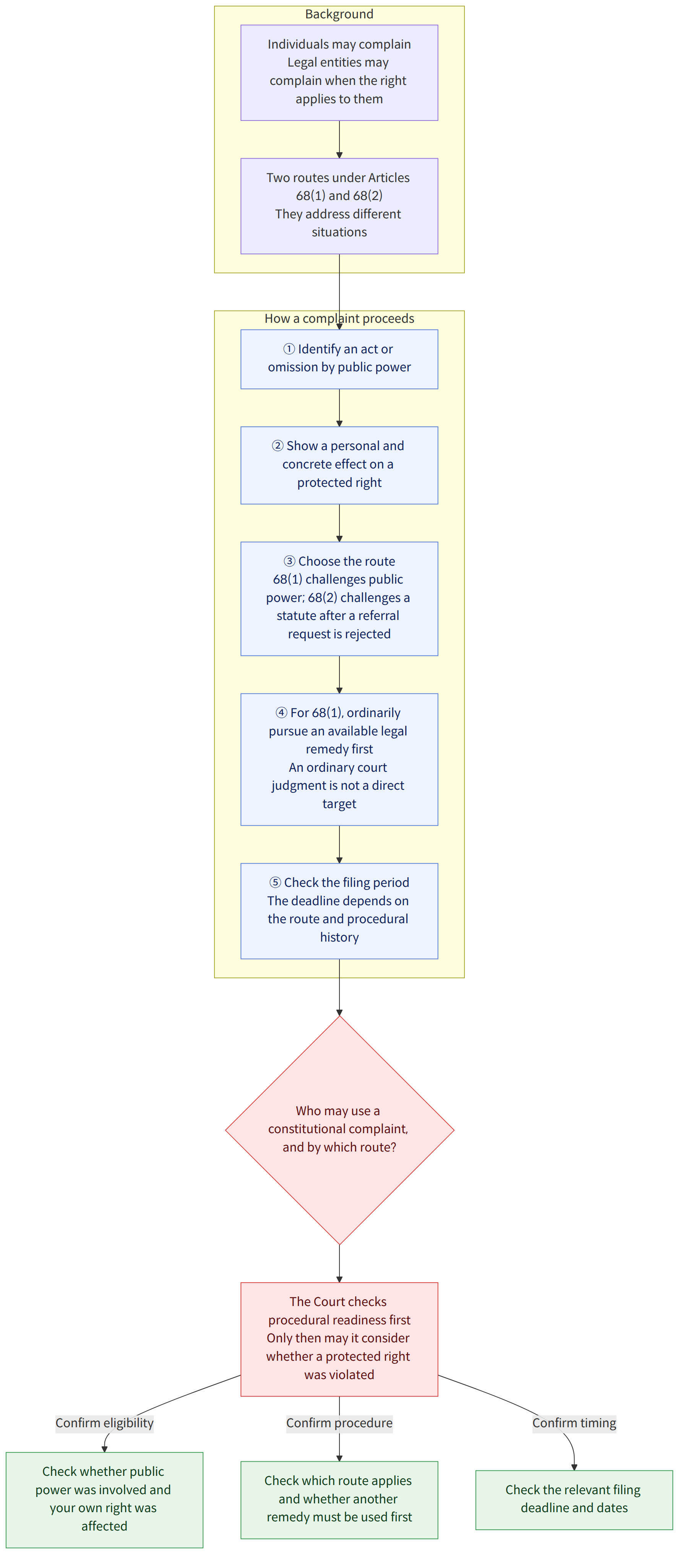
A constitutional complaint is a procedure for asking the Constitutional Court of Korea to protect a fundamental right allegedly infringed by the exercise—or failure to exercise—public power. Individuals may bring a complaint, and legal entities may do so as well where the right at issue can apply to them.
The Constitutional Court Act provides two principal routes, under Articles 68(1) and 68(2). They address different situations.
Article 68(1), in plain terms: A person whose constitutionally protected basic right is harmed by an exercise or non-exercise of public power may seek constitutional review, but an ordinary court judgment is generally excluded as the direct target. If another law provides a remedy, that remedy must ordinarily be pursued first.
For a complaint under Article 68(1), the key points are:
- The alleged harm must come from an act or omission by a public authority, not merely from a private disagreement.
- The complainant must identify a constitutional right that has been affected in a personal and concrete way.
- If another legal procedure can address the complaint, the person generally must complete that procedure before applying to the Constitutional Court.
- A constitutional complaint is not an additional appeal against an ordinary court’s decision.
Article 68(2) is different. It may apply when a person involved in a court case asks the ordinary court to refer a statute to the Constitutional Court for constitutional review, and the ordinary court rejects that request. The person may then bring a constitutional complaint challenging the statute. This is a route focused on the law itself, not simply a way to appeal the government’s original decision.
Important: Filing periods apply, and the applicable deadline depends on the route and procedural history. Under Article 68(1), the general rules include time limits linked to when the person learned of the alleged violation and when it occurred; if other remedies are pursued, a separate period runs after the final decision. Article 68(2) also has a specific filing period after the court rejects the referral request. The relevant dates should be checked carefully rather than assumed.
4. How Korean Courts Approach This
The Constitutional Court generally examines whether a complaint is legally ready for review before deciding whether a fundamental right was actually violated. That distinction matters: a complaint can fail because the procedure was not followed, even if the person has a serious grievance.
In practical terms, the Court asks whether the applicant is personally affected, whether the challenged conduct is attributable to public power, and whether the complaint follows the correct statutory route. For an Article 68(1) complaint, the exhaustion requirement means that an available legal remedy normally must be used first. The exclusion of ordinary court judgments also means that a person cannot simply recast dissatisfaction with a court ruling as a constitutional complaint.
If the complaint passes these procedural questions, the Court can then consider the constitutional merits. A complaint does not succeed merely because a government decision is burdensome or unpopular; the applicant must show that a protected right has been infringed in the circumstances. Conversely, an authority’s use of an official procedure does not, by itself, place its actions beyond constitutional scrutiny.
5. Applying the Law to Grace's Case
Grace’s first question is whether the city’s prohibition was an exercise of public power. Because the city issued an official notice restricting her planned gathering, the decision appears to be government action rather than a private dispute.
Next, she must connect that action to a right of her own. Grace organized the gathering and was directly affected by the prohibition, so her claim is not merely an objection on behalf of the public at large. She would still need to explain how the restriction affected her constitutionally protected freedom of assembly and support the account with the notice and other relevant records.
The most important procedural issue is what legal remedies were available. If she could challenge the city’s decision through an administrative procedure or a court case, an Article 68(1) complaint would generally be premature until she had pursued the required remedy. The Constitutional Court is not ordinarily the first stop for challenging an administrative decision, nor can Grace use this route simply to ask the Constitutional Court to overturn a later ordinary court judgment.
Article 68(2) would not automatically solve that problem. It could become relevant if the dispute turned on the constitutionality of the statute behind the city’s decision and, in the course of a court case, Grace asked the ordinary court to refer that statute to the Constitutional Court but the court refused. That is a separate procedural path with its own requirements and deadline.
Finally, Grace must track the dates. The date she received the prohibition, the dates and results of any administrative or court proceedings, and the date of any final decision may all affect whether a later complaint is timely. Her first filing cannot safely be treated as preserving every possible deadline.
A review of the city’s prohibition notice, any administrative appeal papers, court decisions, and the timeline could help clarify which route is available and whether a filing period may be running; [[lawyer]] can review those documents without assuming that a constitutional complaint is the right remedy.
6. Conclusion: What Happened, and What Should You Do?
In this fictional case, Grace filed an Article 68(1) complaint as soon as she received the city’s notice. Because she had not yet pursued an available legal remedy, the Constitutional Court did not reach the substance of her freedom-of-assembly claim. Her first complaint therefore failed as a procedural matter; it did not establish that the city’s restriction was constitutional or that her underlying concern lacked merit.
Grace’s next step was to pursue the remedy available against the city’s decision, while keeping careful records and checking the deadlines that would apply afterward. If the dispute later depended on the constitutionality of the statute and an ordinary court refused a request for referral, she could assess whether Article 68(2) offered a separate route. The story’s lesson is not that every government restriction can be overturned, but that the correct procedure can determine whether the Constitutional Court ever considers the claim.
For readers facing a similar situation:
- Keep the government notice, the legal basis it cites, and records of when you received it.
- Check whether an administrative or court remedy is available, and follow the required steps before relying on an Article 68(1) complaint.
- Track every relevant date and obtain advice on the correct route and filing period before submitting a constitutional complaint.
A review of the city’s prohibition notice, any administrative appeal papers, court decisions, and the timeline could help clarify which route is available and whether a filing period may be running; attorney Ji-sun Ahn of Ijun Law Firm can review those documents without assuming that a constitutional complaint is the right remedy.

















