

1. A Human Story
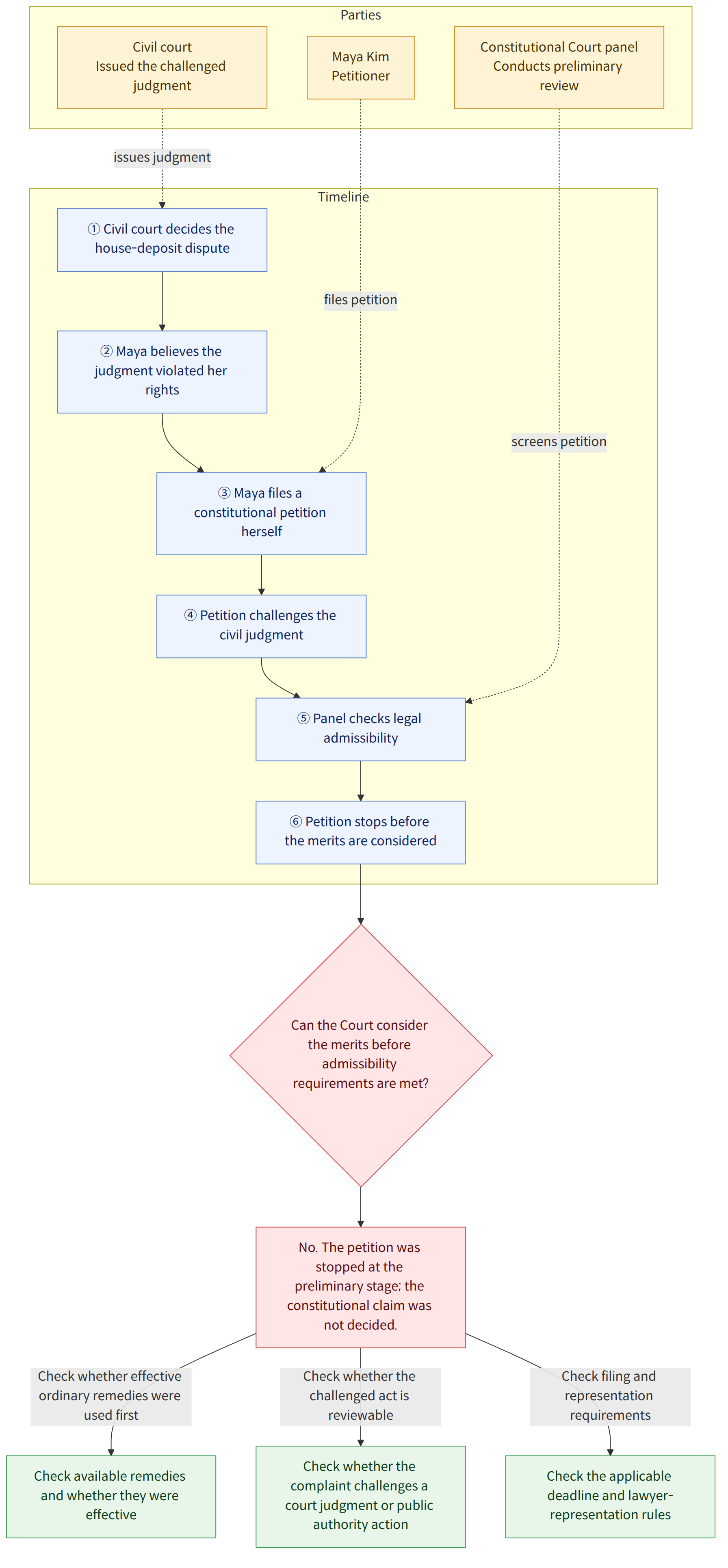
When Maya Kim opened the envelope containing the civil court’s decision, she read it twice. The dispute was about a house-deposit payment, but to Maya it was also about whether the legal system had taken her rights seriously. She believed the judge had misunderstood the facts and dismissed her constitutional arguments.
A friend told her that the Constitutional Court could protect constitutional rights. Maya downloaded a petition form, wrote that the civil judgment violated her rights, and sent it herself. Weeks later, she received a short decision from the Court. The judges had not weighed whether her constitutional argument was persuasive. They had concluded that her petition could not proceed in the form she had filed.
2. The Legal Question
Maya’s experience raises a basic question: What happens after a constitutional complaint is filed, and what must a petitioner satisfy before the Constitutional Court will consider the substance of the claim?
3. What Korean Law Says
A constitutional complaint does not move straight from the filing counter to a full hearing. It first goes to a designated panel for a preliminary review. At this stage, the panel asks whether the petition is legally admissible—not whether the petitioner is right about the underlying dispute.
The preliminary review screens for procedural defects, including failure to meet the requirement to use available remedies, a complaint against a court judgment, a missed filing period, and lack of required lawyer representation. A petition that is inadmissible may be dismissed before the full bench considers its merits.
The main points are:
- Use other available remedies first. The rule of subsidiarity generally requires a person to pursue an effective legal remedy through the ordinary system before asking the Constitutional Court to intervene. Whether a remedy was available or effective can depend on the circumstances.
- Identify a reviewable act or omission. As a general rule, a constitutional complaint is not a route for appealing an ordinary court’s judgment. A complaint aimed at a public authority’s action or failure to act raises a different question, and must still meet the other requirements.
- File within the applicable period. Constitutional complaint deadlines are strict. The relevant period and the point from which it runs depend on the type of complaint and the procedural history, so a person should not assume that time spent preparing a petition is harmless.
- Meet the representation requirement. Lawyer representation is generally required. A person who cannot afford counsel should promptly ask about the applicable court-appointed counsel process and its eligibility requirements.
- Understand the 30-day rule. If the designated panel has not dismissed the petition within 30 days of filing, the petition is treated as having been referred to the full bench. That procedural effect is not a ruling that the claim is valid.
At the final stage, the Court may dismiss a petition as inadmissible, reject it because the claim is unfounded, or uphold it by finding the challenged exercise of public power unconstitutional.
Those outcomes are different. Dismissal means the case fails a procedural or admissibility requirement. Rejection means the Court has considered the claim but finds it does not justify relief. Upholding means the Court accepts the constitutional challenge.
4. How Korean Courts Approach This
Korean constitutional review is designed to protect constitutional rights, but it is not a second, general-purpose appeal system. The preliminary screen helps ensure that the Constitutional Court addresses disputes that fall within its role and have been brought through the proper channel.
That is why a petitioner’s sincere belief that a judge made a serious mistake does not, by itself, make the judgment open to a constitutional complaint. The Court distinguishes between challenging a public authority’s exercise of power and asking it to review an ordinary court’s decision. The latter is generally excluded, subject to the applicable legal framework.
The screening stage also matters because different problems call for different outcomes. A defect that makes a petition inadmissible can end the case without a decision on the constitutional argument. If the petition passes the preliminary review—or is treated as referred after 30 days—the full bench may still decide that the claim is unfounded. Referral is a doorway to consideration, not a promise of success.
5. Applying the Law to Maya’s Case
Maya’s petition faced two immediate obstacles.
- She challenged the civil judgment itself. Her complaint focused on what the judge had decided and why she believed the ruling was wrong. It did not identify a separate act or omission by a public authority that could properly be reviewed through a constitutional complaint. A constitutional petition cannot ordinarily be used to obtain another appeal of a court’s judgment.
- She filed without a lawyer. The lawyer-representation requirement is a separate procedural concern. Even a petitioner with a serious constitutional argument must take that requirement into account and check whether an available counsel process applies.
The designated panel’s task was therefore not to decide whether Maya deserved the deposit or whether her constitutional interpretation was persuasive. It was to determine whether her petition could pass the legal threshold for review. On the facts of this fictional case, the panel dismissed it at the preliminary stage. That outcome did not establish that Maya’s underlying argument was wrong on its merits; it meant the Constitutional Court would not decide that argument through this petition.
For anyone considering a similar filing, the documents that matter include the civil judgment, the petition as submitted, and the Court’s notice or decision. A review of those materials can help clarify what was challenged and which procedural requirements may have been missed. A lawyer can review those documents with you, without any guarantee that a further filing or other step will succeed.
6. Conclusion: What Happened, and What Should You Do?
Maya’s constitutional complaint ended before the full bench considered her claim. Because she directed it at an ordinary court judgment and filed without the required legal representation, the designated panel dismissed the petition at the admissibility stage. Her story illustrates a central point: constitutional rights matter, but the route for asking the Court to protect them matters too.
If you are considering a constitutional complaint:
- Identify precisely what public act or omission you are challenging. Do not assume that disagreement with a court judgment can be reframed as a constitutional complaint.
- Check the procedural history and filing period promptly. Gather the relevant decisions and notices, and confirm whether other remedies had to be used first.
- Address representation before filing. Ask about the lawyer requirement and any applicable court-appointed counsel process, and keep copies of every document you submit or receive.
If you are weighing a constitutional complaint, you could ask attorney Ji-sun Ahn of Ijun Law Firm to review the judgment, the petition you filed or plan to file, and any notice from the Constitutional Court to identify the procedural issue those documents raise.

















