
A Human Story
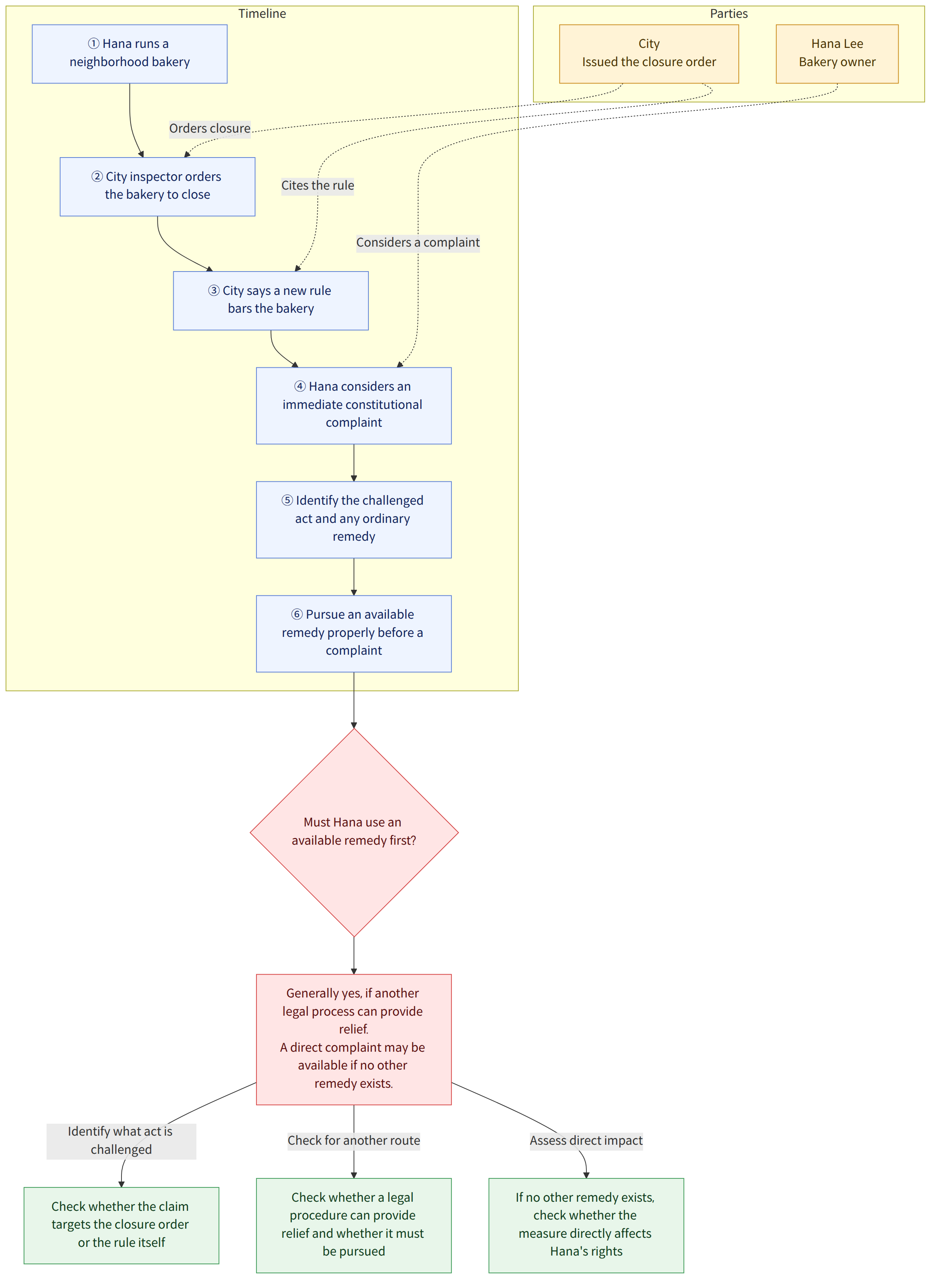
Hana Lee had spent years turning a narrow storefront into a neighborhood bakery. Then a city inspector delivered an order requiring her to close. The city said a new rule barred bakeries like hers from operating in that part of the district. Hana believed the rule unfairly threatened her livelihood and her right to work.
That evening, she searched for a way to challenge the rule and found a powerful-sounding option: a constitutional complaint. She wanted to ask the Constitutional Court to step in immediately. But the city’s closure order was an official decision—and Korean law may provide a route through the ordinary courts to contest it first.
The Legal Question
Must Hana first use the legal procedures available to challenge the closure order, or can she immediately ask the Constitutional Court to review the rule as a violation of her fundamental rights? The answer turns on subsidiarity: the principle that a constitutional complaint is generally a remedy of last resort.
What Korean Law Says
A constitutional complaint can protect fundamental rights from public power. But it is not normally a substitute for procedures that the law already provides. If another legal process can offer relief, a person generally must use that process properly before bringing a constitutional complaint.
Subsidiarity means that a constitutional complaint is ordinarily available only after other legally available remedies have been exhausted.
The most familiar alternative is a court proceeding. If a government agency issues an order that a person can challenge in court, that route will generally have to be pursued first. Korean law also generally excludes challenges to court judgments themselves from the constitutional-complaint process. The complaint is not simply another appeal from a decision the person dislikes.
The practical questions are usually these:
- What public act allegedly infringed the right? It might be an administrative order, a law that directly affects someone, or another exercise of public authority.
- Does the law provide another way to seek relief? This may include challenging an agency decision through the courts or using another procedure established by law.
- Can that procedure actually address the claimed infringement? If it can, it generally must be pursued properly before a constitutional complaint.
- If no other remedy is available, does the challenged measure affect the person directly? In some circumstances, a law itself may directly affect a person’s rights without an intervening decision that can be challenged in court.
Where no other legal remedy is available, a constitutional complaint may serve as the direct route for protecting rights. Where another remedy exists, the constitutional complaint is generally a backstop, not a shortcut.
This requirement does not make constitutional complaints unimportant. It helps define their role: they can address rights violations that ordinary procedures cannot effectively remedy, including certain direct effects of laws or exercises of public authority.
How Korean Courts Approach This
Korean courts and the Constitutional Court generally look at the substance of the dispute, not just the label a person gives it. A person cannot avoid an available legal process by describing an administrative dispute as a constitutional one. If a court can review the challenged government action and provide relief, the person will ordinarily be expected to use that route first.
At the same time, the rule does not mean that every dispute must pass through a court before a constitutional complaint is possible. If the law itself directly affects someone’s rights and there is no separate procedure through which a court can provide relief, a direct constitutional complaint may be available. The same can be true where no other legal remedy has been provided.
The key is therefore to identify the precise act being challenged and the remedies attached to it. A complaint aimed at an agency’s order is not necessarily the same as one aimed directly at a statute. And a constitutional complaint is generally not a means to challenge the court’s own judgment after a case has been decided.
Applying the Law to Hana’s Case
Hana’s immediate problem is not an abstract concern about a new rule. The city has issued a closure order against her bakery. That makes the order—and the legal procedure for challenging it—the starting point.
- Identify the challenged act. The closure order is a specific act by a public authority. Hana should distinguish a challenge to that order from a challenge to the rule on which the city says it relies.
- Check for an ordinary remedy. If Korean law gives her a way to challenge the order in court, that process is generally the first step. A constitutional complaint filed immediately could be rejected because she did not use an available remedy.
- Use the available procedure properly. Hana should examine the order and the applicable procedural rules to determine how to contest it. The existence and details of any remedy depend on the particular decision and governing law.
- Reassess the constitutional route afterward. If she has pursued the available remedy and still alleges that the original public action violated her rights, she can seek advice about whether a constitutional complaint is available and whether its requirements are met. She should not assume that this permits her to challenge a court judgment itself.
For Hana, the important point is that urgency and legal sequence are not the same thing. Her concern may be serious, but filing in the wrong forum or skipping an available process can create a separate obstacle before the substance of her rights claim is considered.
A review of the closure order, the regulation it cites, and any appeal or court filings could help clarify which public act is being challenged and whether another remedy must come first. You could ask attorney Ji-sun Ahn of Ijun Law Firm to review those documents and explain the procedural options that may apply.
Conclusion: What Happened, and What Should You Do?
Hana did not file a constitutional complaint as her first move. She reviewed the city’s order and learned that a court procedure was available to challenge it. She began with that route, preserving the possibility of later constitutional review if the legal requirements were met. Her claim about the rule’s fairness was not decided simply by choosing the Constitutional Court; first, she had to follow the remedy Korean law provided for the order.
If you face a similar government action, keep these practical points in mind:
- Keep the decision and related paperwork. The exact wording of an order, notice, or refusal can determine what is being challenged and what procedures may be available.
- Check the remedy before choosing a forum. Find out whether a court or another legally established process can address the alleged rights violation; do not assume a constitutional complaint is an immediate alternative appeal.
- Get the documents reviewed promptly. A review of the government decision, the rule it cites, and any steps already taken can help clarify whether another remedy must come first or whether a direct constitutional complaint may be considered.

















