

A Human Story
Hannah Lee has spent nearly four decades teaching children in an elementary-school classroom. As she approaches 62, she begins sorting lesson plans and student notes, knowing that the law will soon require her to leave her post.
At a family gathering, Hannah hears that Daniel Cho, a university professor she once met at a teacher-training seminar, expects to continue working until 65. The contrast feels personal: both are public educators, yet one must retire sooner. Hannah wonders whether the difference violates her constitutional right to equality.
The Legal Question
Does setting a retirement age of 62 for elementary, middle, and high school education public officials—but 65 for university faculty—unconstitutionally discriminate against schoolteachers?
What Korean Law Says
The provision at the center of this dispute, Article 47(1) of the Educational Public Officials Act, sets a general retirement age for education public officials and a higher age for university faculty covered by the Higher Education Act.
“The retirement age of education public officials shall be 62. However, the retirement age of education public officials who are faculty members under Article 14 of the Higher Education Act shall be 65.”
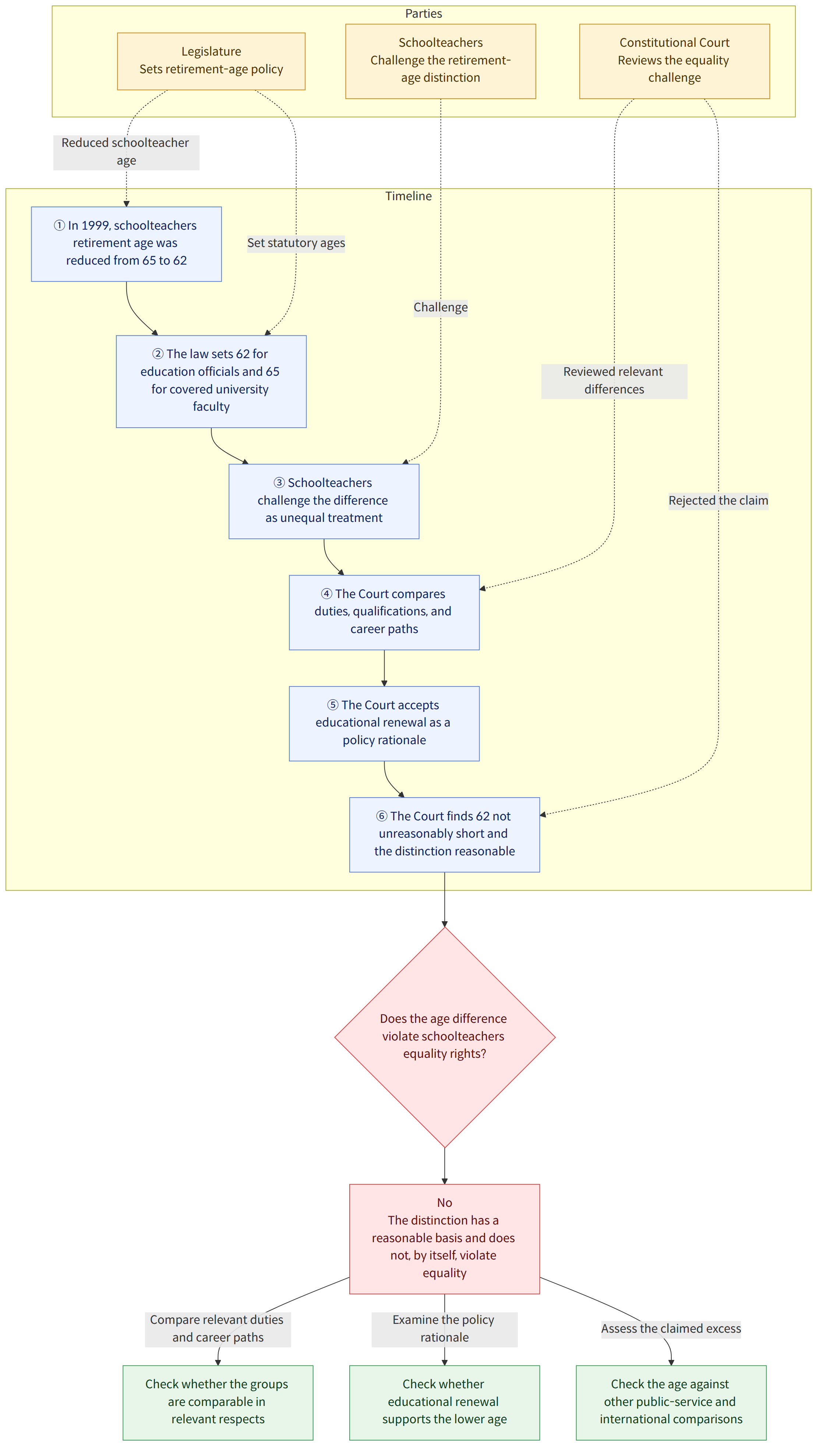
The legislature reduced the retirement age for elementary and secondary school teachers from 65 to 62 in 1999. The constitutional question is not simply whether the two groups are treated differently; it is whether there is a reasonable basis for that difference.
In the ruling that considered this challenge, the Constitutional Court reasoned that the legislature may make policy choices about retirement ages, provided those choices remain within constitutional limits. It accepted that the educational setting and public-policy goals could support the reduction for schoolteachers.
The Court also considered why the law might distinguish university faculty from schoolteachers:
- Their duties and working environments differ: schoolteachers focus on elementary and secondary education, while university faculty undertake higher education and research.
- Their qualification, appointment, and promotion pathways are not the same.
- University faculty may begin their careers at an older age, which can support a later retirement age.
How Korean Courts Approach This
Korean constitutional review does not treat every difference in the law as unconstitutional discrimination. The key question is whether the distinction has a rational basis connected to the purposes the legislature was pursuing.
A difference in treatment may be constitutionally permissible when the groups are not alike in relevant respects and the distinction rests on reasonable grounds.
In reviewing the schoolteachers’ retirement age, the Constitutional Court gave weight to the legislature’s assessment of the country’s educational conditions and its aim of encouraging renewal in the teaching profession. It concluded that setting the schoolteachers’ retirement age at 62 was not unreasonably short when compared with other public-service retirement ages or with retirement systems abroad.
The Court likewise found a reasonable basis for setting university faculty’s retirement age three years higher, given differences in their roles and career paths. It therefore rejected the claim that the distinction, by itself, violated schoolteachers’ equality rights. That ruling remains an important guide unless circumstances change sufficiently to warrant a different constitutional assessment.
Applying the Law to the Case
Hannah’s concern is understandable: the rule affects when she must leave a career to which she has devoted much of her life. But the constitutional analysis proceeds in steps.
- Identify the unequal treatment. Hannah must retire at 62, while a university faculty member covered by the statutory exception may work until 65. The law plainly sets different ages.
- Ask whether the groups are comparable in the relevant ways. Both groups teach, but the Court distinguished their duties, professional qualifications, routes to appointment and promotion, and the role of research in university work.
- Consider the legislature’s stated policy reasons. The Court accepted that educational reform and renewal in elementary and secondary schools could reasonably support a lower retirement age for those teachers.
- Assess whether the difference is excessive or arbitrary. The Court concluded that 62 was not unreasonably low in light of other public-service retirement ages and international comparisons, and that the higher university age had a rational explanation.
On those principles, Hannah’s comparison with Daniel alone would probably not establish an equality violation. A different result would require more than the fact that the retirement ages are unequal; it would require a legally significant basis for concluding that the distinction has become unreasonable or that materially changed circumstances undermine the earlier reasoning.
If you are weighing a challenge, attorney Ji-sun Ahn of Ijun Law Firm could review your retirement notice, appointment records, and the specific statutory category applied to your position to help clarify how the rule affects your circumstances.
Conclusion: What Happened, and What Should You Do?
Hannah considered a constitutional challenge, but the existing Constitutional Court ruling made success unlikely on the same argument: that schoolteachers are treated unequally simply because university faculty may work three years longer. The Court regarded the groups’ different roles and career structures, together with the legislature’s education-policy judgment, as a reasonable basis for the distinction.
For teachers facing a retirement decision, practical steps include:
- Check the retirement notice and the statutory provision it relies on, including whether the job falls within the university-faculty exception.
- Keep appointment records and employment documents that establish your position, status, and expected retirement date.
- If you believe a material change in the law or circumstances affects your case, seek an individual review before deciding whether to pursue a constitutional challenge.
















