
Guide to Absence, Declarations of Disappearance, and Property Administration
Based on 17 consultation cases · Updated · Translated from the Korean original.
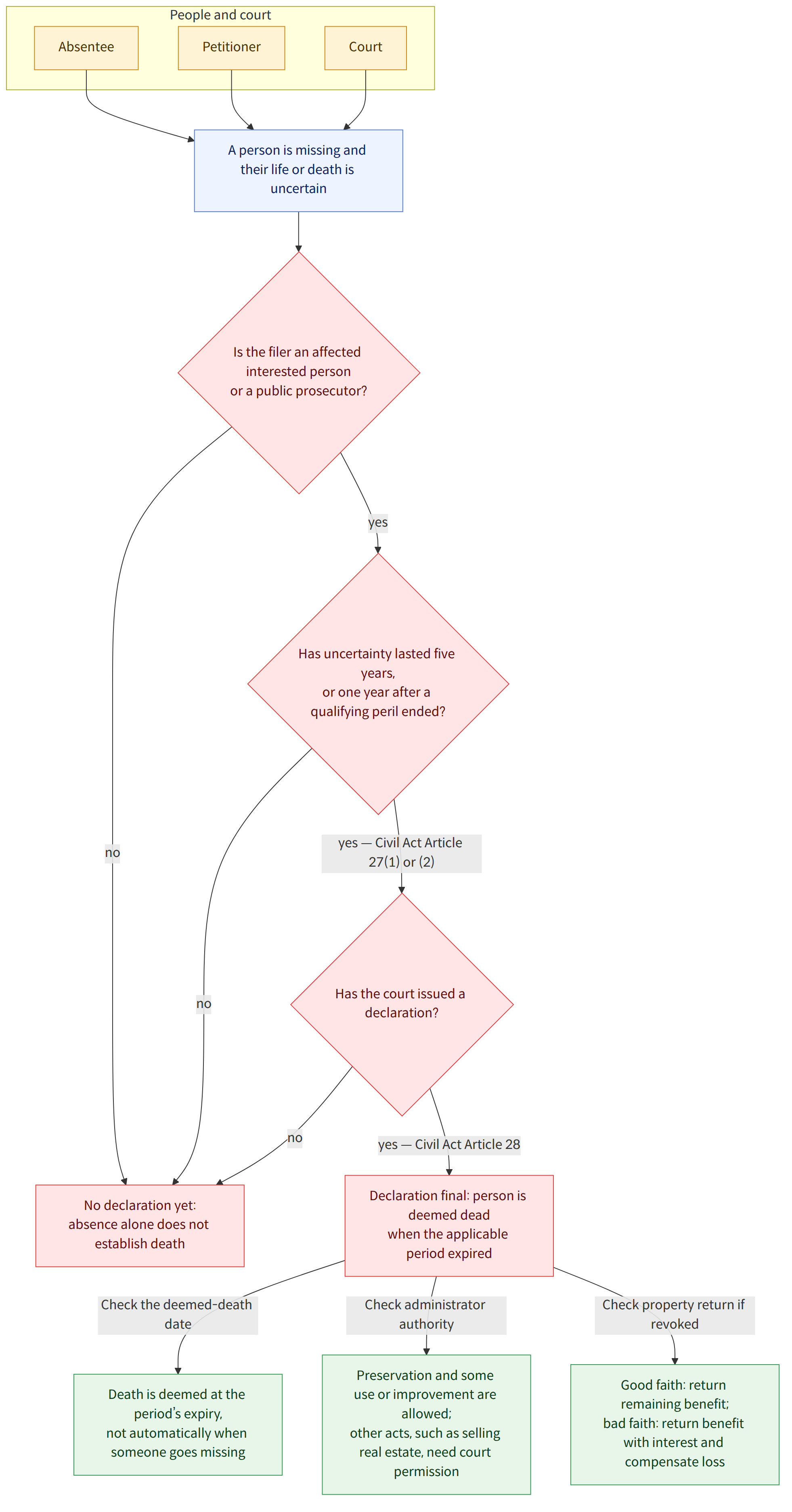
A declaration of disappearance is not automatic merely because a person’s life or death has remained uncertain for a specified period. An interested person or a public prosecutor must petition the court and obtain the declaration. Once the declaration becomes final, the person is deemed to have died at the time prescribed by law. The authority of a property administrator and the return of property after a declaration of disappearance is revoked must also be considered.
At a glance
Key points
- In general, a declaration of disappearance may be sought if an absentee’s life or death has remained uncertain for five years. The court may issue its decision after conducting public notice proceedings (Civil Act, Article 27(1) (민법 제27조 제1항)).
- A person exposed to a peril that could cause death, such as war, the sinking of a vessel, or an aircraft crash, may be eligible for a declaration of special disappearance if their life or death remains uncertain for one year after the peril ends. A peril means an external circumstance that poses a clear danger to life and creates a very high likelihood of death (Civil Act, Article 27(2) (민법 제27조 제2항); Supreme Court Order of January 31, 2011, 2010Seu165).
- A person who has been declared missing is deemed to have died when the period of disappearance expired. Even if the period for seeking a declaration has passed, the court must still issue the declaration (Civil Act, Article 28 (민법 제28조)).
- A petitioner must be an interested person who would directly acquire or be relieved of a personal or economic right or obligation as a result of the declaration, or a public prosecutor. Depending on the inheritance relationship, a daughter-in-law may qualify as an interested person, while a nephew or niece who is a lower-priority heir may not (Supreme Court Order of October 10, 1986, 86Seu20; Supreme Court Order of August 28, 2008, 2008Seu20).
- An absentee’s property administrator may perform acts of preservation and acts of use or improvement that do not alter the nature of the property. Court permission is required for acts beyond the administrator’s authority, such as selling real estate. The permission decision may apply not only to a future disposition but also to ratify retroactively a disposition already made (Civil Act, Articles 25 and 118 (민법 제25조·제118조); Supreme Court Judgment of September 29, 1983, 83Na184).
- If a property administrator agrees to apply to the court for permission for an act exceeding the administrator’s authority but fails to do so, the other party may sue to compel performance of the application procedure. Once a judgment ordering a declaration of intent becomes final, the administrator is deemed to have made the declaration of intent to apply for permission (Supreme Court Judgment of January 11, 2002, 2001Da41971; Civil Execution Act, Article 263(1) (민사집행법 제263조 제1항)).
- If a declaration of disappearance is revoked, a person who acquired property directly as a result of the declaration must return it to the extent of the benefit that remains if the person acted in good faith. If the person acted in bad faith, the benefit received must be returned with interest, and any resulting loss must be compensated (Civil Act, Article 29(2) (민법 제29조 제2항)).
- If two or more people die in the same peril, they are presumed to have died simultaneously. However, if it is established that one person died earlier, the presumption is rebutted, and the inheritance relationship may differ depending on the order of succession (Civil Act, Article 30 (민법 제30조)).
Frequently asked questions
Q. Is a family member automatically declared dead after being missing for one or five years?
No. A petition for a declaration of disappearance may be filed with the court if a person’s life or death has been uncertain for five years in an ordinary disappearance, or for one year after the end of a peril specified by law in a special disappearance. A declaration must be obtained from the court; once issued, the person is deemed to have died when the applicable period of disappearance expired.
Q. Does the one-year period for a special disappearance apply if someone went diving and then went missing?
The fact that a person disappeared after going diving does not, by itself, establish that the person was exposed to a peril qualifying as a special disappearance. Unless an external circumstance that posed a clear danger to life and created a very high likelihood of death—such as a fire, flood, or earthquake—is confirmed, the five-year period for an ordinary disappearance may apply (Supreme Court Order of January 31, 2011, 2010Seu165).
Q. Who can petition for a declaration of disappearance?
A person with an interest who would directly acquire or be relieved of a personal or economic right or obligation as a result of the declaration, or a public prosecutor, may file the petition. A daughter-in-law whose inheritance share would be directly affected may qualify as an interested person. A nephew or niece who is a lower-priority heir may not be entitled to file unless there are additional circumstances, such as the death of a higher-priority heir.
Q. Can a child receive compensation for land registered in a missing parent’s name?
If a child becomes an heir after a declaration of disappearance, the child may negotiate and receive compensation on the basis of the inheritance relationship. In the example, the child, as an interested person, is advised to petition the family court with jurisdiction over the missing person’s last address for a declaration of disappearance and to register it within the prescribed period after the decision becomes final.
Q. Does an absentee’s property administrator need court permission to sell real estate?
Selling real estate exceeds the ordinary scope of an administrator’s authority to preserve and use the absentee’s property, so court permission is required. The court may also grant permission retroactively, ratifying a disposition such as a sale that has already taken place (Civil Act, Articles 25 and 118 (민법 제25조·제118조); Supreme Court Judgment of September 29, 1983, 83Na184).
Q. What can the other party do if the property administrator does not apply for permission?
If the property administrator agreed to carry out the procedure for applying for permission but fails to do so, the other party may sue the administrator to compel performance of that procedure. Once a judgment ordering the administrator to make a declaration of intent becomes final, the administrator is deemed to have made the declaration of intent to apply for permission (Supreme Court Judgment of January 11, 2002, 2001Da41971; Civil Execution Act, Article 263(1) (민사집행법 제263조 제1항)).
Q. Must inherited property be returned if a declaration of disappearance is revoked?
A person who acquired property directly as a result of the declaration of disappearance may be required to return it. If the person acted in good faith, the property must be returned to the extent of the benefit that remains; if the person acted in bad faith, the benefit received must be returned with interest, and any resulting loss must also be compensated (Civil Act, Article 29(2) (민법 제29조 제2항)).
Q. What happens to a parentage lawsuit if a declaration of disappearance concerning the other party becomes final during the case?
If the other party is deemed to have died as a result of a declaration of disappearance, an application must be made to substitute the public prosecutor as a party to the proceedings. According to the example, the application must be made within six months from the other party’s death; if it is not made within that period, the proceedings may be terminated (Supreme Court Judgment of September 4, 2014, 2013Meu4201).
Q. Can the family relations register be closed if a declaration of disappearance is issued?
That may happen. The example identifies a declaration of disappearance or absence concerning the person as a ground for closing the family relations register.
Relevant laws
- Civil Act, Article 23 (민법 제23조)
- Civil Act, Article 24(1) (민법 제24조 제1항)
- Civil Act, Article 24(2) (민법 제24조 제2항)
- Civil Act, Article 25 (민법 제25조)
- Civil Act, Article 27(1) (민법 제27조 제1항)
- Civil Act, Article 27(2) (민법 제27조 제2항)
- Civil Act, Article 28 (민법 제28조)
- Civil Act, Article 29(1) (민법 제29조 제1항)
- Civil Act, Article 29(2) (민법 제29조 제2항)
- Civil Act, Article 30 (민법 제30조)
- Civil Act, Article 118 (민법 제118조)
- Civil Act, Article 865(2) (민법 제865조 제2항)
- Rules of Family Litigation, Article 54 (가사소송규칙 제54조)
- Family Litigation Act, Article 16(2) (가사소송법 제16조 제2항)
- Act on Registration of Family Relationships, Article 20 (가족관계의 등록 등에 관한 법률 제20조)
Watch out for
- The passage of the applicable period of disappearance does not, by itself, result in a person being declared dead. A petition must be filed and the court must issue a declaration of disappearance.
- The one-year period for a special disappearance does not apply merely because a person has gone missing. It is necessary to determine whether the person faced an external peril creating a very high likelihood of death.
- If a defendant dies during a parentage lawsuit or is deemed to have died as a result of a declaration of disappearance, an application to substitute the public prosecutor as a party to the proceedings must, according to the example, be made within six months from the date of death.
- The extent to which property must be returned after a declaration of disappearance is revoked may depend on whether the recipient acted in good or bad faith. Identify the property acquired as a result of the declaration and the benefit that remains.
Source cases
This guide was compiled by AI from the following Korea Legal Aid Corporation consultation cases (in Korean).
- 부재자 재산관리인의 권한초과행위에 대한 허가신청의 강제이행방법
- 행방불명된 부친명의의 토지수용보상금을 자녀가 수령할 수 있는지
- 친생자관계 존부 확인 소송 중 피고가 사망한 경우 어떻게 하나요?
- 실종선고 된 이후 실제 사망일자를 알게 된 경우 어떻게 해야하나요?
- 민법 제27조 제2항의 특별실종선고기간 1년이 적용되는 ‘위난’ 이란 무엇을 의미하나요?
- 시아버지가 실종된 경우 며느리도 실종선고를 청구할 수 있나요?
- 실종 선고
- 재산관리인의 권한초과행위에 대한 법원의 허가결정의 효력은 기왕의 처분행위에도 미치나요?
- 재산관리인이 있는데도 부재자에 대해서 공시송달 판결이?
- 부재자의 재산관리인에게 권한을 초과한 행위를 위해 법원의 허가신청절차를 소구할 수 있나요?
- 남편과 아들이 동시에 사망한 줄 알았는데 남편이 먼저 사망한 것이 밝혀졌을 경우 상속은 어떻게 되나요?
- 甲의 부재자 재산관리인으로 선임되었습니다. 무엇을 하여야 하는가요?
- 후순위 상속인도 실종선고의 취소를 청구할 수 있나요?
- 실종기간 만료 후 상속이 이루어졌는데 실종선고가 취소되었습니다. 저는 상속재산을 반환하여야 하나요?
- 자녀가 있는 외국인을 고용하고 있었는데 실종되었습니다. 어떻게 하여야 하나요?
- 실종 선고
- 가족관계등록부의 폐쇄
This guide is general legal information about Korean law, not legal advice for your situation. For a specific case, consult a lawyer or the Korea Legal Aid Corporation (call 132 in Korea).