
Time Limits, Procedures, and Remedies for Administrative Appeals
Based on 41 consultation cases · Updated · Translated from the Korean original.
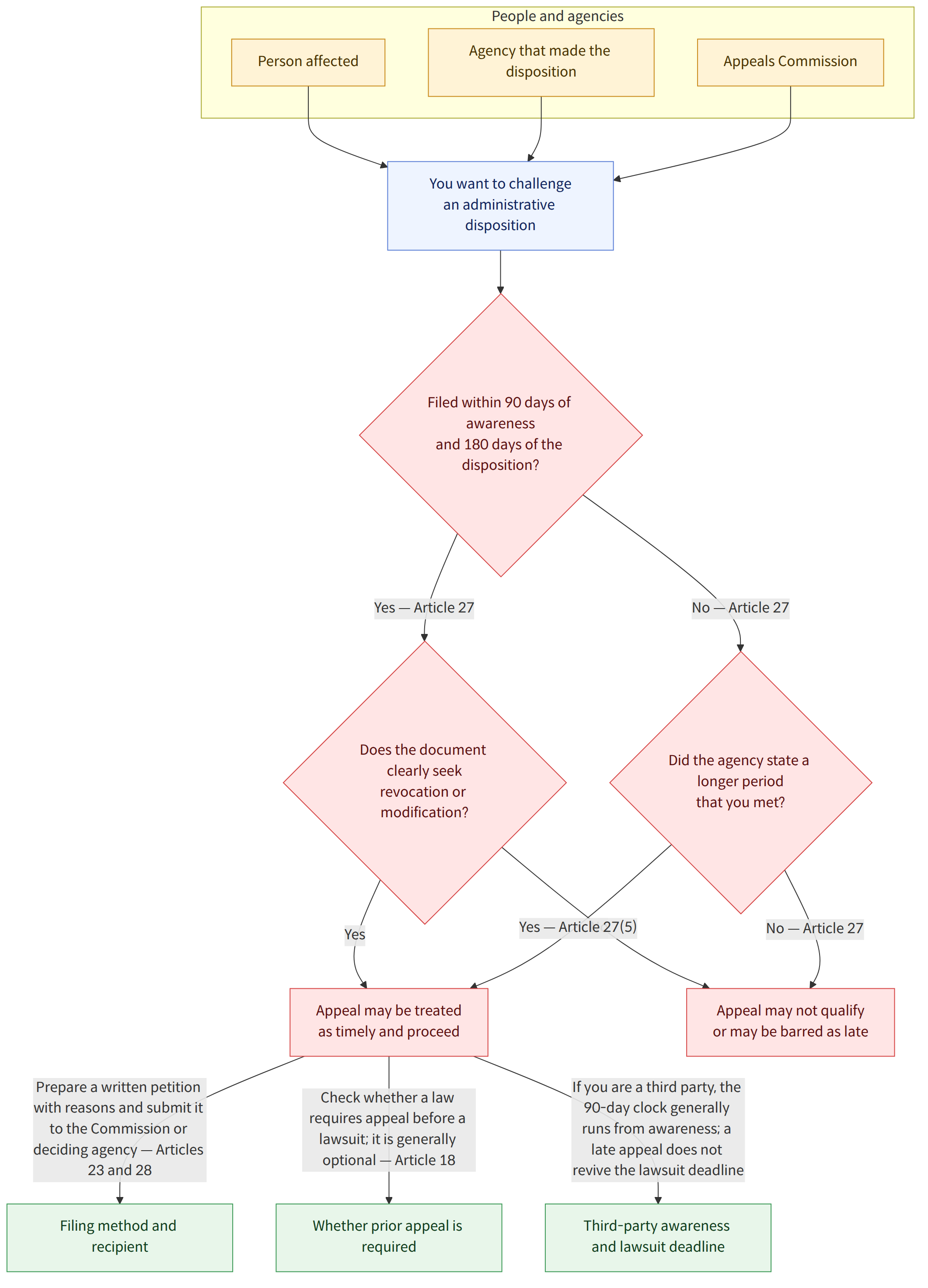
As a general rule, an administrative appeal must be filed within 90 days from the date you became aware of the disposition and within 180 days from the date the disposition was made. It is important to check in advance how to submit the petition, when an administrative appeal must be pursued, and the consequences of missing the deadline.
At a glance
Key points
- The filing periods are 90 days from the date you became aware of the disposition and 180 days from the date it was made. As a general rule, if either period has expired, you may not file an administrative appeal (Administrative Appeals Act, Article 27 (행정심판법 제27조)).
- Prepare an appeal petition and materials explaining why the disposition was unlawful or unreasonable, and submit them in writing to either the Commission or the administrative agency that made the disposition, which is the respondent (Administrative Appeals Act, Articles 23 and 28 (행정심판법 제23조, 제28조)).
- As a general rule, pursuing an administrative appeal before filing an administrative lawsuit is optional. However, where a law separately so provides, you may have to pursue the appeal procedure first (Administrative Litigation Act, Article 18 (행정소송법 제18조)).
- If you file an administrative appeal after the deadline and it is dismissed, filing a lawsuit within 90 days of receiving the decision on the appeal does not revive the time limit for suing over the original disposition (Examples 4 and 13).
- A third party who is not the addressee of a disposition may have difficulty learning of it immediately, but must generally file within 90 days from the time they became aware of it (Administrative Appeals Act, Article 27 (행정심판법 제27조); Supreme Court Decision of May 24, 2002, 2000Du3641).
- If an administrative agency incorrectly states a period longer than the statutory period, an administrative appeal filed within the incorrectly stated period may be treated as timely. This rule, however, concerns the time limit for filing an administrative appeals petition (Administrative Appeals Act, Article 27(5) (행정심판법 제27조 제5항)).
- A document may be construed as an administrative appeal petition if it makes clear that the person seeks revocation or modification of the disposition; the document’s title and the agency to which it was submitted are not, by themselves, determinative (Supreme Court Decision of June 1, 2007, 2005Du11500).
- A decision granting an appeal binds the administrative agency and related administrative agencies, but it does not have the same res judicata effect as a court judgment (Administrative Appeals Act, Article 49 (행정심판법 제49조); Supreme Court Decision of November 27, 2015, 2013Da6759).
Frequently asked questions
Q. By when must I file an administrative appeal?
As a general rule, you must file within 90 days from the date you became aware of the disposition and within 180 days from the date the disposition was made. Exceptions may be recognized where filing was prevented by force majeure, such as a natural disaster, or where there was a justifiable reason for not filing within 180 days after the disposition.
Q. Where and how do I file an administrative appeal?
Prepare a written administrative appeal petition and materials explaining why the disposition was unlawful or unreasonable, and submit them in writing either to the Appeals Commission or to the administrative agency that made the disposition (the respondent). As a general rule, once the respondent agency receives the petition or has it forwarded to it, it must send it to the Commission within 10 days.
Q. Do I have to pursue an administrative appeal before filing an administrative lawsuit?
As a general rule, you may file a lawsuit directly without first pursuing an administrative appeal. However, some laws separately require a prior procedure, such as an administrative appeal, so you should check which procedure applies to the type of disposition involved.
Q. If my administrative appeal is dismissed because I filed it late, can I file a lawsuit after receiving the decision?
Even if your administrative appeal was dismissed because it was filed late, filing a lawsuit to revoke the original disposition within 90 days of receiving the decision on the appeal does not mean that you met the deadline. If you choose to pursue an administrative appeal, you must generally file it first within 90 days from the date you became aware of the disposition.
Q. Can a third party who is not the addressee of a disposition file an administrative appeal?
A third party may also challenge a disposition if it infringes that party’s legally protected interests. Even if it was difficult to learn of the disposition immediately, as a general rule you must file within 90 days from the time you became aware, or could easily have become aware, that the disposition had been made.
Q. If an administrative agency incorrectly tells me that the filing period is longer, may I file within the stated period?
If an administrative agency incorrectly informs you that the filing period is longer than the statutory period, an appeal filed within the incorrectly stated period is treated as having been filed within the statutory period. However, this rule applies to the time limit for administrative appeals; it does not extend the time limit for filing an administrative lawsuit.
Q. Can a document be recognized as an administrative appeal petition even if it is titled “Objection” or “Request to Revoke a Disposition”?
The outcome is not determined by the document’s title alone. If the document makes clear that you are seeking revocation or modification of a disposition, and explains why, it may be construed as an administrative appeal petition. Likewise, even where an objection procedure is required, a submitted document may be treated as an objection if its contents satisfy the requirements for one.
Q. Is the period during which a disposition’s effect is suspended excluded from the time limit for filing an administrative appeal?
The court decision discussed in the example rejected the argument that the period during which the disposition’s effect was suspended should be excluded from the filing period. It is therefore safest not to assume that the filing period is extended merely because the disposition’s effect was suspended.
Q. Can an administrative agency issue a new disposition after it has been revoked in an administrative appeal?
An administrative agency may issue a new disposition after correcting or supplementing the grounds for illegality, provided that it does not conflict with the decision on the appeal. Whether the new disposition merely repeats the same outcome in the same circumstances may be at issue, so you should check the contents of the new disposition.
Relevant laws
- Administrative Appeals Act, Article 3 (행정심판법 제3조)
- Administrative Appeals Act, Article 5 (행정심판법 제5조)
- Administrative Appeals Act, Article 23 (행정심판법 제23조)
- Administrative Appeals Act, Article 24 (행정심판법 제24조)
- Administrative Appeals Act, Article 27 (행정심판법 제27조)
- Administrative Appeals Act, Article 28 (행정심판법 제28조)
- Administrative Appeals Act, Article 49 (행정심판법 제49조)
- Administrative Appeals Act, Article 58 (행정심판법 제58조)
- Administrative Litigation Act, Article 2 (행정소송법 제2조)
- Administrative Litigation Act, Article 18 (행정소송법 제18조)
- Administrative Litigation Act, Article 20 (행정소송법 제20조)
- Framework Act on National Taxes, Article 56 (국세기본법 제56조)
- Customs Act, Article 120 (관세법 제120조)
- State Public Officials Act, Article 16 (국가공무원법 제16조)
- Local Public Officials Act, Article 20-2 (지방공무원법 제20조의2)
Watch out for
- The 90-day and 180-day periods must be checked separately. If you file an administrative appeal after the deadline, the time limit for suing over the original disposition may not begin anew.
- An administrative agency’s failure to give notice or its incorrect guidance does not extend every deadline for challenging a decision. Check what was communicated and distinguish between the applicable procedures.
- A court decision is discussed holding that a period during which the disposition’s effect was suspended is not excluded from the time limit for filing an administrative appeal.
- Some matters, such as dispositions involving public officials, may be subject to appeal, review, or other procedures and deadlines that differ from those for ordinary administrative appeals.
Source cases
This guide was compiled by AI from the following Korea Legal Aid Corporation consultation cases (in Korean).
- 행정심판의 청구기간 및 청구절차는 어떻게 되는지
- 행정소송을 제기하기 전에 행정심판을 꼭 거쳐야 하는지
- 공무원의 직위해제처분에 대한 불복절차
- 행정심판 제기기간의 기산점
- 행정심판청구의 적법 여부 및 행정심판 제기 없이 그 취소소송을 제기할 수 있는지 여부
- 감액경정처분의 행정심판의 대상은 무엇인지
- 취소소송 제기기간 도과 후에 행정청이 행정심판청구를 할 수 있다고 잘못 알렸다면 취소소송 가능한지
- 재조사결정에 따른 심판청구기간 기산점
- 학교폭력대책자치위원회의 회의록을 공개하라는 정보공개청구를 할 수 있는지 여부
- 학교폭력 자치위원회가 개최된다는 사실이 가해 학생과 그 부모에게 하루 전에 통지가 이루어진 경우
- 제3자효를 수반하는 행정행위 인용재결의 항고소송의 대상이 되는지 여부
- 이의신청을 제기해야 하는데 ‘행정심판청구서’를 제출한 경우 선해되는지
- 취소소송 제기기간 도과 이후 행정심판 청구하고 취소소송 제기 가능한지
- 재결의 기속력
- 제3자효 행정행위에 대한 행정심판의 청구기간
- 행정심판 재결의 법률적 판단에 법원이 기속되는지
- 제3자의 행정심판청구기간은 어떠한지
- 대통령의 처분에 대하여도 행정심판을 청구할 수 있는지
- 재결의 기속력
- 재결고유의 위법 여부
- 행정청이 심판청구 기간을 잘못 알린 경우 심판청구가능한지
- 재결청이 국민정서를 근거로 원처분을 취소할 수 있는지
- 행정절차상의 하자와 구제방안
- 취지가 불명확한 행정심판청구서를 제출해도 행정심판으로 선해되는지
- 행정처분 효력 정지 기간은 행정심판 청구기간에서 공제되는지
This guide is general legal information about Korean law, not legal advice for your situation. For a specific case, consult a lawyer or the Korea Legal Aid Corporation (call 132 in Korea).