
Essential Guide to Adoption, Termination, and Full Adoption
Based on 38 consultation cases · Updated · Translated from the Korean original.
Adoption creates a legal relationship different from that of a biological parent and child. The intent to adopt, the statutory requirements, and the actual caregiving relationship matter more than form alone. Full adoption has different effects from ordinary adoption, including the general termination of kinship with the biological parents. To end an adoption, the procedures prescribed by law, such as rescission or judicial dissolution, must be followed.
At a glance
Key points
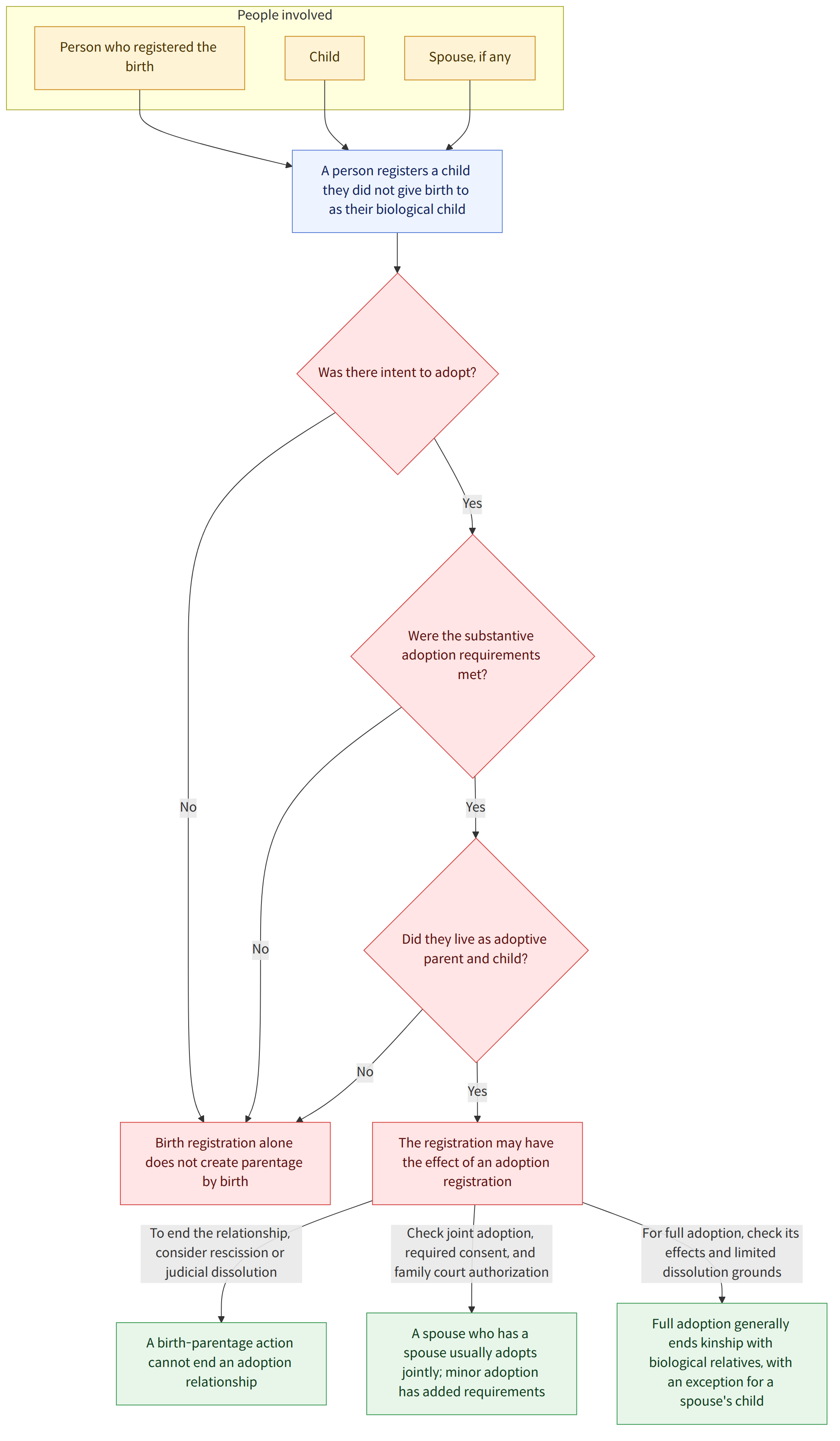
- Registering the birth of a child whom a person did not actually give birth to as if the child were that person’s biological child does not create a parent-child relationship by birth. However, if there is an intent to adopt, the substantive requirements for adoption are met, and the parties live as adoptive parent and child, the birth registration may have the effect of an adoption registration (Supreme Court Decision 93Meu119, May 24, 1994, and others).
- If a false birth registration has the effect of an adoption, an action to confirm the absence of a parent-child relationship by birth cannot be used to end the adoptive parent-child relationship. The applicable procedure, such as rescission of the adoption or its termination by judicial dissolution, should be considered (Civil Act, Articles 776 and 897 (민법 제776조, 제897조); Cases 11 and 25).
- As a rule, a person who has a spouse must adopt jointly with that spouse. Even if an adoption is made without the other spouse’s consent, its effect between each spouse and the adopted child may be determined separately (Civil Act, Article 874 (민법 제874조); Case 15).
- For the adoption of a minor, consent or approval is required depending on the minor’s age, and the adoption is subject to authorization by the family court. However, even where the legal representative has not consented, approval may be presumed in light of the specific circumstances, or a statutory exception may apply (Civil Act, Articles 867, 869, and 908-2 (민법 제867조, 제869조, 제908조의2); Cases 10 and 22).
- Once the judgment granting a full adoption becomes final, the child acquires the same status as a child born during the adoptive parents’ marriage and takes their surname and family origin. Kinship with the biological parents and their blood relatives generally ends, except where a spouse’s biological child is adopted as a full child by the other spouse alone (Civil Act, Article 908-3).
- An ordinary adoption does not end merely because the adoptive parents divorce. Kinship created by adoption ends through rescission of the adoption or its termination by judicial dissolution (Civil Act, Article 776 (민법 제776조); Supreme Court en banc Decision 2000Meu1493, May 24, 2001).
- The grounds for judicial dissolution differ between an ordinary adoption and a full adoption. Judicial dissolution of a full adoption may be sought only on the limited grounds prescribed by law (Civil Act, Articles 905 and 908-5).
- The fact that a child who has already been adopted is subsequently adopted by someone else does not, by itself, terminate the existing adoptive parent-child relationship by judicial dissolution (Supreme Court Decision 2012Meu806, July 24, 2014).
Frequently asked questions
Q. Will adoption be recognized if I register an adopted child’s birth as if the child were my biological child?
A parent-child relationship by birth is not created merely by filing a birth registration. However, if there is an intent to create a parent-child relationship by adoption, the substantive requirements for adoption are met, and an actual relationship in daily life, such as raising the child, accompanies it, the registration may have the effect of an adoption registration.
Q. Can an adoptive parent-child relationship created by a false birth registration be ended through an action to confirm the absence of a parent-child relationship by birth?
If the birth registration has the effect of an adoption, in principle the adoptive parent-child relationship cannot be ended through an action to confirm the absence of a parent-child relationship by birth. You should consider whether there are grounds and procedures for rescinding the adoption or terminating it by judicial dissolution.
Q. Is an adoption made without a spouse’s knowledge effective between that spouse and the child as well?
As a rule, spouses must adopt jointly, and one spouse’s intention alone may not create an adoption relationship between the other spouse and the child. An adoption relationship may separately take effect between the adopting spouse and the child, and there are also cases in which the other spouse may seek to have the adoption rescinded.
Q. Does the relationship between an adoptive mother and an adopted child end if the adoptive parents divorce?
Divorce alone does not end an adoptive parent-child relationship. Kinship created by adoption ends through rescission of the adoption or its termination by judicial dissolution. Accordingly, the relationship between each divorced adoptive parent and the adopted child must be considered separately.
Q. What is the difference between an ordinary adoption and a full adoption?
Once the judgment granting a full adoption becomes final, the child acquires the same status as a child born during the adoptive parents’ marriage and takes their surname and family origin. Unlike an ordinary adoption, kinship with the biological parents and their blood relatives generally ends, subject to an exception where a spouse’s biological child is adopted as a full child by the other spouse alone.
Q. Can a full adoption proceed if the biological parents do not consent?
In principle, the biological parents’ consent is required. However, a family court may authorize the adoption without consent if a biological parent refuses consent without a justifiable reason, fails to perform the duty to support the child for certain reasons, or seriously harms the child’s welfare by abusing or abandoning the child, among other circumstances.
Q. Can grandparents adopt their grandchildren as full children?
A full adoption of a grandchild by a grandparent may cause confusion in family relationships and order, and may be found not to serve the child’s welfare in the long term. In the case described, the court reached a negative conclusion on the full adoption based on these circumstances.
Q. Can an adoption of a minor be terminated by agreement?
Under the Civil Act provisions explained in the case, an adoption cannot be terminated by agreement if the adopted child is a minor or an adult under guardianship; a petition for judicial dissolution must be filed instead. The grounds for judicial dissolution differ between ordinary adoption and full adoption, so the type of adoption and the specific grounds must be checked.
Q. Is parental authority automatically restored to the biological parents when an adoption is rescinded?
Rescinding an adoption does not automatically restore parental authority to the biological parents. A petition may be filed with the family court, within the prescribed period, to have the biological parents designated as holders of parental authority.
Relevant laws
- Civil Act, Article 776 (민법 제776조)
- Civil Act, Article 781, Paragraph 4 (민법 제781조 제4항)
- Civil Act, Article 809, Paragraph 1 (민법 제809조 제1항)
- Civil Act, Article 867 (민법 제867조)
- Civil Act, Article 869 (민법 제869조)
- Civil Act, Article 874 (민법 제874조)
- Civil Act, Article 878 (민법 제878조)
- Civil Act, Article 881 (민법 제881조)
- Civil Act, Article 883 (민법 제883조)
- Civil Act, Article 884 (민법 제884조)
- Civil Act, Article 897 (민법 제897조)
- Civil Act, Article 898 (민법 제898조)
- Civil Act, Article 905 (민법 제905조)
- Civil Act, Article 908 (민법 제908조)
- Civil Act, Article 908-2 (민법 제908조의2)
Watch out for
- Whether a birth registration has the effect of an adoption registration is not determined by the intent to adopt alone. The substantive requirements for adoption and the specific circumstances of daily life, including the raising of the child, are considered together.
- Rescission of an adoption and its termination by judicial dissolution have different grounds and effects. In particular, the case explains that rescission of an adoption does not have retroactive effect, and an adoption cannot be rescinded through an action to confirm the absence of a parent-child relationship by birth.
- Full adoption differs from ordinary adoption in its effects on the relationship with the biological parents and in the requirements for judicial dissolution. The rules for ordinary adoption should therefore not be applied as if they were the same.
- The case sets out time limits for seeking rescission or judicial dissolution. The date from which the period runs and the applicable time limit may differ depending on the grounds, so the relevant grounds and the law currently in force should be checked.
Source cases
This guide was compiled by AI from the following Korea Legal Aid Corporation consultation cases (in Korean).
- 실제로는 입양한 아이를 친생자로 출생신고 한 경우의 효력
- 이성양자(異姓養子)의 성(姓)을 양친의 성으로 변경할 수 있는지
- 혼인 외의 자(子)를 생모와 그 배우자가 입양하는 경우
- 부모를 알 수 없는 기아(棄兒)를 양자로 하는 경우
- 양친자관계존부확인의 소의 가능여부
- 양부모 중 일방이 사망한 경우 생존하는 다른 일방이 사망한 일방과 양자 사이의 양친자관계의 해소를 구할 수 있는지
- 조부모가 손자녀를 친양자로 입양할 수 있는지
- 양자로 입양된 후 다시 다른 부부에게 친양자로 입양되기 위한 요건
- 민법 개정 전 동성애자의 입양 효력
- 미성년자 입양에 있어서의 대락 추정
- 친생자로 출생신고 한 양자에 대한 ‘친생자관계부존재확인청구’ 여부
- 친생자 아닌 자를 자신과 내연관계에 있는 남자의 혼외자로 출생신고 한 것이 유효한지
- 이혼으로 양부의 가를 떠난 양모와 양자관계의 소멸 여부
- 무효인 입양이 묵시적 추인에 의하여 유효한 것으로 될 수 있는지
- 부부 공동의사에 의하지 않은 입양
- 부부공동입양 원칙과 파양
- 친양자 입양의 경우 재판상 파양의 가능여부
- 국가대표 선수로 선발시키기 위해 외국 국적의 미성년자를 대한민국 국민이 입양할 수 있는지
- 친양자 제도의 특징
- 입양의 취소와 친권자 지정
- 입양의 취소
- 친양자로 하려는 사람의 법정대리인이 친양자 입양에 동의하지 않는 경우 친양자 입양을 할 수 없는지
- 중복 입양된 경우 이전의 양친자관계가 파양으로 소멸하는지
- 파양의 요건과 절차
- 친생자가 양자를 상대로 입양을 취소하려는 취지로 친생자관계부존재확인을 구할 수 있는지
This guide is general legal information about Korean law, not legal advice for your situation. For a specific case, consult a lawyer or the Korea Legal Aid Corporation (call 132 in Korea).