
How Should You Respond to Arrest, Detention, Release, and Bail?
Based on 44 consultation cases · Updated · Translated from the Korean original.
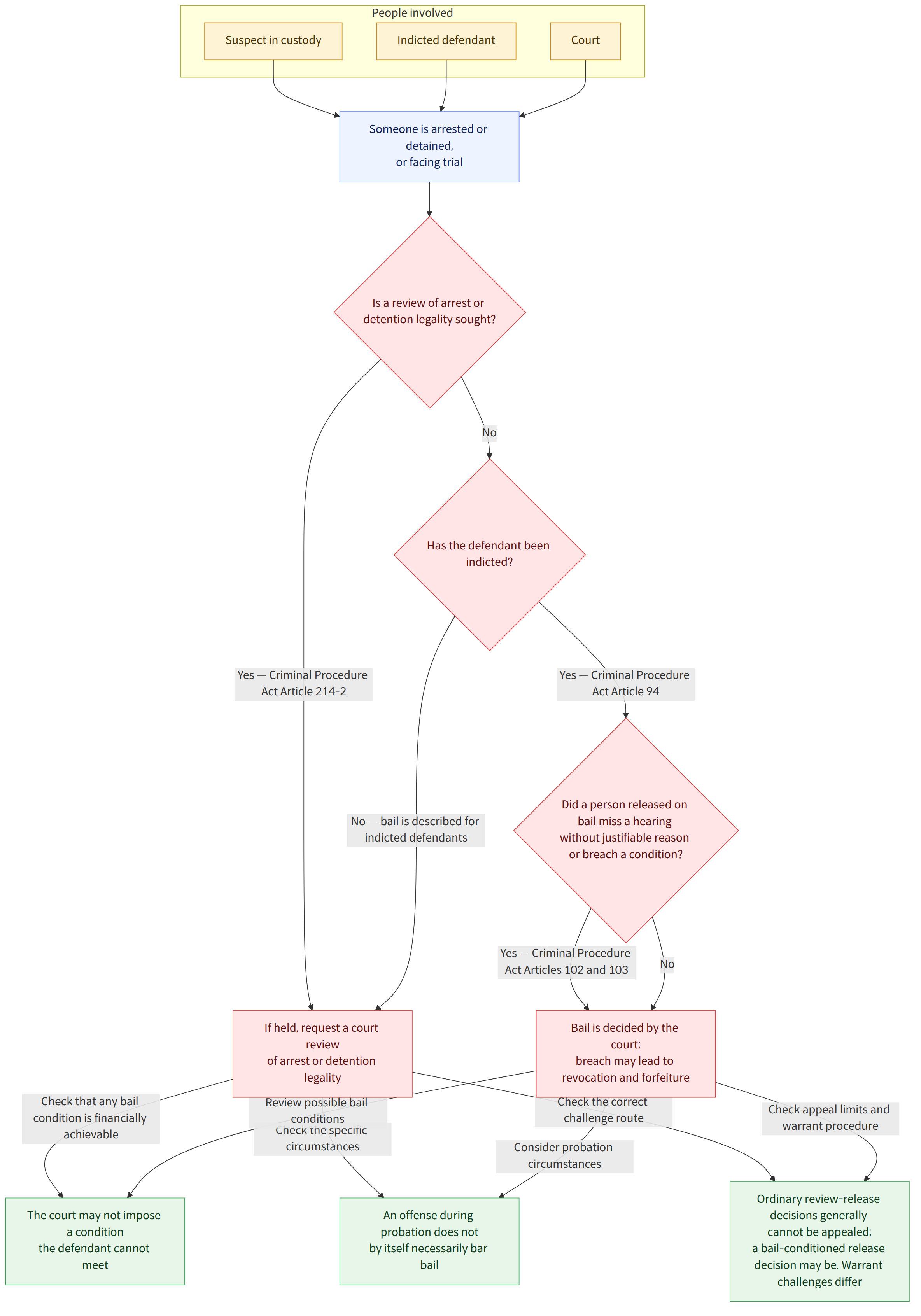
A suspect in custody may request a review of the legality of the arrest and detention during the investigation stage, while an indicted defendant may apply for bail. Whether release is granted and what conditions apply are determined by the court based on the specific circumstances. Violating bail conditions may result in renewed detention or forfeiture of bail.
At a glance
Key points
- A review of the legality of arrest and detention may be requested by a suspect who has been arrested or detained, or by their counsel, legal representative, spouse, lineal relatives, siblings, family members, cohabitants, or employer (Criminal Procedure Act, Article 214-2 (형사소송법 제214조의2)).
- An indicted defendant may apply for bail. The application may also be made by the defendant’s counsel, spouse, relatives, family members, cohabitants, or employer (Criminal Procedure Act, Article 94 (형사소송법 제94조)).
- When granting bail, the court may impose various conditions in addition to payment of bail, such as a pledge to appear, restrictions on residence, or an appearance guarantee. The court may not impose a condition that the defendant cannot meet given their financial means or assets (Criminal Procedure Act, Articles 98 and 99 (형사소송법 제98조·제99조)).
- The fact that a person committed an offense during a period of probation does not, by itself, necessarily bar bail. Whether to grant bail is determined after considering the specific circumstances (Supreme Court Decision No. 90Mo22, dated April 18, 1990 (대법원 1990. 4. 18.자 90모22 결정)).
- If a person released on bail fails to appear at a trial hearing without a justifiable reason or violates the bail conditions, bail may be revoked and all or part of the bail may be forfeited (Criminal Procedure Act, Articles 102 and 103 (형사소송법 제102조·제103조)).
- An appeal may not be brought against an ordinary decision denying or granting release following a review of the legality of arrest and detention. However, a precedent has held that an ordinary appeal may be brought against a release decision conditioned on payment of bail (Criminal Procedure Act, Article 214-2(8) (형사소송법 제214조의2 제8항); Supreme Court Decision No. 97Mo21, dated August 27, 1997 (대법원 1997. 8. 27.자 97모21 결정)).
- The method of challenging the issuance of an arrest warrant itself is different from requesting a review of the legality of arrest and detention. The case explains that an appeal or quasi-appeal cannot be brought against the order issuing the arrest warrant itself, and identifies a request for a review of the legality of arrest and detention as the available response.
- The case explains that when a judgment that causes an arrest warrant to cease to have effect, such as an acquittal or a suspended sentence, is pronounced, the warrant ceases to have effect even before the judgment becomes final, and the defendant must be released immediately in court (Criminal Procedure Act, Article 331 (형사소송법 제331조)).
Frequently asked questions
Q. How long can a detained suspect be held in custody?
According to the case, a judicial police officer must transfer an arrested suspect to a prosecutor within 10 days, and the prosecutor must release the suspect if the prosecutor does not indict them within 10 days after receiving them. At the prosecutor’s request, the court may extend the detention period at the prosecution stage once, by no more than 10 days. The case therefore explains that the maximum period of detention during the investigation stage is 30 days. The detention period is calculated from the date of arrest or apprehension, and a separate court detention period applies after indictment (Criminal Procedure Act, Articles 202, 203, 203-2, and 205 (형사소송법 제202조·제203조·제203조의2·제205조)).
Q. Can I request a review of the legality of detention to get a detained family member released?
Yes. According to the case, a person legally entitled to apply—including the suspect’s spouse and lineal relatives—may request a review of the legality of the arrest and detention from the competent court. The application must state information about the suspect and applicant, the date of detention, and the relief sought and reasons for the application. Supporting materials, such as documents showing family relationships or a settlement agreement, may also be attached. After questioning the suspect, the court decides whether to release them and may order release subject to payment of bail (Criminal Procedure Act, Article 214-2 (형사소송법 제214조의2)).
Q. What can I do to request release after indictment?
An indicted defendant may apply for bail. In deciding whether to grant bail and what conditions to impose, the court considers various circumstances, including the type of crime, the defendant’s criminal record, the risk of evidence destruction or flight, the certainty of the defendant’s residence, and the recovery of harm. The applicant may present circumstances such as having reached a settlement with the victim, having a stable residence, or facing difficulties with business or livelihood.
Q. Do I have to pay a cash bail deposit to apply for bail?
No. The case explains that the court is not required to impose payment of bail as a condition of release on bail and may instead set other conditions, such as a written pledge or an appearance guarantee. Even if payment of bail is required, the court may not impose a condition that the defendant cannot meet given their financial means or assets. In some cases, securities or a guarantee submitted by another person may be accepted in place of bail (Criminal Procedure Act, Articles 98, 99, and 100 (형사소송법 제98조·제99조·제100조)).
Q. Can I move or travel to another area after being released on bail?
If restrictions on residence are included among the conditions of release on bail, you must comply with them. You must obtain the court’s permission before changing your residence. The case explains that violating the conditions may result in revocation of bail, a fine for negligence, or detention in a workhouse. Even if you need to travel for business, do not violate the restrictions without permission; obtain the court’s approval (Criminal Procedure Act, Articles 98 and 102 (형사소송법 제98조·제102조)).
Q. If I miss a trial hearing after being released on bail, will my bail be forfeited immediately?
If you fail to appear at a trial hearing without a justifiable reason, bail may be revoked, and all or part of the bail may be forfeited. According to the case, revocation of bail and forfeiture of bail do not have to be decided at the same time; a separate forfeiture order may be issued after bail is revoked. Forfeiture may also become an issue if, after a conviction becomes final, you fail without a justifiable reason to respond to a summons for enforcement or if you flee (Criminal Procedure Act, Articles 102 and 103 (형사소송법 제102조·제103조)).
Q. Can I challenge the issuance of an arrest warrant itself?
The case explains that an order issuing an arrest warrant for a suspect cannot itself be challenged by an immediate appeal, an ordinary appeal, or a quasi-appeal. Instead, you may ask the court to review whether the detention is lawful or whether continued detention is necessary by requesting a review of the legality of the arrest and detention. However, a precedent has held that an ordinary appeal may be brought against a decision to release a suspect following such a review, subject to payment of bail.
Q. Can a judge issue an arrest warrant without questioning the suspect at a pre-arrest hearing?
According to the case, although a pre-arrest hearing for a suspect takes place after an arrest warrant is requested, the judge is not required to question the suspect. A precedent is cited holding that it is not unlawful merely because the judge issues the warrant without questioning the suspect after deciding that questioning is unnecessary. The case also explains that if the suspect who is to be questioned does not have counsel, the court must appoint counsel on its own initiative (Criminal Procedure Act, Article 201-2 (형사소송법 제201조의2)).
Q. Will I remain in custody until the judgment becomes final if I receive a suspended sentence?
The case explains that when a suspended sentence is pronounced, the arrest warrant ceases to have effect and the defendant is released, even before the judgment becomes final. It also refers to a Constitutional Court decision holding that a person subject to release may not be taken back to prison against their wishes (Criminal Procedure Act, Article 331 (형사소송법 제331조); Constitutional Court Decision No. 95Heon-Ma247, dated December 24, 1997 (헌법재판소 1997. 12. 24.자 95헌마247 결정)).
Relevant laws
- Constitution, Article 27(4) (헌법 제27조 제4항)
- Criminal Procedure Act, Article 39 (형사소송법 제39조)
- Criminal Procedure Act, Article 66 (형사소송법 제66조)
- Criminal Procedure Act, Article 70 (형사소송법 제70조)
- Criminal Procedure Act, Article 92 (형사소송법 제92조)
- Criminal Procedure Act, Article 93 (형사소송법 제93조)
- Criminal Procedure Act, Article 94 (형사소송법 제94조)
- Criminal Procedure Act, Article 95 (형사소송법 제95조)
- Criminal Procedure Act, Article 98 (형사소송법 제98조)
- Criminal Procedure Act, Article 99 (형사소송법 제99조)
- Criminal Procedure Act, Article 100 (형사소송법 제100조)
- Criminal Procedure Act, Article 102 (형사소송법 제102조)
- Criminal Procedure Act, Article 103 (형사소송법 제103조)
- Criminal Procedure Act, Article 201 (형사소송법 제201조)
- Criminal Procedure Act, Article 201-2 (형사소송법 제201조의2)
Watch out for
- A review of the legality of arrest and detention and bail apply to different people and at different stages. The case explains that a suspect may request a review during the investigation stage, while an indicted defendant may apply for bail.
- The case explains that the detention period is calculated from the date of arrest or apprehension. However, the detention period during the investigation stage must be distinguished from the detention period during trial, depending on whether the person has been indicted.
- Whether bail is granted and what conditions apply depend on the individual circumstances. You cannot assume that release will automatically be granted.
- If you violate bail conditions or fail to appear at a trial hearing without a justifiable reason, revocation of bail, renewed detention, forfeiture of bail, a fine for negligence, or detention in a workhouse may become an issue. Check the conditions and hearing schedule.
Source cases
This guide was compiled by AI from the following Korea Legal Aid Corporation consultation cases (in Korean).
- 구속된 경우 최장구속수사기간은 얼마나 되는지
- 유치장 수용자의 신체검사 시 알몸신체검사 허용 여부
- 구속·기소된 피고인이 석방될 수 있는 보석청구절차
- 보증금 납입 조건부 석방결정에 대한 보통항고 가능여부
- 보석불허결정사유를 어느 정도 구체적으로 기재하여야 하는지 여부
- 긴급체포 후 석방된 피의자를 다시 구속할 수 있는지
- 구속 후 무죄판결을 받을 경우 손해배상 청구가 가능한지
- 보증금 없이 보석결정을 받을 수 있는지
- 피의자 구속영장발부명령에 대한 불복가부
- 구속된 피의자가 석방될 수 있는 구속적부심사청구절차
- 구속영장의 효력범위
- 구속기간의 구체적인 계산방법
- 집행유예기간 중 죄를 범한 피고인에 대한 보석 가능 여부
- 구속전피의자심문절차와 변호인선임문제
- 구속된 피의자 또는 피고인이 석방될 수 있는 방법
- 보석으로 석방된 사람에 대한 주거의 제한
- 보석취소결정과 보증금몰취결정을 동시에 해야하는지 여부
- 집행유예 판결 선고 시 피고인이 석방되는 시기
- 압수·수색영장으로 재차 압수수색할 수 있는지
- 구속영장 기재 범죄사실과 공소장 기재 공소사실이 다른 경우
- 공판기일 불출석시 구속여부
- 보석 후 실형이 선고되자 도주한 때 보석보증금 몰수 여부
- 벌금형에 따르는 노역장유치의 집행을 위하여 형집행장을 발부하여 구인하는 경우, 구속사유에 관한 형사소송법 제70조 나 구속이유...
- 구속취소의 가능성
- 구속전피의자심문에서 판사가 피의자에게 꼭 질문을 해야하는지
This guide is general legal information about Korean law, not legal advice for your situation. For a specific case, consult a lawyer or the Korea Legal Aid Corporation (call 132 in Korea).