
Guide to Bodily Injury, Assault, and Self-Defense under the Criminal Act
Based on 27 consultation cases · Updated · Translated from the Korean original.
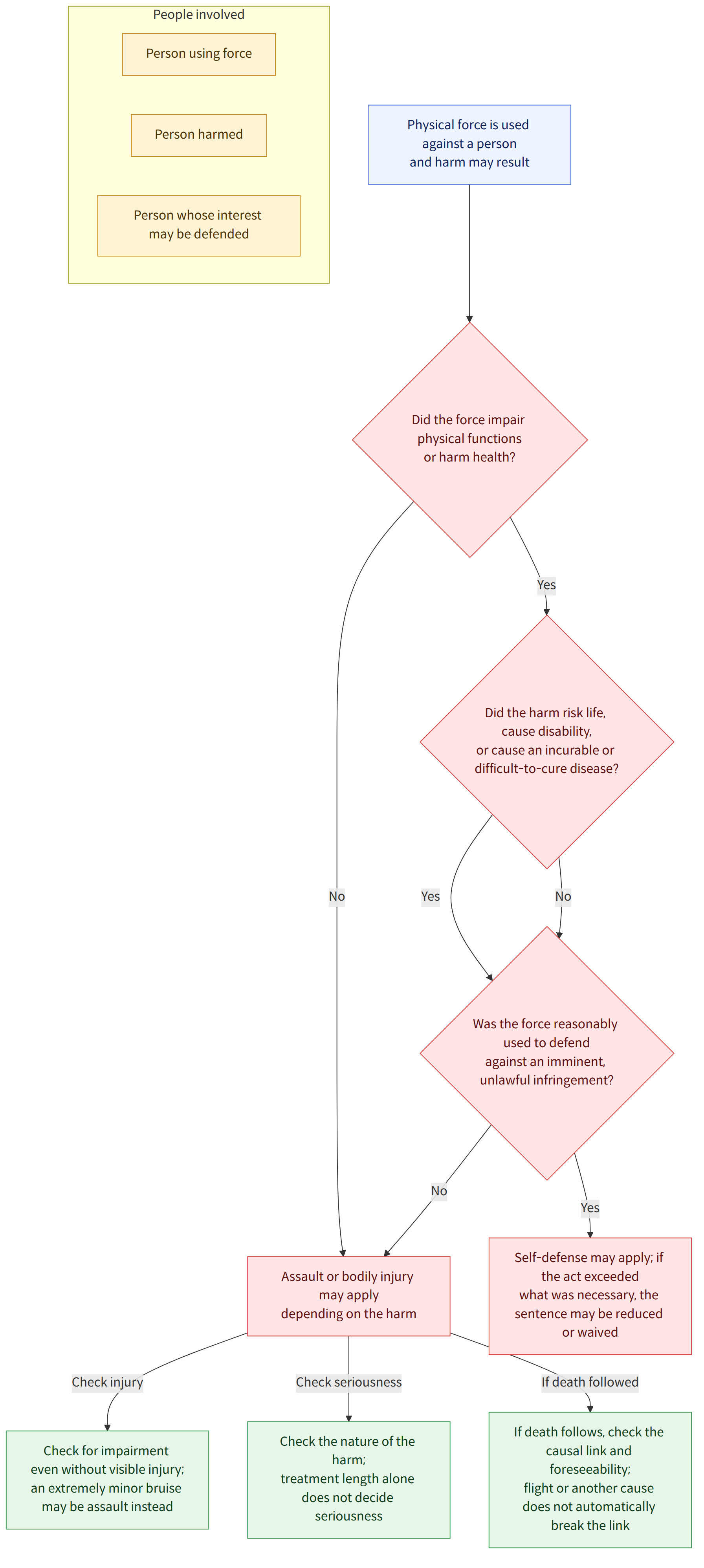
Assault is the use of physical force against a person, while bodily injury involves harm to the person’s physical functions or health. The offense charged may vary depending on the severity of the injury, the causal connection between the conduct and the outcome, and whether self-defense applies, so the specific circumstances must be considered.
At a glance
Key points
- Bodily injury means impairment of physical functions or harm to health. It may be established even without external injuries if physiological functions are impaired, such as when a person faints after prolonged assault or threats (Cases 24 and 25).
- An injury that is unlikely to have adversely affected a person’s health, such as an extremely minor bruise that could arise in everyday life, may be treated as assault rather than bodily injury (Case 24).
- Serious bodily injury means an injury that puts a person’s life at risk or results in a disability or an incurable or incurable-with-difficulty disease. Whether an injury is serious is not determined solely by the period of hospitalization or treatment (Criminal Act, Article 258; Cases 12 and 17).
- Self-defense requires reasonable grounds for an act to defend one’s own or another person’s legally protected interest against an imminent and unlawful infringement. Self-defense may be difficult to establish where both parties fought with the intent to attack (Criminal Act, Article 21; Cases 8, 15, and 16).
- If a defensive act goes beyond what is necessary, it may constitute excessive self-defense. According to the cases, the sentence may be reduced or waived depending on the circumstances (Criminal Act, Article 21; Case 21).
- Where assault or bodily injury results in death, the causal connection between the conduct and the death, as well as whether the death was foreseeable, may be at issue. The causal connection is not automatically disproved merely because the victim was fleeing or another cause intervened (Criminal Act, Article 262; Cases 4, 9, 19, and 22).
- Whether an object is dangerous is determined not only by its type but also by whether, in the circumstances of its use, it could have put another person or a third party in danger of harm to life or body. A car may also qualify as a dangerous object depending on how it was used in the assault (Criminal Act, Article 261; Cases 14 and 23).
- Even if the victim consented, unlawfulness may not be removed if the consent was contrary to social norms (Criminal Act, Article 24; Case 6).
Frequently asked questions
Q. Can a minor injury, such as a bruise, constitute the offense of bodily injury?
The mere fact that there is an injury does not necessarily mean that the offense of bodily injury has been committed. If a bruise so minor that it could arise in everyday life is unlikely to have impaired the person’s health, the conduct may be treated as assault rather than bodily injury.
Q. Can the offense of bodily injury be established even if there are no visible injuries?
Yes. If a person’s physiological functions are impaired—for example, if they faint after being unable to withstand prolonged threats and assault—the conduct may constitute bodily injury even if there are no visible external injuries.
Q. Does treatment or hospitalization for several weeks qualify as serious bodily injury?
Whether an injury is serious is not determined solely by the length of treatment or hospitalization. It is necessary to consider whether the person’s life was put at risk or whether the injury resulted in a disability or an incurable or incurable-with-difficulty disease. In the cases cited, a leg fracture requiring one to two months of hospitalization and a chest injury requiring three weeks of treatment were not treated as serious bodily injury.
Q. If both parties fought, can I claim self-defense against the other person’s assault?
Where both parties fight with the intent to attack, and each person’s conduct is both defensive and aggressive in nature, self-defense is unlikely to be recognized. By contrast, self-defense may be recognized where a person acts to escape or defend against a one-sided attack.
Q. Is pushing an assailant to protect someone else an act of self-defense?
An act to prevent an imminent and unlawful infringement of another person’s legally protected interest may also constitute self-defense. Whether the infringement was ongoing, whether the act was intended as a defense, and whether there were reasonable grounds for it are determined based on the specific circumstances.
Q. If I injure the other person while defending myself, is it impossible to avoid punishment?
If the defensive act was supported by reasonable grounds, it may not be punishable as an act of self-defense. Even if the act went beyond what was necessary for defense, the cited cases indicate that the sentence may be reduced or waived on the grounds of excessive self-defense, but the circumstances and extent of the defensive act must be considered.
Q. Can causing injury constitute the offense of bodily injury even if the other person consented?
The victim’s consent does not, by itself, always make an act lawful. If the consent is contrary to social norms of ethics and morality, it may not be regarded as valid consent.
Q. Is pushing or hitting someone with a car special assault?
A car may qualify as a dangerous object, and “carrying” an object may include using it, not just possessing it. Whether an object is dangerous is determined based on how it was used and the specific circumstances.
Q. Can a person be guilty of assault resulting in death even if they did not directly cause the death?
Where several people commit an assault together, it may be necessary to consider whether the fatal outcome could have been foreseen and whether each person’s assault contributed to the death. Causation may also be established if the victim is injured or dies while fleeing, or if another negligent act also contributed to the outcome.
Relevant laws
- Criminal Act, Article 19 (형법 제19조)
- Criminal Act, Article 20 (형법 제20조)
- Criminal Act, Article 21 (형법 제21조)
- Criminal Act, Article 24 (형법 제24조)
- Criminal Act, Article 257 (형법 제257조)
- Criminal Act, Article 258 (형법 제258조)
- Criminal Act, Article 260 (형법 제260조)
- Criminal Act, Article 261 (형법 제261조)
- Criminal Act, Article 262 (형법 제262조)
- Criminal Act, Article 263 (형법 제263조)
- Punishment of Minor Offenses Act, Article 1, Item 26 (경범죄처벌법 제1조 제26호)
- Punishment of Minor Offenses Act, Article 8 (경범죄처벌법 제8조)
- Civil Act, Article 775 (민법 제775조)
Watch out for
- Even where assault occurred in the same circumstances, the offense charged may differ depending on whether the result was a minor injury or bodily injury that impaired physical functions or health.
- Self-defense and excessive self-defense are assessed by considering together whether the infringement was imminent, the purpose of the defensive act, its extent, and the circumstances at the time. It is difficult to reach a conclusion based solely on the fact that someone “hit back.”
- Where death or serious bodily injury occurs, the issues include not only the causal connection between the conduct and the outcome but also whether the outcome could have been foreseen.
- Whether an object qualifies as dangerous is not determined solely by its name; the manner in which it was actually used and the risk it posed to the other person must be considered.
Source cases
This guide was compiled by AI from the following Korea Legal Aid Corporation consultation cases (in Korean).
- 임차인이 연탄가스 중독으로 사망한 경우 임대인의 형사책임
- 통보처분과 일사부재리
- 독립된 상해행위가 경합되어 사망하게 된 경우 형사책임
- 수인의 상해행위와 사망의 결과 발생
- 폭행치사와 정당행위
- 피해자의 승낙을 받고 상해를 가한 경우에도 처벌되는지
- 이혼소송 중 남편이 찾아와 가위로 폭행하고 변태적 성행위를 강요하여, 이에 처가 남편을 칼로 찔러 사망하게 한 경우 정당방위 ...
- 타인을 위한 정당방위의 인정 여부
- 폭행과 사망 사이의 인과관계
- 상해를 교사하였으나, 교사를 받은 사람이 피해자를 살인한 경우 교사자의 죄책
- 태아를 사망에 이르게 한 행위가 임산부에 대한 상해에 해당하는지
- 중상해에 이르기 위한 부상의 정도
- 남편 사망 후 시어머니를 상해한 경우 존속상해죄 성립 여부
- 위험한 물건의 판단기준
- 일방적인 싸움(외관상 싸움)에서의 정당방위 인정
- 싸움 등 쌍방폭행에서의 정당방위 부정
- 중상해의 의미
- 인분을 앞마당에 던진 것이 폭행인지 여부
- 피해자의 과실이 개입되어 중한 결과가 발생한 경우의 인과관계 인정
- 존속상해죄의 성립 요건
- 과잉방위
- 폭행치사의 공동원인에서 한 쪽의 인과관계 인정
- 승용차로 사람을 치는 것도 위험한 물건을 휴대하여 폭행한 것인지
- 상해에 해당하는 상처의 정도
- 오랜 시간 동안의 협박·폭행에 못 이겨 실신한 것이 상해에 해당하는지
This guide is general legal information about Korean law, not legal advice for your situation. For a specific case, consult a lawyer or the Korea Legal Aid Corporation (call 132 in Korea).