
Guide to Claim Assignments: Effect and Requirements for Asserting Them
Based on 54 consultation cases · Updated · Translated from the Korean original.
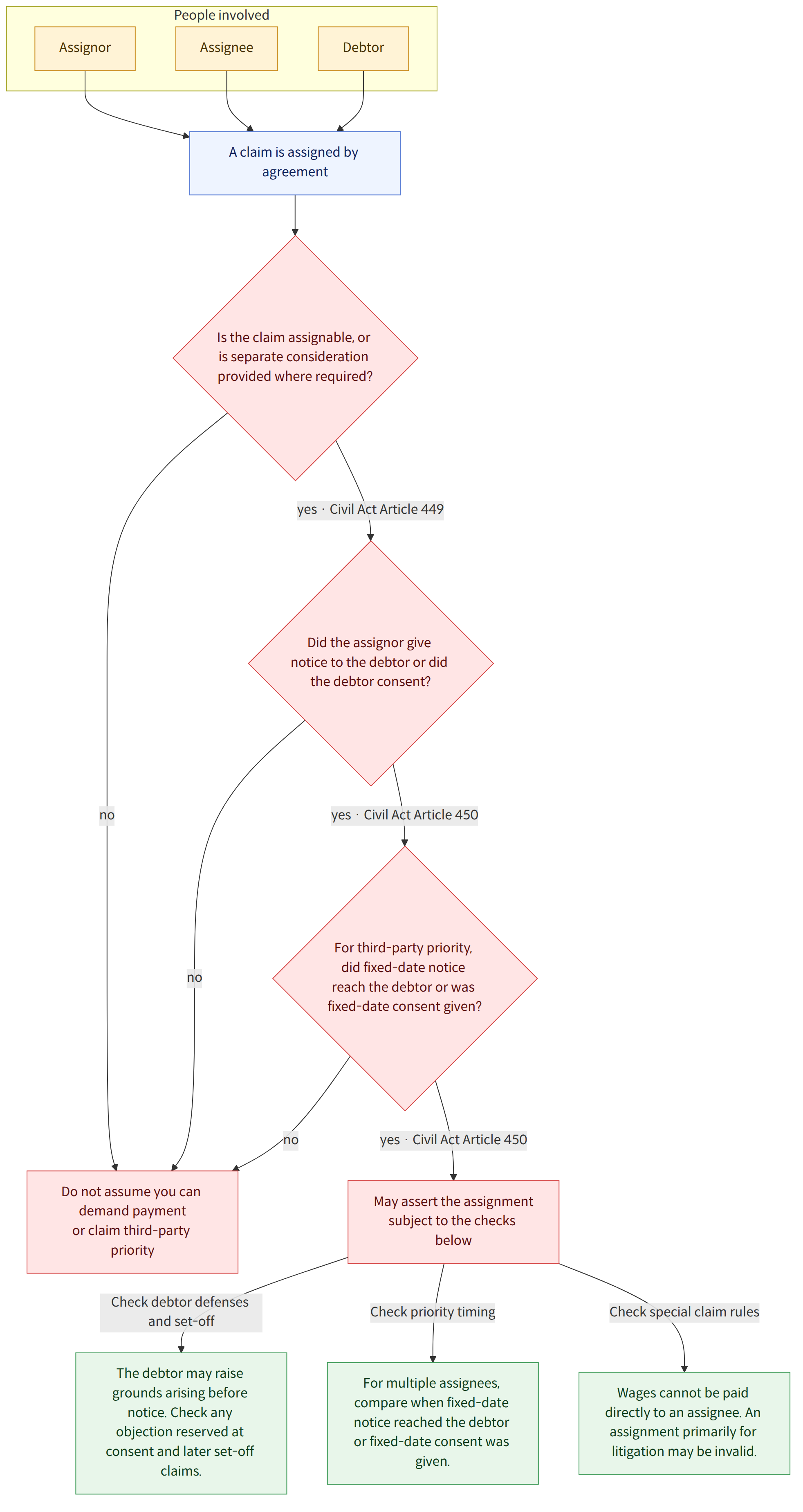
A claim is assigned by agreement between the assignor and the assignee, but requirements such as notice or consent must be met to assert the right against the debtor or another assignee. The outcome may vary depending on an agreement prohibiting assignment, the debtor's defenses and right of set-off, and the type of claim. You should therefore not assume that the assignment alone entitles you to demand payment.
At a glance
Key points
- As a rule, a claim payable to a specifically identified creditor may be assigned. However, separate consideration is required if assignment is not permitted by the nature of the claim or if an agreement prohibits assignment (Civil Act, Article 449 (민법 제449조)).
- For an assignee to assert the assignment against the debtor, the assignor must give notice or the debtor must consent. To assert it against a third party other than the debtor, notice or consent must be documented in a document bearing a fixed date (Civil Act, Article 450 (민법 제450조)).
- If a claim is assigned to more than one person, the relevant comparison is not limited to the dates of the assignment agreements or the fixed dates written on the documents. It is when notice bearing a fixed date reached the debtor or when consent bearing a fixed date was given (Case 1).
- Even if an agreement prohibits assignment, the debtor may not be able to rely on it against an assignee who neither knew of the agreement nor was grossly negligent in being unaware of it. The debtor asserting the assignee's knowledge or gross negligence must prove it (Civil Act, Article 449(2) (민법 제449조 제2항), Cases 3, 9, and 25).
- The debtor may assert against the assignee any grounds that arose against the assignor before receiving notice of the assignment. If the debtor consented, it is important, among other things, whether the debtor reserved an objection at the time of consent. As a rule, the debtor cannot set off a claim acquired afterward against the assignee (Civil Act, Article 451 (민법 제451조), Cases 10 and 16).
- The assignee may give notice as the assignor's agent, but the agency relationship must be apparent. Notice given only in the assignee's own name may not be effective (Cases 4 and 6).
- Even if a wage claim may be assigned, the employer cannot pay the assignee directly. In addition, an assignment made primarily to enable litigation may be invalid (Labor Standards Act, Article 43(1) (근로기준법 제43조 제1항); Trust Act, Article 7 (신탁법 제7조); Cases 8 and 21).
- A claim for return of a deposit under an unregistered lease may be assigned subject to the condition that the claim for return arises in the future. Also, even if the landlord and tenant renew their agreement after a claim for return of the lease deposit is assigned, the renewal may not take effect against the assignee (Cases 2 and 7).
Frequently asked questions
Q. If I receive an assignment of a claim, can I immediately demand payment from the debtor?
A transfer agreement alone can transfer a claim between the assignor and the assignee, but to assert the assignment against the debtor, the assignor must give notice or the debtor must consent. If priority against a third party is at issue, notice or consent must also be documented in a document bearing a fixed date (Civil Act, Article 450 (민법 제450조)).
Q. If two people receive assignments of the same claim, who has priority?
Priority between assignees is not determined solely by which assignment agreement was made first. The relevant comparison is when notice of the assignment bearing a fixed date reached the debtor or when consent bearing a fixed date was given (Case 1).
Q. Can I receive an assignment of a claim that is subject to an agreement prohibiting assignment?
If an agreement prohibits assignment, the debtor may invoke it against an assignee who knew of the agreement or was unaware of it through gross negligence. If the assignee neither knew of the agreement nor was grossly negligent in being unaware of it, the debtor may not be able to rely on the agreement against the assignee. The debtor must prove the assignee's knowledge or gross negligence (Civil Act, Article 449(2) (민법 제449조 제2항), Cases 3 and 9).
Q. Can the debtor set off a claim acquired after consenting to an assignment?
As a rule, after the debtor consents to an assignment, the debtor cannot assert a set-off against the assignee based on a claim the debtor acquires against the assignor afterward. However, a set-off may be allowed if, before the assignment, a circumstance giving rise to the set-off already existed and the assigned claim was subject to simultaneous performance with the debtor's claim (Civil Act, Article 451 (민법 제451조), Cases 10 and 16).
Q. Can the assignee give notice of an assignment on the assignor's behalf?
The assignee may give notice as the assignor's agent. However, the notice must make clear that the assignee is acting as the assignor's agent. If the assignee gives notice only in the assignee's own name without indicating the agency relationship, the notice may be ineffective (Case 6).
Q. If a wage claim is assigned, can the assignee demand direct payment of wages from the company?
A wage claim itself may be assigned, but wages must be paid directly to the employee. Therefore, the assignee cannot demand direct payment of wages from the employer, and the employer must not pay wages to the assignee (Labor Standards Act, Article 43(1) (근로기준법 제43조 제1항), Case 21).
Q. If the lease is renewed after a claim for return of the lease deposit has been assigned, does the assignee have to wait?
Even if the landlord and tenant renew the lease or extend its term after notice of the assignment, the effect of their agreement may not extend to the assignee of the claim for return of the security deposit. However, in some cases, repayment of the deposit and surrender of the residence must be performed together, so whether the tenant has surrendered the residence must also be considered (Case 7).
Q. If an assignment agreement is rescinded, can the assignor immediately make a new demand against the debtor?
If the assignment agreement is rescinded after notice of the assignment has already been given, the assignee may need to notify the debtor of the rescission before the assignor can rely on it to make a new demand against the debtor. Even if the agreement that gave rise to the assignment ceases to be effective through termination or otherwise, the assignee may have a duty to notify the debtor that the claim has reverted (Cases 12 and 14).
Q. Can I assign a claim to a family member so they can handle litigation?
An assignment of a claim made primarily to enable litigation may be invalid under an analogous application of Article 7 of the Trust Act. The circumstances of the assignment, the relationship between the parties, and the process leading to litigation after the assignment should all be considered. An assignment between family members is not necessarily valid in every case (Case 8).
Relevant laws
- Civil Act, Article 108(2) (민법 제108조 제2항)
- Civil Act, Article 114 (민법 제114조)
- Civil Act, Article 115 (민법 제115조)
- Civil Act, Article 149 (민법 제149조)
- Civil Act, Article 449 (민법 제449조)
- Civil Act, Article 450 (민법 제450조)
- Civil Act, Article 451 (민법 제451조)
- Civil Act, Article 452(2) (민법 제452조 제2항)
- Civil Act, Article 487 (민법 제487조)
- Civil Act, Article 667 (민법 제667조)
- Civil Act, Article 667(3) (민법 제667조 제3항)
- Civil Act, Article 668 (민법 제668조)
- Civil Act, Article 669 (민법 제669조)
- Civil Act, Article 670 (민법 제670조)
- Civil Act, Article 671 (민법 제671조)
Watch out for
- The mere existence of a document bearing a fixed date does not determine priority over a third party. You must check when notice was received or when consent was given.
- Notice of an assignment merely informs the debtor of the assignment and may not, by itself, be treated as a demand for performance of the claim. If a claim is subject to a peremptory period, you should check whether the right was exercised separately (Case 18).
- The general rules on assignment may not apply in the same way to every type of claim. Claims for registration of transfer of ownership, wage claims, deposit claims, and assignments made for security purposes each raise separate issues (Cases 11, 13, 17, 21, and 25).
Source cases
This guide was compiled by AI from the following Korea Legal Aid Corporation consultation cases (in Korean).
- 채권이 이중으로 양도된 경우 누가 우선권자가 되는지
- 채권적 전세의 보증금반환채권을 양수한 채권양수인의 권리행사방법
- 양도금지특약이 있는 채권을 양도한 경우 그 효력이 있는지
- 하수급인이 수급인의 직불동의서 통지한 것이 채권양도통지인지
- 채권양도나 채권에 대한 질권설정에 있어서 채무자가 이의를 보류하지 않은 승낙을 한 경우, 양수인 또는 질권자에게 대항할 수 없...
- 채권양수인이 양도인의 대리인으로서 채권양도 통지를 할 수 있는지
- 전세보증금반환청구채권 양도 후 양수인의 동의 없이 계약이 갱신된 경우
- 부부사이에 소송행위를 하게 할 목적으로 채권양도를 한 경우 그 효력
- 양도금지특약 있는 채권양도의 경우 채무자가 채권자불확지공탁 가능한지
- 채권양도 승낙 후 취득한 채권으로 양도된 채권과 상계할 수 있는지
- 소유권이전등기청구권양도의 경우 채무자에 대한 양도통지로 대항력 있는지
- 다른 채무담보로 채권양도, 피담보채무소멸로 양수금청구 거절가능한지
- 회생계획인가결정에 따라 회생채무자의 채권에 관하여 설정된 양도담보권이 소멸되는 경우, 채권양수인이 민법 상 대항요건을 갖추면 ...
- 채권양도통지 후 계약해제된 경우 양수인의 그 사실통지의무 여부
- 허위표시에 의해 성립한 지명채권을 선의 양수한 경우에도 채무자에게 통지하거나 승낙을 받아야 하는지 여부
- 채권양도와 상계
- 저당권의 피담보채권과 저당권을 함께 양수하였으나 채권양도의 대항요건을 갖추지 못한 경우, 양수인의 저당권실행 가부
- 채권양도 통지만으로 제척기간 준수에 필요한 ‘권리의 재판외 행사’가 이루어졌다고 볼 수 있는지 여부
- 채권양도통지가 채무자에게 도달하였는지 여부에 대한 판단기준
- 처분권한 없는 자의 지명채권 양도의 유효성
- 근로자 임금 채권의 양도성
- 채권이 이미 타인에게 양도되었다는 사실이 민법 제451조 제1항 전단의 “양도인에게 대항할 수 있는 사유”에 해당하는지 여부
- 대항력없는 채권양수인의 재판상 청구
- 채무자가 채권양도를 승낙하면서 조건을 붙일 수 있는지
- 예금채권을 양수한 경우 은행에 예금채권의 지급을 구할 수 있는지
This guide is general legal information about Korean law, not legal advice for your situation. For a specific case, consult a lawyer or the Korea Legal Aid Corporation (call 132 in Korea).