
Building-Related Administration: Permits, Corrective Orders, and How to Challenge Them
Based on 67 consultation cases · Updated · Translated from the Korean original.
Whether a building permit or corrective order can be challenged depends on whether the decision affects a legally protected interest and whether statutory requirements have been violated. The outcome is not determined solely by the fact that land has been used as a road in practice or that there are concerns about the surrounding environment; the specific circumstances, including the nature of the permit and the progress of construction, must also be considered.
At a glance
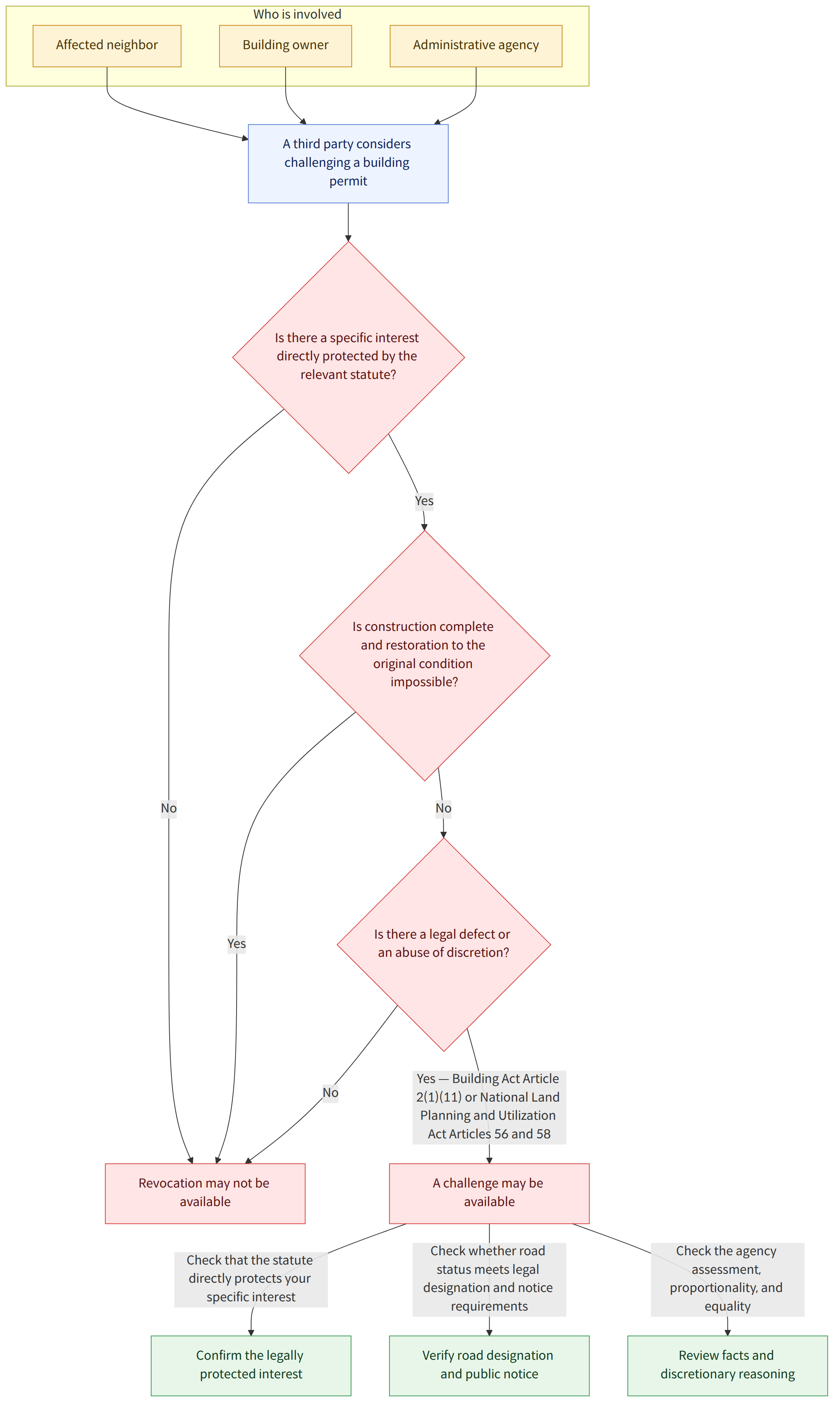
Key points
- A third party adversely affected by a building permit may bring an action to revoke it if they have a specific interest directly protected by the statute on which the decision is based, but an indirect de facto or economic interest alone is insufficient (Case 1).
- If construction has been completed and revoking the permit would not make restoration to the original condition possible, there may be no legally protected interest in seeking revocation of the building permit (Case 1).
- The fact that land has long been used in practice as a passageway does not make it a road under the Building Act. Statutory requirements, such as public notification under the relevant laws or designation and public notification as a road, must be considered (Building Act, Article 2(1)(11) (건축법 제2조 제1항 제11호); Case 8).
- A building permit in a designated use area may also have the character of a development activity permit, so the administrative agency may have discretion. However, the decision may be challenged if the agency exceeds or abuses its discretion, for example by wrongly assessing the facts or violating the principles of proportionality or equality (National Land Planning and Utilization Act, Articles 56 and 58 (국토의 계획 및 이용에 관한 법률 제56조·제58조); Case 18).
- If an attached parking facility is used for another purpose without permission, or the use of a building is changed, a successor’s continued use for that purpose may also be considered unlawful (Parking Lot Act, Article 29 (주차장법 제29조); Building Act, Article 19 (건축법 제19조); Case 13).
- Changing the name of the building owner may not be subject to administrative litigation against the administrative agency. If the transferor refuses to cooperate, you may bring a civil claim against the transferor to require them to complete the name-change procedure (Case 9).
- A case held that an administrative agency’s request to an electricity or telephone provider to suspend supply on the ground of a Building Act violation was advisory in nature and did not constitute an administrative disposition subject to an appeal action (Case 21).
Frequently asked questions
Q. If sunlight access may be obstructed by a neighboring building, can I ask to have the building permit revoked?
A third party may also bring an action if they have a legally protected interest in seeking revocation of the permit. However, the interest must be a specific interest directly protected by the relevant statute. If construction has been completed and revoking the permit would not make restoration to the original condition possible, there may be no interest in seeking revocation.
Q. Is land that has long been used as a path a road under the Building Act?
The fact that residents have used land for passage for a long time, or that part of the land has effectively been used as a road, does not by itself mean that it is a road under the Building Act. You must check whether it satisfies statutory requirements, such as being publicly notified as a road under the relevant laws or designated and publicly notified as a road when a building permit was issued.
Q. Can a building permit be denied because of concerns about odor or pollution affecting the surrounding area?
A building permit in a designated use area may also have the character of a development activity permit, and the administrative agency may have discretion when assessing permit criteria relating to the surrounding environment. However, if, considering the specific facts as a whole, the agency has exceeded or abused its discretionary authority, the decision may be open to challenge through administrative litigation.
Q. Could there be a problem if I buy a building whose use was changed illegally and continue using it?
In the case discussed, continued use of a building for a use to which it had been changed without permission was considered an act of changing its use. Accordingly, even if a purchaser did not know about the existing unauthorized change of use, continuing to use the building in that way may raise issues of violation of the Building Act or the Parking Lot Act.
Q. If the building owner does not agree to a change of name, do I have to sue the administrative agency?
A court decision discussed in the case states that changing the name of the building owner is merely an act of changing the name recorded in the permit register, and is therefore unlikely to be subject to administrative litigation. If the transferor refuses to cooperate after you acquire a building, you may bring a civil claim against the transferor to require them to complete the name-change procedure.
Q. Can I challenge in court an administrative agency’s request to cut off electricity to a building that violates the Building Act?
The court decision discussed in the case held that a request to suspend supply was advisory in nature and did not constitute an administrative disposition subject to an appeal action. However, the subject and method of a challenge may differ depending on what actually occurred.
Q. Is a house built with a building permit but without approval for use excluded from eligibility for a relocation site lot?
In one case, the court held that a building could not be excluded from relocation measures as an unauthorized building solely because it had not received approval for use. However, the outcome may differ if the actual building is so different from the approved plans that it cannot substantively be regarded as having been permitted.
Q. If a fence violates the Building Act, can I always be ordered to take corrective action, such as demolishing it?
The answer may depend on whether the fence is physically and functionally integrated with the building, has lost its independence, and constitutes an ancillary facility attached to the building, or whether it is a structure subject to a separate construction report. The fact that something is a fence does not, by itself, determine uniformly whether it is subject to a corrective order.
Relevant laws
- Building Act, Article 2(1)(2) (건축법 제2조 제1항 제2호)
- Building Act, Article 2(1)(11) (건축법 제2조 제1항 제11호)
- Building Act, Article 3(2) (건축법 제3조 제2항)
- Building Act, Article 11 (건축법 제11조)
- Building Act, Article 16 (건축법 제16조)
- Building Act, Article 19 (건축법 제19조)
- Building Act, Article 44 (건축법 제44조)
- Building Act, Article 47 (건축법 제47조)
- Building Act, Article 79 (건축법 제79조)
- Building Act, Article 80 (건축법 제80조)
- Building Act, Article 83 (건축법 제83조)
- Enforcement Rule of the Building Act, Article 11 (건축법 시행규칙 제11조)
- Enforcement Decree of the Building Act, Article 28 (건축법 시행령 제28조)
- Enforcement Decree of the Building Act, Article 118 (건축법 시행령 제118조)
- Parking Lot Act, Article 19 (주차장법 제19조)
Watch out for
- The statutes and court decisions cited in the cases are based on the laws in force at the time of each case. For an actual matter, you should check the laws currently in force and the specific facts.
- Whether an action to revoke a building permit is possible is not determined solely by concerns about potential harm. You must consider whether the interest is protected by the relevant statute and whether revoking the decision could result in meaningful restoration.
- Changing the name of the building owner, revoking a building permit, issuing a corrective order, and requesting suspension of supply may each have different legal characteristics and methods of challenge. The proper defendant and type of action should therefore be distinguished.
- For the report of a change to a building-related party discussed in Case 2, a provision requiring the report to be made within 7 days from the date the relevant fact arose is described. Whether it applies and what deadline governs must be checked against the current law and the specific circumstances.
Related articles
Source cases
This guide was compiled by AI from the following Korea Legal Aid Corporation consultation cases (in Korean).
- 일조권침해 우려가 있는 경우 건축허가취소소송 가능한지
- 건축주명의변경금지 가처분 후 명의변경신고 수리처분 시 그 효력
- 구분소유등기를 해 놓지 않은 경우 구분소유자 중 1인의 지분에 대한 저당권 설정의 효력
- 분양목적으로 건축된 공동주택에 하자가 있을 경우 구제방법
- 시정명령을 받은 건축주에게 뒤늦게 이행 기회가 제공된 경우 과거의 기간에 대한 이행강제금의 적법 여부
- 공터의 주차시설을 다른 용도로 사용할 수 있는지
- 주택분양보증인이 분양이행한 경우 집합건물법상 하자담보책임을 부담하는지 여부
- 사실상 도로로 사용되는 토지상의 건축허가신청반려처분이 정당한지
- 양수인의 건축주명의변경 청구 시 행정소송절차를 이용해야 하는지
- 개발제한구역법상 취락지구가 아닌 지역으로 이축이 허용되는 건축물에 위 규정 시행일 이전에 철거가 완료된 건축물이 포함되는지 여...
- 건물에 딸린 시설물과 건축법상 시정조치 대상
- 과태료처벌에 국가재정법상 소멸시효 등이 적용되는지
- 불법용도변경된 건축물을 매수하여 사용한 경우도 위법인지
- 스크린골프장이 게임제공업 시설인지 또는 골프연습장인지 여부
- 건축물의 대지가 도로에 접하여야 하는지
- 부속건축물과 주된 건축물의 이격 필요여부
- 체납관리비의 소멸시효 중단의 효력이 구분소유자의 승계인에게도 미치는지 여부
- 국토계획법상 용도지역 내 오염을 발생시킬 수 있는 개발행위에 대한 건축허가 반려 처분의 적법 여부
- 조합원의 주택양도와 조합원자격 득실여부
- 의결정족수 미달로 재건축조합설립인가처분무효확인소송 가능한지
- 건축법 위반 시 전기 공급중지 요청행위가 행정처분인지
- 공용부분의 용도 및 형상변경이 구분소유자 전원의 동의가 필요한 것인지
- 건축물의 설계변경허가신청에 대한 허가권자
- 토지수용재결시 무허가건축물 내 축산업자에 대한 영업손실 인정 가부
- 건축허가를 받아 택지개발사업구역 내의 토지에 주택을 신축하였으나 사용승인을 받지 않은 경우 이주자택지 공급대상자 선정 대상 여...
This guide is general legal information about Korean law, not legal advice for your situation. For a specific case, consult a lawyer or the Korea Legal Aid Corporation (call 132 in Korea).