
Guide to Responding to Business-Related Administrative Permits and Dispositions
Based on 59 consultation cases · Updated · Translated from the Korean original.
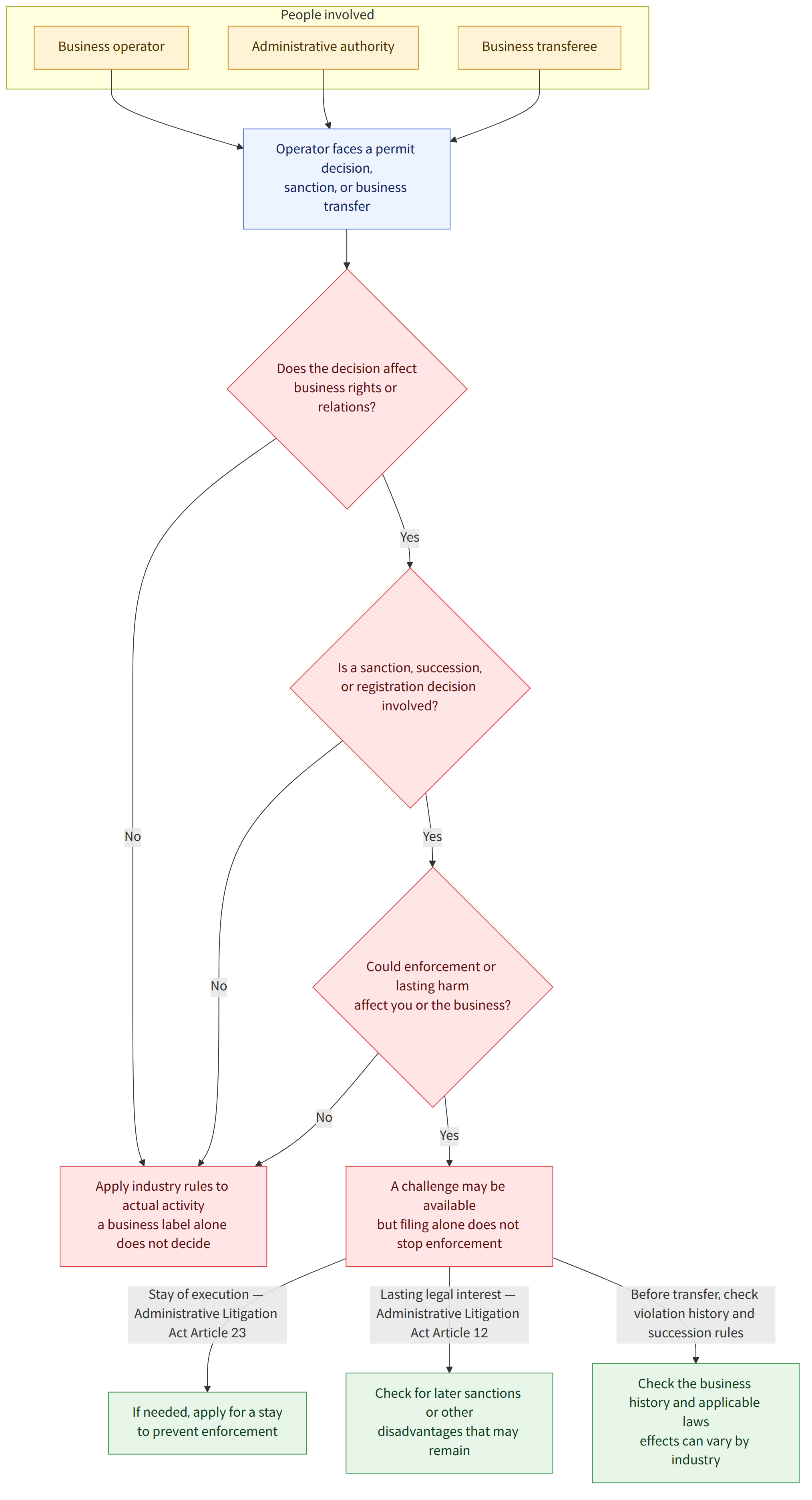
Business permits and notices, succession to an operator’s status, and business suspensions or license revocations are assessed under the laws applicable to each industry and in light of the actual form of the business. To challenge an administrative disposition, consider separately its effect and whether execution has been stayed, any disadvantages that remain after the disposition ends, and the consequences of transferring or acquiring the business.
At a glance
Key points
- Requirements for permits, registrations, and notices vary by industry. A business permit under the Food Sanitation Act may be denied even if the facility requirements are met, where the building violates other laws (Case 4).
- The actual business activities may determine the applicable business category, rather than the label used for a business permit or notice (Youth Protection Act, Article 2(5) (청소년보호법 제2조 제5호), Case 2).
- Filing an action for revocation of a sanction, such as a business suspension or license revocation, does not automatically suspend the effect or enforcement of the disposition. If necessary, an application for a stay of execution must be made (Administrative Litigation Act, Article 23 (행정소송법 제23조), Cases 7 and 20).
- Even after a prescribed sanction period has ended, a legal interest in seeking revocation may be recognized if legal disadvantages, such as a subsequent aggravated disposition or a reduction in credibility rating, may remain (Administrative Litigation Act, Article 12 (행정소송법 제12조), Case 15).
- After a business is transferred, grounds for sanctions relating to the establishment may still affect the transferee, and a disposition accepting a report of succession to an operator’s status may restrict the former operator’s rights and interests (Cases 17 and 19).
- Provisions serving as the basis for sanctions or criminal penalties must not be interpreted broadly to the detriment of the affected party beyond their text (Cases 11, 13, and 25).
- Whether an authorization granted to another operator can be challenged depends not merely on a decrease in sales, but on whether the relevant laws protect an individual, direct, and specific interest (Case 1).
- Even a procedure formally involving a notice or registration, such as refusal to amend business registration or acceptance of a report of succession to an operator’s status, may constitute a disposition subject to administrative litigation if it affects legal relations (Cases 18 and 19).
Frequently asked questions
Q. If I file a lawsuit to challenge a business suspension order, can I continue operating right away?
No. As a general rule, filing an action for revocation does not suspend the effect or enforcement of the disposition. If there is an urgent need to prevent harm that would be difficult to remedy, you may apply to the court for a stay of execution (Administrative Litigation Act, Article 23 (행정소송법 제23조)).
Q. Can I seek to have a business suspension order revoked even though the suspension period has already ended?
Even after the suspension period has ended, a legal interest in seeking revocation may be recognized if a subsequent sanction based on the prior disposition is realistically anticipated, or if disadvantages such as a reduction in your credibility rating remain. The specific disadvantages and applicable disposition criteria must be examined (Administrative Litigation Act, Article 12 (행정소송법 제12조)).
Q. What happens to the prescribed business suspension period if the court stays execution of the suspension order?
A stay of execution remains effective until the time specified in the court’s order. If the court orders a stay until judgment is rendered in the main action, the business suspension period stops running in the meantime. Once the stay expires, the remaining period may begin to run again.
Q. I acquired a business. Can I be suspended because of violations by the previous operator?
In the cited case, a business suspension or closure of a public sanitation business was treated as a disposition attaching to the establishment. The court therefore found that the transferee could be subject to a disposition based on violations that occurred before the transfer, even if the transferee had filed a new notice of commencement of business. The outcome may vary depending on the industry and applicable laws, so check the disposition and violation history before acquiring the business.
Q. Can someone else immediately rent a location where a business license was revoked and operate the same type of business there?
Under the Food Sanitation Act provisions cited in the case, subject to certain exceptions, the same type of business could not be operated at the same location until six months had passed after revocation of the license. The Act also provided that, in certain cases, the operator whose license had been revoked could not obtain a license for the same type of business for two years. The restrictions on the location and on the person should therefore be checked separately.
Q. Must the former operator be given an opportunity to submit an opinion when a report of succession to the operator’s status is accepted?
In the cited case, the court found that accepting a report of succession to an operator’s status could have the legal effect of denying the former operator’s status, and therefore that the former operator was a direct party to the acceptance disposition. Accordingly, accepting the report without prior notice and an opportunity to submit an opinion may be unlawful (Administrative Procedures Act, Articles 21 and 22 (행정절차법 제21조·제22조)).
Q. A nearby tobacco retailer has opened and my sales have fallen. Can I challenge its authorization?
A decrease in sales alone does not necessarily establish a right to bring a lawsuit. Standing is determined by considering whether the relevant laws protect the existing operator’s individual, direct, and specific interests, and whether the new designation infringes those interests.
Q. Can the provisions underlying a business suspension or an order to modify facilities be interpreted broadly?
The cited cases explain that provisions serving as the basis for sanctions or criminal penalties must be interpreted strictly, and that prohibitions or duties not found in the statutory text may not be broadly interpreted to the detriment of the affected party. However, the lawfulness of an administrative disposition is determined based on the specific circumstances, including the laws governing the industry and the actual form of the business.
Relevant laws
- Tobacco Business Act and its Enforcement Decree and Enforcement Rules (담배사업법 및 같은 법 시행령·시행규칙)
- Food Sanitation Act, Articles 36, 37, 38, 39, 44, 74, 75, and 78 (식품위생법 제36조, 제37조, 제38조, 제39조, 제44조, 제74조, 제75조, 제78조)
- Enforcement Decree of the Food Sanitation Act, Article 21 (식품위생법 시행령 제21조)
- Enforcement Rules of the Food Sanitation Act, Article 36 [Attached Table 14] and Article 89 [Attached Table 23] (식품위생법 시행규칙 제36조 [별표 14], 제89조 [별표 23])
- Youth Protection Act, Article 2(5) (청소년보호법 제2조 제5호)
- Enforcement Decree of the Youth Protection Act, Article 6 (청소년보호법 시행령 제6조)
- Administrative Litigation Act, Articles 12 and 23 (행정소송법 제12조, 제23조)
- Public Sanitation Management Act, Articles 11, 11-2, and 11-4 (공중위생관리법 제11조, 제11조의2, 제11조의4)
- Enforcement Rules of the Public Sanitation Management Act, Article 19 [Attached Table 7] (공중위생관리법 시행규칙 제19조 [별표 7])
- Liquor Tax Act, Article 15 (주세법 제15조)
- Wastes Control Act, Articles 1, 26, 27, 28, 32, 42, and 60 (폐기물관리법 제1조, 제26조, 제27조, 제28조, 제32조, 제42조, 제60조)
- Enforcement Rules of the Wastes Control Act, Articles 17, 18, and 43 (폐기물관리법 시행규칙 제17조, 제18조, 제43조)
- Act on the Regulation of Terms and Conditions, Articles 6, 10, 17, and 17-2 (약관의 규제에 관한 법률 제6조, 제10조, 제17조, 제17조의2)
- Monopoly Regulation and Fair Trade Act, Articles 23, 24, and 56 (독점규제 및 공정거래에 관한 법률 제23조, 제24조, 제56조)
- Enforcement Decree of the Monopoly Regulation and Fair Trade Act, Article 36 (독점규제 및 공정거래에 관한 법률 시행령 제36조)
Watch out for
- Some cases cite laws and disposition criteria as they stood before amendments. For an actual matter, check both the laws applicable when the disposition was issued and the current provisions.
- The effect of a stay of execution depends on the period and scope specified in the order. Do not assume that filing a lawsuit, by itself, stops enforcement of a business suspension.
- When transferring or acquiring a business, check not only whether permits or notices pass to the new operator, but also prior violations, any ongoing disposition proceedings, and restrictions concerning the same location or type of business.
- Cases alone cannot establish permit requirements or filing deadlines for every industry. The specific disposition notice and the laws governing the industry must also be reviewed.
Source cases
This guide was compiled by AI from the following Korea Legal Aid Corporation consultation cases (in Korean).
- 담배 일반소매인으로 지정되어 영업을 하고 있는 기존업자의 신규업자에 대한 이익이 ‘법률상 보호되는 이익’에 해당하여 항고소송의...
- 야간에만 주류를 판매하는 경우에도 청소년고용금지업소인지
- 대규모소매업자가 파견종업원의 근로조건 등에 관한 서면계약서 작성 교부 없이 종업원을 파견 받은 행위의 효력
- 무허가건축물도 식품위생법상 영업허가를 받을 수 있는지
- 영업양도인이 영업자지위승계신고에 협조하지 않는 경우 구제방법
- 신문사가 신문보급소와 신문판매계약을 체결하면서 독자부수를 훨씬 초과한 유가부수를 일방적으로 책정하여 제공하고 그 유가부수에 해...
- 주류판매면허취소처분에 대하여 영업을 계속하면서 다툴 수 있는지
- 대규모 쇼핑몰 임대분양 사업자가 임차인과 사이의 임대분양계약에서 임대료를 일방적으로 인상할 수 있도록 한 규정의 효력
- 사업자가 소속 판매 대리점들에 대한 판매지역권을 부당하게 침해하는행위에 대한 제재
- 폐기물중간처리업 허가의 성질 및 영업장 소재지, 시설ㆍ장비 등이 그 허가의 대상을 이루는 중요한 요소인지 여부
- 업종별 시설기준에 관한 구 식품위생법 시행규칙 제36조 [별표 14]에서 ‘유흥주점 외의 영업장에 무도장을 설치한 것’을 금지...
- 여관종업원이 주인 몰래 성매매를 알선한 경우 여관주인의 책임
- 사납금 징수에 대한 행정청의 과태료 및 감차처분의 적법 여부
- 행정사가 신용보증 신청의 대리 업무를 할 수 있는지 여부
- 행정처분의 효력기간 경과 후 그 처분의 취소소송이 가능한지
- 특정된 기간의 영업정지처분에 대한 효력정지결정이 있었을 때의 유효기간
- 양수인에 대하여 양도 전 사유로 영업정지처분 가능한지
- 공동으로 사업자등록을 하여 사업을 하던 중 1인이 탈퇴하여 사업자 등록정정 신고를 하였으나 거부당한 경우 취소소송의 가부
- 신고의 수리가 처분이 되는 경우
- 영업정지처분집행정지 전 영업한 경우 영업허가취소 가능한지
- 약국에 설치된 의약품 원격화상투약기를 이용하여 일반의약품을 판매할 수 있는지 여부
- 수익증권상품을 판매하면서 수익 발생과 무관하게 이자를 지급한다는 광고에 대한 제재
- 행정처분 이후 같은 위반사항이 적발되었는데 그 위반한 날이 1차 적발된 위반행위가 있기 전인 경우에 관하여
- 영업허가 취소된 후 같은 장소에서 제3자가 동종영업허가신청 가능한지
- 동물판매업자가 반려동물을 영업적으로 번식시켜 영업자 아닌 소비자에게 판매하려는 경우 동물생산업 신고를 하여야 하는지 여부
This guide is general legal information about Korean law, not legal advice for your situation. For a specific case, consult a lawyer or the Korea Legal Aid Corporation (call 132 in Korea).