
Guide to Liability and Claims for Compensation for Automobile Accident Losses
Based on 148 consultation cases · Updated · Translated from the Korean original.
Liability for compensation for automobile accident losses is determined by considering the operator of the vehicle involved, the circumstances of the accident and the victim’s status, and the causal relationship between the vehicle’s operation and the loss. Vehicle owners and insurance companies are not always liable, and the scope of a claim may vary depending on the facts at the time of the accident and the insurance policy.
At a glance
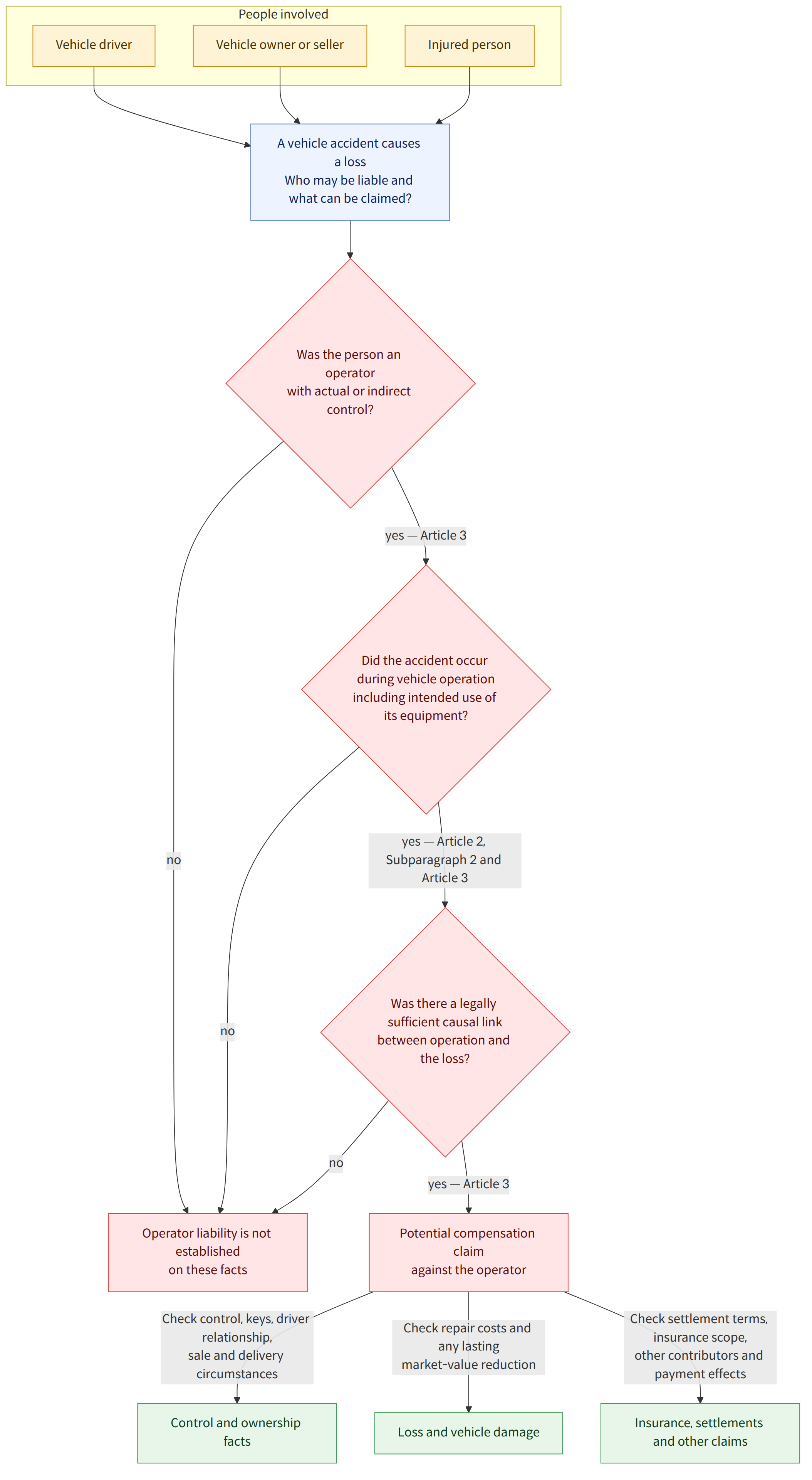
Key points
- Under the Guarantee of Automobile Accident Compensation Act (자동차손해배상 보장법), an operator may include not only a person who exercises actual control over a vehicle but also someone who has indirect control, or the ability to control it, in light of social norms (Guarantee of Automobile Accident Compensation Act, Article 3 (자동차손해배상 보장법 제3조); Examples 2, 3, and 5).
- Even in an accident involving unauthorized use of a vehicle, the owner may be found liable as an operator unless special circumstances show that the owner completely lost control over the vehicle’s operation and any benefit from its operation. This is determined by considering all the circumstances, including how the vehicle and its keys were kept and the owner’s relationship with the driver (Example 2).
- An accident may qualify as occurring during the operation of a vehicle even if the vehicle was not moving, if it occurred in the course of using the vehicle’s equipment for its intended purpose. However, it is not enough that the accident occurred during operation; a legally sufficient causal relationship between the operation and the accident must also be considered (Guarantee of Automobile Accident Compensation Act, Article 2, Subparagraph 2, and Article 3 (자동차손해배상 보장법 제2조 제2호·제3조); Examples 9, 10, 12, and 16).
- Even if a vehicle has been sold and delivered, the seller’s liability is not automatically established merely because the vehicle remains registered in the seller’s name. The terms of sale, whether the documents were handed over and the vehicle delivered, the insurance arrangements, and the seller’s ability to interfere with or manage the vehicle’s actual operation must all be considered (Example 5).
- When the conduct of multiple people contributes to a loss, their liability to the victim must be distinguished from the shares they must bear among themselves. If one person pays more than their share, the question may arise whether they can seek contribution from the other joint tortfeasors (Civil Act, Article 425 (민법 제425조); Examples 1, 11, and 20).
- If a vehicle sustains serious damage that cannot be fully repaired even after repairs, the resulting reduction in its market value may be recoverable in addition to repair costs. Whether the damage is serious is determined by considering various circumstances, including the location and extent of the damage, the repair method, and the vehicle’s age and mileage (Examples 18 and 23).
- The meaning and scope of settlement amounts or insurance benefits received by the victim or an insurance company may vary depending on the settlement terms, the circumstances of payment, and the insurance policy. Where an insurer’s subrogation rights or the effect of performance by a third party is at issue, the specific statements of intent and what the other party knew must also be considered (Examples 6, 7, and 13).
- Unless there are special circumstances, payment of medical expenses resulting from an accident may be treated as an acknowledgment of the debt for the accident-related losses as a whole, and may therefore affect the limitation period for claims for lost income or consolation money (Example 24).
Frequently asked questions
Q. Does a vehicle owner have to pay compensation if a family member secretly takes the vehicle and causes an accident?
Unless there are special circumstances showing that the owner completely lost control over the vehicle’s operation and any benefit from its operation, the owner may be liable as an operator. This is determined by considering all the circumstances, including how the keys were kept, the owner’s relationship with the driver, how the vehicle was taken without permission, and what the victim knew.
Q. Can an accident that occurs while a vehicle is stopped be considered an accident caused by its operation?
An accident may occur while a vehicle is parked or stopped, even if it is not being driven, in the course of using its equipment for its intended purpose. However, the fact that an accident occurred while the vehicle was in operation does not by itself determine liability; a legally sufficient causal relationship between the vehicle’s operation and the accident must also be considered.
Q. If I sold a car and handed over the documents and vehicle but did not transfer the registration, is the seller also liable?
The fact that the vehicle remains registered in the seller’s name does not, by itself, establish the seller’s liability as an operator. The circumstances of the sale and delivery, any agreement concerning the transfer-registration documents, the insurance arrangements, and whether the seller could manage or interfere with the vehicle’s operation must all be considered.
Q. If several people’s negligence contributed to an accident, whom can the victim claim compensation from?
If joint tort liability is established, multiple liable parties may owe compensation to the victim. The share each party must bear may be determined according to the degree of fault among those parties. If one party pays more than their share, the question may arise whether they can seek contribution from the other liable parties.
Q. Can I claim compensation if my car’s used-car value has fallen even after repairs were completed?
If a serious accident damages major structural parts of the vehicle or otherwise leaves damage that cannot be fully repaired even after repairs, the resulting reduction in the vehicle’s market value may be recoverable as ordinary loss in addition to repair costs. Whether the damage is serious is determined by considering all the circumstances, including how the accident occurred, the damaged parts, the repair method, and the vehicle’s condition.
Q. The insurance company paid my medical expenses. Can I later claim lost income or consolation money too?
If the insurance company paid the accident-related medical expenses before the limitation period expired, this may, absent special circumstances, be treated as an acknowledgment of the entire compensation debt arising from the accident. Accordingly, the payment of medical expenses may affect the limitation period for claims for lost income or consolation money as well.
Q. Can the insurance company seek reimbursement even if the at-fault party did not know that I received insurance benefits after settling?
The circumstances at the time of settlement are important, including whether the at-fault party knew or could have known that the victim was entitled to benefits under uninsured-motorist coverage. The scope of the insurance company’s subrogation rights and whether the insurance benefits paid to the victim exceeded the actual loss must also be considered.
Q. Can I receive compensation if I am in an accident involving a vehicle whose driver cannot be identified?
If a person is killed or injured by the operation of a vehicle whose owner cannot be identified, they may claim compensation under the compensation program provided by the Guarantee of Automobile Accident Compensation Act. The example explains how to submit documents proving the accident and the resulting injury to the insurance company responsible for handling compensation claims.
Relevant laws
- Guarantee of Automobile Accident Compensation Act, Article 2, Subparagraph 2 (자동차손해배상 보장법 제2조 제2호)
- Guarantee of Automobile Accident Compensation Act, Article 3 (자동차손해배상 보장법 제3조)
- Guarantee of Automobile Accident Compensation Act, Article 5, Paragraph 1 (자동차손해배상 보장법 제5조 제1항)
- Guarantee of Automobile Accident Compensation Act, Article 9, Paragraph 1 (자동차손해배상 보장법 제9조 제1항)
- Guarantee of Automobile Accident Compensation Act, Article 11 (자동차손해배상 보장법 제11조)
- Guarantee of Automobile Accident Compensation Act, Article 26 (자동차손해배상 보장법 제26조)
- Guarantee of Automobile Accident Compensation Act, Article 30, Paragraph 1, Subparagraph 1 (자동차손해배상 보장법 제30조 제1항 제1호)
- Guarantee of Automobile Accident Compensation Act, Article 45 (자동차손해배상 보장법 제45조)
- Enforcement Decree of the Guarantee of Automobile Accident Compensation Act, Article 3 (자동차손해배상 보장법 시행령 제3조)
- Civil Act, Article 421 (민법 제421조)
- Civil Act, Article 425 (민법 제425조)
- Civil Act, Article 469 (민법 제469조)
- Civil Act, Article 470 (민법 제470조)
- Civil Act, Article 756 (민법 제756조)
- Commercial Act, Article 659, Paragraph 1 (상법 제659조 제1항)
Watch out for
- Whether liability exists and its scope may vary depending on the specific facts, including how the accident occurred, the ability to control the vehicle’s operation, the victim’s status, and causation.
- The registered owner’s name alone does not determine who actually controlled the vehicle’s operation. Relevant materials, including the vehicle’s delivery, the terms of sale, and insurance arrangements, should also be reviewed.
- The scope of coverage under an insurance policy and whether the insurer has a right of subrogation may depend on the policy terms and the circumstances of payment and settlement. The scope of a claim should not be determined solely by the amount paid.
- Some provisions of the Road Traffic Act (도로교통법) and its Enforcement Rule (시행규칙) referenced in the examples are based on legislation in force before amendment. The laws applicable to the actual case and the limitation period should be checked separately.
Source cases
This guide was compiled by AI from the following Korea Legal Aid Corporation consultation cases (in Korean).
- 소멸시효를 이유로 공동불법행위자의 구상권을 거절할 수 있는지
- 미성년의 아들이 열쇠를 몰래 가져가 무면허운전 중 사고를 낸 경우
- 자동차수리업자의 종업원이 시운전 중 사고 낸 경우 운행책임자
- 자동차보험 보통약관에 있는 ‘피해자 측의 과실비율에 따라 상계한 후의 금액이 치료관계비 해당액에 미달하는 경우에는 그 치료관계...
- 이전서류를 받은 자동차매수인이 명의이전을 미루던 중 사고가 난 경우
- 보험자가 대리운전업자와 자동차보험계약을 체결하면서 대리운전차량이 자동차손해배상보장법상 책임보험대상인 경우에는 그 초과액만을 보...
- 보험자가 피보험자의 손해배상청구권을 대위할 수 있는지
- 동일한 사고로 인하여 부상한 자에게 후유장해가 생긴 경우, 책임보험금 산정방법을 규정하고 있는 자동차손해배상 보장법 시행령 제...
- 구급차로 환자를 병원에 후송한 후 구급차에 비치된 들것(간이침대)으로 환자를 하차시키던 도중 들것을 잘못 조작하여 환자를 땅에...
- 자동차손해배상법 제3조에서 규정하는 ‘운행으로 인하여’의 판단 기준
- 고속도로에서 후행 추돌사고로 선행 사고차량에서 흘러나온 휘발유 등에 불이 붙어 화재가 발생한 경우의 후행차량의 책임유무
- 정차한 버스에서 내리던 승객이 넘어져 다친 경우 운행 중의 사고인지
- 무보험자동차 상해담보보험의 보험자대위의 범위가 약관상 지급기준에 따른 보험금 지급의무가 인정되는 범위에 한정되는지 여부
- 자동차보험 특별약관에서 ‘보험회사는 피보험자동차가 양도된 날로부터 15일째 되는 날의 24시까지 그 자동차를 피보험자동차로 간...
- 면책사유인 ‘피보험자의 고의에 의한 사고’에서 ‘고의’의 의미
- 기중기 장치로 공사자재를 옮기던 도중 공사자재가 손괴된 경우가 영업용 자동차 보험사고에 해당하는지 여부
- 신원 불상의 도주차량에 교통사고를 당한 피해자의 구제방법
- 수리비 외에 수리불능으로 인한 교환가치의 감소액도 통상의 손해에 해당하는지 여부
- 고속도로에서 교통사고시 보행자의 책임
- 영업용택시를 타고 가던 중 사고로 부상당한 경우 손해배상청구권
- 대리운전기사에 의한 대리운전 중 발생한 교통사고에 대한 책임
- 무면허운전 중 상대방의 과실에 의해 부상당한 경우 국민건강보험이 적용되는지
- 불법행위로 훼손된 물건을 수리한 후에도 수리가 불가능한 부분이 남아있는 경우, 수리비 외에 수리불능으로 인한 교환가치의 감소액...
- 불법행위에 따른 손해배상청구권의 소멸시효 완성 전에 가해자의 보험자가 피해자의 치료비를 자동차손해배상보장법에 따라 의료기관에 ...
- 경과실만 있는 공무원이 자동차의 운행자에 해당하는 경우
This guide is general legal information about Korean law, not legal advice for your situation. For a specific case, consult a lawyer or the Korea Legal Aid Corporation (call 132 in Korea).