
A Guide to Claiming and Changing Child Support and Securing Payment
Based on 50 consultation cases · Updated · Translated from the Korean original.
Parents have a duty to support their minor children, and child support set at the time of divorce may also be changed depending on the child’s welfare and the parents’ circumstances. It may also be possible to claim past child support or take steps to secure payment of unpaid support, but the outcome may vary depending on whether paternity has been legally established, the terms of any existing agreement or court decision, and the circumstances in which the child was actually raised.
At a glance
Key points
- When divorcing, parents may agree on who will care for the child, responsibility for child support, visitation, and other matters. If they cannot reach an agreement, or the agreement is not in the child’s welfare, the Family Court may decide these matters (Civil Act, Article 837 (민법 제837조)).
- Even matters settled by agreement or mediation concerning child support may be changed by applying to the Family Court if they are unfair in light of all the circumstances or need to be changed. A material change in circumstances is not the only basis for a change (Supreme Court, Judgment of June 25, 1991, 90Meu699; Cases 2 and 15).
- If one parent has raised the child, that parent may, absent special circumstances, seek an appropriate contribution from the other parent toward both future and past child-rearing expenses. The amount of any contribution for past expenses is determined in light of factors such as how the child was raised, the expenses, and the parents’ financial circumstances (Supreme Court, Decision of May 13, 1994, 92Seu21; Case 5).
- Even if the parents signed an undertaking waiving child support, an application for a change may be made after considering its terms, the circumstances in which it was made, and the child’s welfare. An agreement between the parents does not, by itself, automatically restrict the child’s own specific claim for support (Cases 2 and 4).
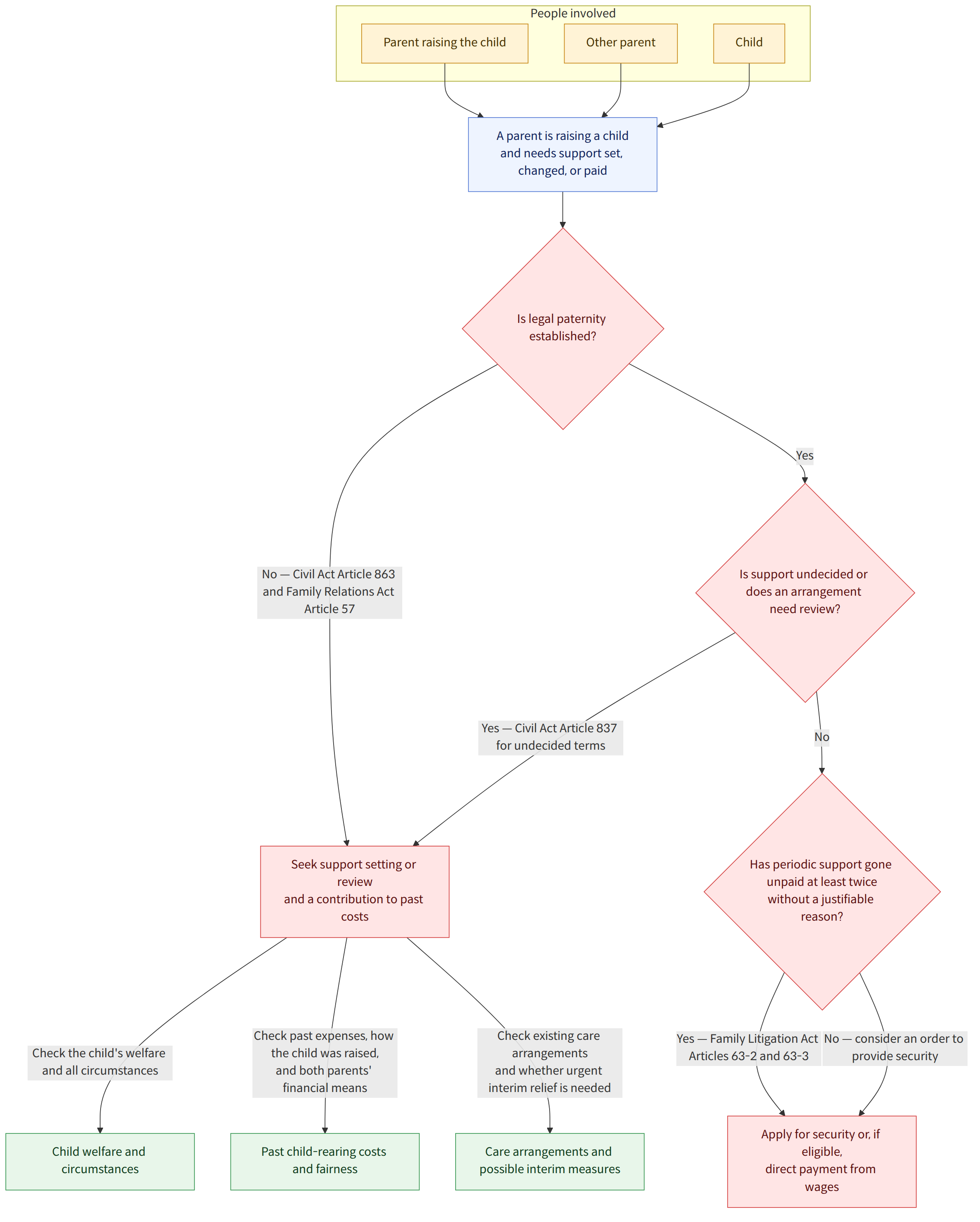
- A child born to parents in a de facto marriage may not have a legally established parent-child relationship with the father until paternity is acknowledged. Before claiming child support, it may therefore be necessary to determine whether a birth report has the legal effect of an acknowledgment of paternity or to pursue a procedure to establish paternity (Civil Act, Article 863 (민법 제863조); Act on Registration of Family Relations, Article 57 (가족관계의 등록 등에 관한 법률 제57조); Cases 1 and 24).
- A lower-court decision found that, where necessary for the child’s welfare, a parent may seek designation as the child’s caregiver and child support even while the parents are living apart. However, this was a lower-court case discussed as an example, and the outcome may vary depending on the specific circumstances (Case 6).
- If you continue to raise a child without following the existing arrangements for the child’s care, you may be unable to claim child support for the period before a new agreement or court decision is made. If circumstances are urgent, you may consider seeking interim measures through a preliminary disposition (Supreme Court, Judgment of January 21, 1992, 91Meu689; Case 8).
- To secure payment of periodic child support, you may apply for an order to provide security or an order requiring direct payment from wages. A direct-payment order requires that child support has gone unpaid at least twice without a justifiable reason (Family Litigation Act, Articles 63-2 and 63-3 (가사소송법 제63조의2, 제63조의3); Cases 19 and 23).
Frequently asked questions
Q. We did not decide on child support when we divorced. Can I claim it later?
If the parents have not reached an agreement on child support, or cannot do so, either parent may ask the Family Court to determine child support. The court considers various circumstances, including the child’s age and the parents’ financial circumstances (Civil Act, Article 837 (민법 제837조)).
Q. Can I claim child support again even though I signed an undertaking waiving it?
Even if you have signed a written undertaking, the Family Court may change the child-support arrangement if it finds that the agreed terms are unfair in light of all the circumstances. The circumstances in which the undertaking was made and the child’s welfare are among the specific factors that matter.
Q. Can I claim child support for the period when I raised the child alone?
You may seek a contribution from the other parent toward past child-rearing expenses. However, past expenses are not necessarily determined using the same standard in every case. The court considers factors such as how the child came to be raised by you, the actual expenses, the parents’ financial means, and fairness in allocating the burden.
Q. Can a child born to parents in a de facto marriage claim child support from the father?
According to the case, a child born to parents in a de facto marriage is treated as a child born outside marriage, and it must be determined whether a legal parent-child relationship has been established with the father. A birth report may have the legal effect of an acknowledgment of paternity; if it does not, you may claim child support after completing the procedure to establish paternity.
Q. Can I claim child support while living apart before getting divorced?
A lower-court case found that, even while a married couple is living apart, a parent may seek designation as the child’s caregiver and claim child support, taking into account the child’s welfare and living environment. This is not automatically allowed in every separation, however, so the specific circumstances must be considered.
Q. We agreed on child support, but the amount is not enough. Can it be changed?
You may ask the Family Court to change child support agreed upon through negotiation or mediation. The court may consider not only whether there has been a material change in circumstances, but also whether the existing agreement is unfair in light of all the circumstances.
Q. If I am not receiving child support, can it be paid directly from the payer’s wages?
If periodic child support has not been paid at least twice without a justifiable reason, a creditor holding an enforceable title may ask the Family Court to order that child support be deducted from the payer’s wages and paid directly. According to the case, the missed payments do not need to be consecutive; two or more missed payments in total are sufficient.
Q. We agreed that I would receive child support regularly. Can I require security?
The Family Court may order the provision of security to ensure that child support is paid. Failure to comply with an order to provide security without a justifiable reason may result in an administrative fine.
Relevant laws
- Civil Act, Article 4 (민법 제4조)
- Civil Act, Article 837 (민법 제837조)
- Civil Act, Article 843 (민법 제843조)
- Civil Act, Article 860 (민법 제860조)
- Civil Act, Article 863 (민법 제863조)
- Civil Act, Article 864 (민법 제864조)
- Civil Act, Article 908-2 (민법 제908조의2)
- Civil Act, Article 909 (민법 제909조)
- Civil Act, Article 913 (민법 제913조)
- Civil Act, Article 978 (민법 제978조)
- Family Litigation Act, Article 2 (가사소송법 제2조)
- Family Litigation Act, Article 62 (가사소송법 제62조)
- Family Litigation Act, Article 63-2 (가사소송법 제63조의2)
- Family Litigation Act, Article 63-3 (가사소송법 제63조의3)
- Family Litigation Act, Article 64 (가사소송법 제64조)
Watch out for
- A written undertaking or agreement concerning child support is not necessarily final in every case, but whether it can be changed is assessed based on the specific circumstances, including how it was made and the child’s welfare.
- If you raise a child without following the existing court-ordered or agreed arrangements for the child’s care, you may be unable to receive child support for that period. If circumstances change urgently, you should consider procedures such as applying for interim measures.
- Even if you can claim past child support, you cannot assume that the full amount will be awarded or that it will be calculated using the same standard as future child support. The circumstances in which the child was raised, the actual expenses, and the parents’ financial means are among the factors considered.
Related articles
Source cases
This guide was compiled by AI from the following Korea Legal Aid Corporation consultation cases (in Korean).
- 사실혼 중 출생한 미성년의 자녀에 대한 양육권자지정신청
- 양육비청구권 포기각서를 번복하여 양육비청구를 할 수 있는지
- 이혼 시 자녀양육권자를 정하는 방법
- 모가 양육비포기각서를 작성한 경우 그 자(子)의 양육비청구권
- 이혼 후 자녀를 부양해 온 모(母)의 과거양육비청구권
- 별거중인 부부 사이의 미성숙자녀에 대한 양육비청구 가부 및 그 양육비의 범위
- 협의이혼 시 자녀들에 대한 양육비 등에 대한 약정의 효력
- 양육권 없는 자가 양육한 기간동안의 양육비청구 가능한지
- 이혼 당시 지정했던 친권자와 양육권자를 변경할 수 있는지
- 양육권자에게 유아인도를 거절하는 경우 대처방법
- 유아인도명령으로 인한 자녀의 인도 전까지 기간 과거양육비를 청구 가부
- 재판상 이혼의 경우 양육권 재판의 누락
- 성년 연령 변경과 양육비 지급의 종료 시점
- 양육비 긴급지원 제도
- 양육에 관한 사항이 정해진 후 가정법원이 그 사항을 변경할 수 있는지
- 과거 양육비에 대한 소멸시효 진행 여부
- 양육비에 갈음하여 부동산 양도시 양도소득세 산정 기준
- 협의 이혼을 전제로 한 양육비 지급 약정의 효력
- 양육비 지급 간접 이행 강제 지원
- 협의가 이루어진 후 제기된 양육비 청구가 양육비 부담 변경 청구로 볼 수 있는지 여부
- 한부모가족에 대한 양육비 지원 제도
- 양육비 결정 없이, 타방과 재혼한 자가 자녀에 대해 친양자 지정을 할 수 있는지
- 근로소득이 있는 상대방으로부터 양육비이행 확보수단
- 사실혼 배우자에 대한 양육비 지급청구
- 양육권과 친권이 각각 달리 귀속될 수 있는지
This guide is general legal information about Korean law, not legal advice for your situation. For a specific case, consult a lawyer or the Korea Legal Aid Corporation (call 132 in Korea).