
Guide to Civil Agency Authority and Liability for Apparent Agency
Based on 73 consultation cases · Updated · Translated from the Korean original.
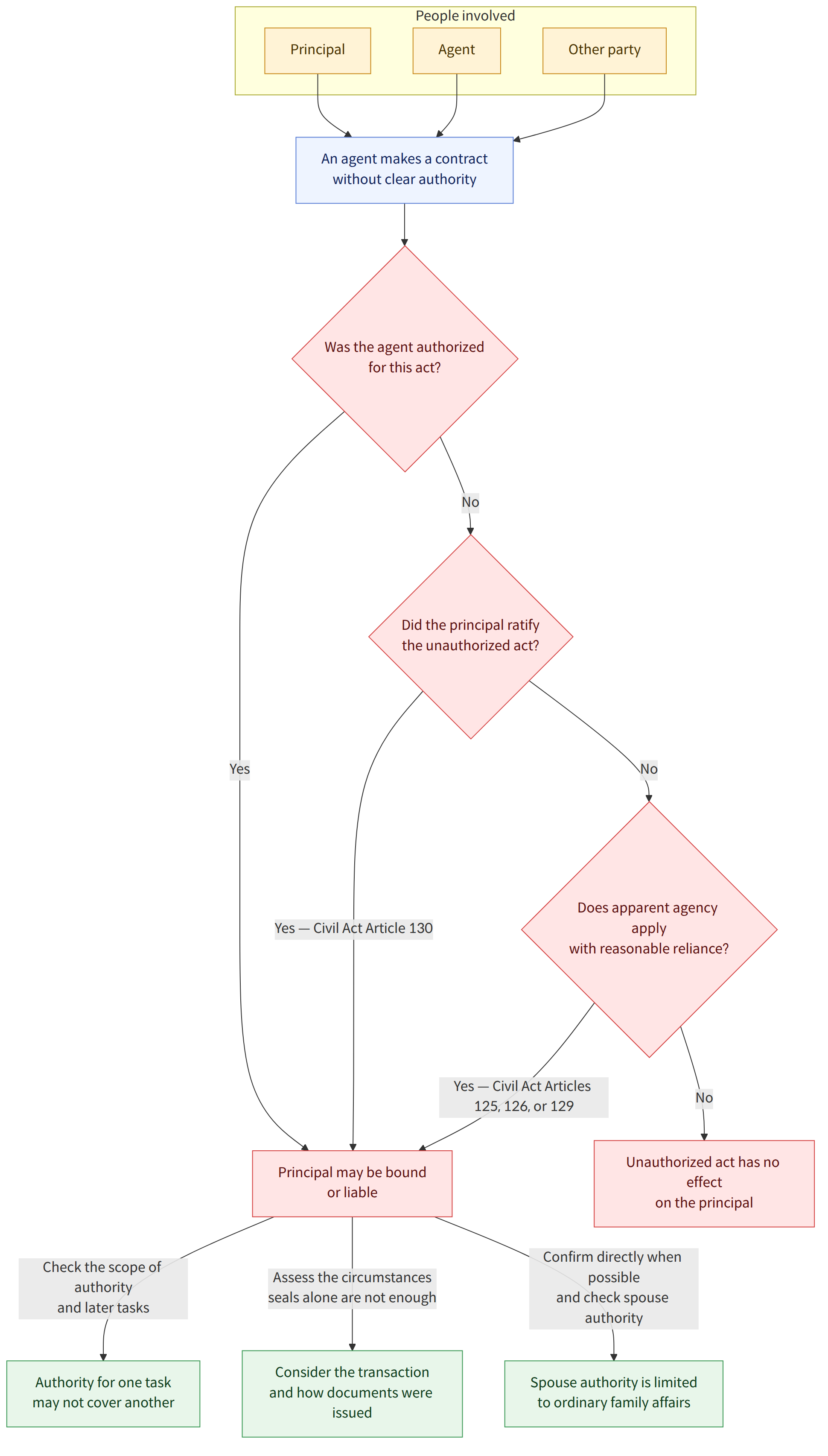
As a general rule, a contract entered into without agency authority has no effect on the principal, but the principal may be liable if the statutory requirements for apparent agency are met. Merely possessing a certificate of seal impression or a seal does not establish agency authority; the scope of the authority and the circumstances at the time of the transaction must also be considered.
At a glance
Key points
- An unauthorized agency act has no effect on the principal unless the principal ratifies it (Civil Act, Article 130 (민법 제130조)).
- Apparent agency is divided into cases where the grant of agency authority was represented, where the agent exceeded their existing authority, and where the transaction took place after the authority had expired, among others; the requirements differ in each case (Civil Act, Articles 125 (민법 제125조), 126 (민법 제126조), and 129 (민법 제129조)).
- Whether there was reasonable cause is determined by objectively examining the various circumstances at the time of the agency act. The mere fact that the agent possesses documents such as a certificate of seal impression or a seal may not be sufficient (Cases 1, 4, 20, and 25).
- If the other party could have directly checked the agent’s authority with the principal but did not do so, a court may find that there was no reasonable cause (Cases 4, 9, 17, 20, and 23).
- A spouse’s agency authority is limited to acts in the ordinary course of family affairs. Disposing of real estate or guaranteeing another person’s debt, for example, generally cannot be treated as authorized solely because it concerns ordinary family affairs; separate objective circumstances are needed for apparent agency to be established (Civil Act, Articles 827 (민법 제827조) and 832 (민법 제832조); Cases 3, 11, and 13).
- The fact that a spouse is unconscious does not, by itself, create agency authority for all legal acts outside the ordinary course of family affairs (Case 14).
- Being entrusted with entering into a contract does not automatically establish authority to handle subsequent matters, such as canceling the contract or receiving payment (Civil Act, Articles 128 (민법 제128조) and 129 (민법 제129조); Case 7).
- An unauthorized agency act may be ratified expressly or impliedly, but the fact that no criminal complaint was filed for a long time does not, by itself, establish ratification (Civil Act, Articles 130 (민법 제130조) and 133 (민법 제133조); Case 24).
Frequently asked questions
Q. Is a contract valid if an agent has a certificate of seal impression and the seal?
The fact alone does not automatically establish agency authority or apparent agency. The matter is assessed by considering the contents of the documents, the circumstances in which they were issued and delivered, the type of transaction, and whether the principal was contacted for confirmation, among other factors.
Q. Am I liable if my spouse provides my real estate as security without my consent?
Providing real estate as security is generally difficult to regard as an act of ordinary family affairs. However, the likelihood of liability based on apparent agency depends on whether there were objective circumstances that made it reasonable to believe the spouse had been entrusted with that act.
Q. If my spouse borrowed money to pay the purchase price for a home for our family, must I also repay it?
The purpose of the loan alone does not determine the outcome. Whether the debt is one incurred in the ordinary course of family affairs is assessed by considering various circumstances, including the amount, how the funds were actually used, the need for housing, and the spouses’ assets and income.
Q. If the principal is unconscious, can the spouse enter into all contracts on their behalf?
No. The fact that the principal is unconscious does not, by itself, give the spouse authority to act as an agent in all legal matters, including assuming debts. A separate basis, such as an authorization, is required for acts outside the ordinary course of family affairs.
Q. How can I safely verify an agent’s authority in a real estate sale?
Checking only the power of attorney and certificate of seal impression may not be enough. It is important to examine the transaction and the circumstances in which the documents were issued and delivered and, if possible, to confirm directly with the principal their intention to sell and the scope of the agent’s authority.
Q. Can I also authorize the agent who entered into the contract to receive the return of the deposit?
Authority to enter into a contract does not automatically include authority to cancel it or receive a refund. If you do not verify whether the agent has authority for subsequent tasks, you may end up having to return the money to the principal.
Q. If a bank employee secretly withdrew my deposit, can I claim that the bank must return it?
The precedent in the cited case held that the fact that an employee had been handling off-premises deposit collection did not, by itself, establish that the customer had authorized that employee to act as an agent to withdraw the customer’s deposit. Whether you can claim that the financial institution must return the deposit depends on the specific circumstances of the transaction.
Q. If no criminal complaint is filed for a long time about an unauthorized agency act, is that treated as consent?
The fact that no criminal complaint was filed for a long time does not, by itself, establish implied ratification. It is necessary to consider whether there were other circumstances showing that the principal expressed an intention to accept the effects of the act.
Q. How can I contest compulsory execution based on a notarized deed prepared by an unauthorized agent?
The precedent in the cited case held that the Civil Act provisions on apparent agency do not apply to the preparation of a notarized deed containing consent to compulsory execution. Compulsory execution may be contested by filing an action to oppose the claim, but filing the action does not, by itself, suspend execution, so the issue of a stay of execution must also be addressed separately.
Relevant laws
- Civil Act, Article 114 (민법 제114조)
- Civil Act, Article 115 (민법 제115조)
- Civil Act, Article 125 (민법 제125조)
- Civil Act, Article 126 (민법 제126조)
- Civil Act, Article 128 (민법 제128조)
- Civil Act, Article 129 (민법 제129조)
- Civil Act, Articles 130 through 133 (민법 제130조부터 제133조까지)
- Civil Act, Article 135, Paragraph 1 (민법 제135조 제1항)
- Civil Act, Article 827, Paragraph 1 (민법 제827조 제1항)
- Civil Act, Article 832 (민법 제832조)
Watch out for
- Whether there was reasonable cause for apparent agency is assessed based on the circumstances at the time of the agency act. Circumstances learned of only after the transaction do not automatically establish or negate reasonable cause at the time.
- Even if documents such as a certificate of seal impression, a seal, or a power of attorney are present, you should verify the scope of the authorization, the circumstances in which the documents were provided, and the principal’s actual intention.
- Filing an action to oppose a claim concerning a notarized deed executed by an unauthorized agent does not automatically suspend compulsory execution.
Source cases
This guide was compiled by AI from the following Korea Legal Aid Corporation consultation cases (in Korean).
- 인감증명서를 도용당한 본인의 표현대리책임 성립 여부
- 법인명의 예금의 거래인감 변경신고 시 은행의 주의의무
- 정신병원에 입원한 남편소유 주택을 처가 매도한 경우 그 효력
- 소유자 인감증명서의 소지자와 부동산매매계약체결 한 경우 그 효력
- 처가 남편명의 아파트의 분양대금을 빌린 경우 남편의 책임
- 훔친 인감증명으로 집행력 있는 공증을 한 경우 표현대리 성립 여부
- 민법 제129조의 표현대리
- 파출수납해온 은행직원이 예금주 몰래 예금을 인출한 경우
- 건축공사 수급인이 임의로 주택을 임대한 경우 그 효력
- 처가 남편명의의 차용증을 작성·교부한 경우 남편의 책임
- 대리권 없는 남편이 처의 대리로 체결한 연대보증계약과 표현대리
- 민법 제126조를 유추적용할 수 있는 경우 (2)
- 부부가 연대하여 대여금 반환의무를 부담하는 경우
- 교통사고로 의식불명인 자의 배우자에게 법률행위대리권이 있는지
- 피상속인의 무권대리인이 상속인이 된 경우 무권대리의 효력
- 건설회사의 명의차용인인 소위 부금상무의 무권대리행위인 회사 명의의 어음배서행위의 효력
- 부부 일방이 허락 없이 한 대리행위의 효력 (1)
- 본인을 위한 것임을 표시하지 않은 경우 표현대리 성립 여부
- 대리권한을 넘은 부동산거래의 효력(3)
- 대리권한을 넘은 부동산거래의 효력(1)
- 부부 일방이 허락 없이 한 대리행위의 효력 (3)
- 민법 제115조 단서를 묵시적 대리권 수여에도 적용 가능한지
- 대리권한을 넘은 부동산거래의 효력(4)
- 무권대리행위의 묵시적 추인
- 대리권한을 넘은 부동산거래의 효력(5)
This guide is general legal information about Korean law, not legal advice for your situation. For a specific case, consult a lawyer or the Korea Legal Aid Corporation (call 132 in Korea).