
Civil Appeals: Deadlines and Methods of Challenging a Judgment
Based on 136 consultation cases · Updated · Translated from the Korean original.
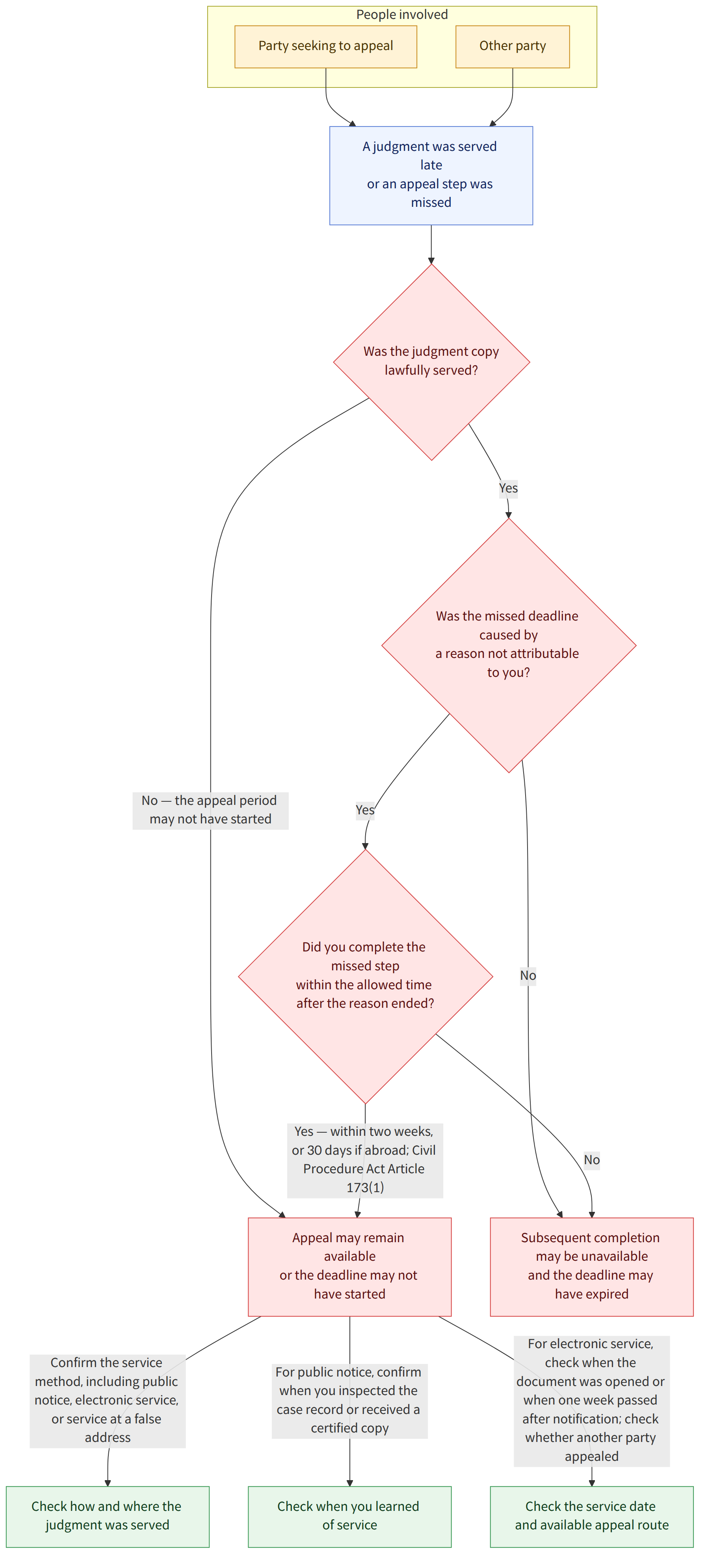
In civil proceedings, appeals to an intermediate appellate court or the Supreme Court must comply with the prescribed deadlines and procedures. If a party missed a deadline for a reason not attributable to them, subsequent completion may be available. However, the effect and available remedies vary depending on the facts, including whether service was made by public notice, at a false address, or through electronic litigation. The method of service and when the party learned of it should therefore be confirmed.
At a glance
Key points
- If you miss a non-extendable period for a reason not attributable to you, you may complete the missed procedural act within two weeks from the day that reason ceased to exist. If you were abroad when the reason ceased to exist, the period is 30 days (Civil Procedure Act, Article 173(1) (민사소송법 제173조 제1항)).
- The time when you learned that a judgment had been served by public notice may differ from when you merely learned that a judgment existed. Generally, you may be considered to have learned of service by public notice when you inspected the case record or received a certified copy of the judgment (Cases 2, 3, and 4).
- Whether subsequent completion is available should be considered differently when documents from the copy of the complaint through the certified copy of the judgment were served by public notice, and when documents were ordinarily served at first but later served by public notice after service could not be effected during the proceedings (Cases 2 and 3).
- If the other party gave a false address and someone else received the litigation documents, the certified copy of the judgment may not have been lawfully served, meaning that the appeal period may not have started. By contrast, in one case, service of a judgment by public notice was held effective even though the requirements for service by public notice were defective. The situations must therefore be distinguished (Cases 5, 17, and 19).
- In electronic litigation, an electronic document is deemed served when it is checked after being posted. If it is not checked within one week after notification, it is deemed served when that week has passed. If it could not be checked for a reason not attributable to the party, the missed act may be completed within two weeks from the day that reason ceased to exist (Electronic Documents Act, Article 11(4) (전자문서법 제11조 제4항); Rules on Electronic Litigation, Article 26 (전자소송규칙 제26조)).
- If a party did not appeal or file an incidental appeal as to a portion of the first-instance judgment adverse to them, that portion may not be appealed separately to the Supreme Court if it was not reviewed by the appellate court. Conversely, if the other party appealed, the appellee may seek to change an adverse portion by incidental appeal or expand the claim (Cases 23 and 24).
- An agreement not to appeal made before judgment must clearly state in writing that no appeal will be filed. The phrase “abide by the outcome of the judgment” alone may not establish an agreement not to appeal (Case 11).
- The court to which a case is remanded is, in principle, bound by the determination on which the Supreme Court based its decision to vacate the judgment. However, it may reach the same conclusion as before remand if new arguments or evidence after remand change the facts, or if it makes a determination different from the one given as grounds for vacatur (Civil Procedure Act, Article 436(2) (민사소송법 제436조 제2항); Cases 6 and 21).
Frequently asked questions
Q. I learned belatedly that I lost because service was made by public notice. Can I appeal again?
If you missed the appeal period for a reason not attributable to you, you may be able to file an appeal by subsequent completion. The relevant time may be when you learned that service had been made by service by public notice, rather than merely when you learned that a judgment had been issued. You should generally confirm when you inspected the case record or received a certified copy of the judgment. You must take the required steps within two weeks from the day the reason ceased to exist (Civil Procedure Act, Article 173(1) (민사소송법 제173조 제1항)).
Q. If judgment was entered by public notice after I moved during the lawsuit, can I file an appeal by subsequent completion?
Unlike a case in which a copy of the complaint and other documents were served by public notice from the outset, when a party moves during the proceedings without notifying the court of a change in the place of service and documents are then served by public notice after service cannot be effected, it must be separately considered whether the party had a reason not attributable to them for missing the deadline. Accordingly, it cannot be assumed that subsequent completion will automatically be allowed merely because service was made by public notice.
Q. What should I do if the other party sued me using a false address to obtain a judgment, even though they knew my address?
If documents were served at a false address and received by someone other than you, the certified copy of the judgment may not have been lawfully served on you, meaning that the appeal period may not have started. In that case, you may file an appeal, rather than an appeal by subsequent completion or a retrial. If a registration has already been made pursuant to the judgment, you may also separately seek cancellation of the registration. This situation should be distinguished from service by public notice.
Q. I did not check an electronic litigation document, and the judgment became final. Is there a way to appeal?
Even if you do not check an electronic litigation document, it may be deemed served once one week has passed from the date you were notified that it had been posted. However, if a registered user was unable to check the document within that period for a reason not attributable to them, they may complete the missed procedural act within two weeks from the day that reason ceased to exist. The fact that you did not receive a notification does not, by itself, establish that the requirements have been met.
Q. Part of my claim was dismissed at first instance, but I did not appeal. Can I appeal only that part to the Supreme Court after the appellate proceedings?
Even if the other party appealed and the case proceeded to the appellate court, the portion of the first-instance judgment adverse to you that you did not appeal or challenge by incidental appeal may not be subject to review by the appellate court. There is a case in which it was held that a party may not appeal to the Supreme Court solely as to that portion if the appellate court did not rule on it.
Q. The other party alone appealed. Can I increase my claim in the appellate court?
If the other party appeals, the appellee may file an incidental appeal before the close of oral arguments or expand the relief sought to claim matters not contested at first instance. The extent to which expanding the claim puts the other party at a disadvantage may be treated as an incidental appeal. However, if the principal appeal is withdrawn or dismissed as improper, the incidental appeal may also lose effect.
Q. If we agreed during the lawsuit to “abide by the outcome of the judgment,” can I no longer appeal?
That wording alone may not be sufficient to show that the parties clearly agreed not to appeal. To make an agreement not to appeal before judgment, the agreement must be in writing and must clearly state that no appeal will be filed.
Q. Can a court on remand reach a conclusion different from the Supreme Court’s decision vacating and remanding the case?
The court to which a case is remanded is, in principle, bound by the Supreme Court’s factual and legal determinations that formed the basis for vacating the judgment. However, it may reach the same conclusion as before remand if new arguments or evidence after remand change the facts underlying the determination, or if it reaches that conclusion on a different basis while avoiding the determination identified as erroneous in the grounds for vacatur.
Relevant laws
- Civil Procedure Act, Article 34 (민사소송법 제34조)
- Civil Procedure Act, Article 39 (민사소송법 제39조)
- Civil Procedure Act, Article 59 (민사소송법 제59조)
- Civil Procedure Act, Article 64 (민사소송법 제64조)
- Civil Procedure Act, Article 82(1) (민사소송법 제82조 제1항)
- Civil Procedure Act, Article 109(1) (민사소송법 제109조 제1항)
- Civil Procedure Act, Article 117(1) (민사소송법 제117조 제1항)
- Civil Procedure Act, Article 118 (민사소송법 제118조)
- Civil Procedure Act, Article 121 (민사소송법 제121조)
- Civil Procedure Act, Article 173(1) (민사소송법 제173조 제1항)
- Civil Procedure Act, Article 186(1) (민사소송법 제186조 제1항)
- Civil Procedure Act, Article 194 (민사소송법 제194조)
- Civil Procedure Act, Article 213(1) (민사소송법 제213조 제1항)
- Civil Procedure Act, Article 252 (민사소송법 제252조)
- Civil Procedure Act, Article 395 (민사소송법 제395조)
Watch out for
- The period for subsequent completion is not uniformly measured from the day you learned of the judgment; it is determined from the day the reason not attributable to you ceased to exist. You should also confirm when you learned that service was made by public notice.
- The legal effect and appropriate response may differ when another person received documents sent to a false address and when the court served documents by public notice.
- If you wish to contest a portion of the first-instance judgment in the appellate court, confirm that you included it within the matters for review by filing an appeal or incidental appeal.
Related articles
Source cases
This guide was compiled by AI from the following Korea Legal Aid Corporation consultation cases (in Korean).
- 소송구조
- 항소장 부본 등의 공시송달로 인하여 항소심의 소송계속을 몰라 변론의 기회가 없었음을 이유로 소액사건의 항소심판결에 대하여 ...
- 송달불능으로 공시송달 된 때 추후보완항소가 가능한지
- 민사소송법 제186조 제1항 에서 말하는 ‘송달할 장소’와 ‘동거인’의 의미 및 판결의 선고 및 송달 사실을 알지 못하여 상소...
- 피고의 주소를 허위로 하여 승소판결을 받은 경우 구제방법
- 환송판결의 기속력이 재상고심의 전원합의체에도 미치는지
- 임차보증금 지급 판결의 기판력이 연체차임 채무의 부존재에도 미치는지
- 전자소송의 송달방법
- 확정판결의 집행이 권리남용이 되는 경우 청구이의의 소송 허용 여부
- 건물철거소송 중 건물이 양도된 경우 취해야 할 절차
- 판결 선고 전의 불상소 합의의 방식
- 한정위헌결정이 법원의 법령해석·적용권한에 대해 기속력이 있는지
- 관할위반을 이유로 한 이송신청의 기각결정에 대한 특별항고의 가부
- 정기금 지급판결 확정 후 사정변경을 이유로 추가청구 가능한지
- 가집행선고가 가능한 경우와 불가능한 경우
- 상소심에서 소송비용에 대한 담보제공 신청을 할 수 있는지
- 주소를 알고도 공시송달로 승소확정판결 받은 경우 구제방법
- 대표권의 보정이 항소심에서도 가능한지 여부
- 사위(詐僞)판결에 대한 항소없이 곧바로 이전등기말소청구 가능한지
- 항소인이 항소장 제출 이후 피항소인이 소송대리인을 선임하기 전에 불복신청의 범위를 감축한 경우, 소송비용에 산입되는 변호사의 ...
- 원심법원에서 환송 전 판결과 같은 판단을 한 경우 위법한 것인지
- 소송촉진 등에 관한 특례법 제23조에 따라 진행된 제1심의 불출석 재판에 대하여 검사만 항소하고 항소심도 불출석 재판으로 진행...
- 제1심 일부기각 후 항소제기 안한 원고가 제1심 기각부분 상고 가능한지
- 교통사고로 인한 손해배상청구 시 부대항소로 청구취지 확장 가능한지
- 제1심 법원이 반의사불벌죄로 기소된 피고인에 대하여 소송촉진 등에 관한 특례법 제23조에 따라 피고인의 진술 없이 유죄를 선고...
This guide is general legal information about Korean law, not legal advice for your situation. For a specific case, consult a lawyer or the Korea Legal Aid Corporation (call 132 in Korea).