
Guide to Asset Disclosure and Asset Inquiries in Civil Enforcement
Based on 12 consultation cases · Updated · Translated from the Korean original.
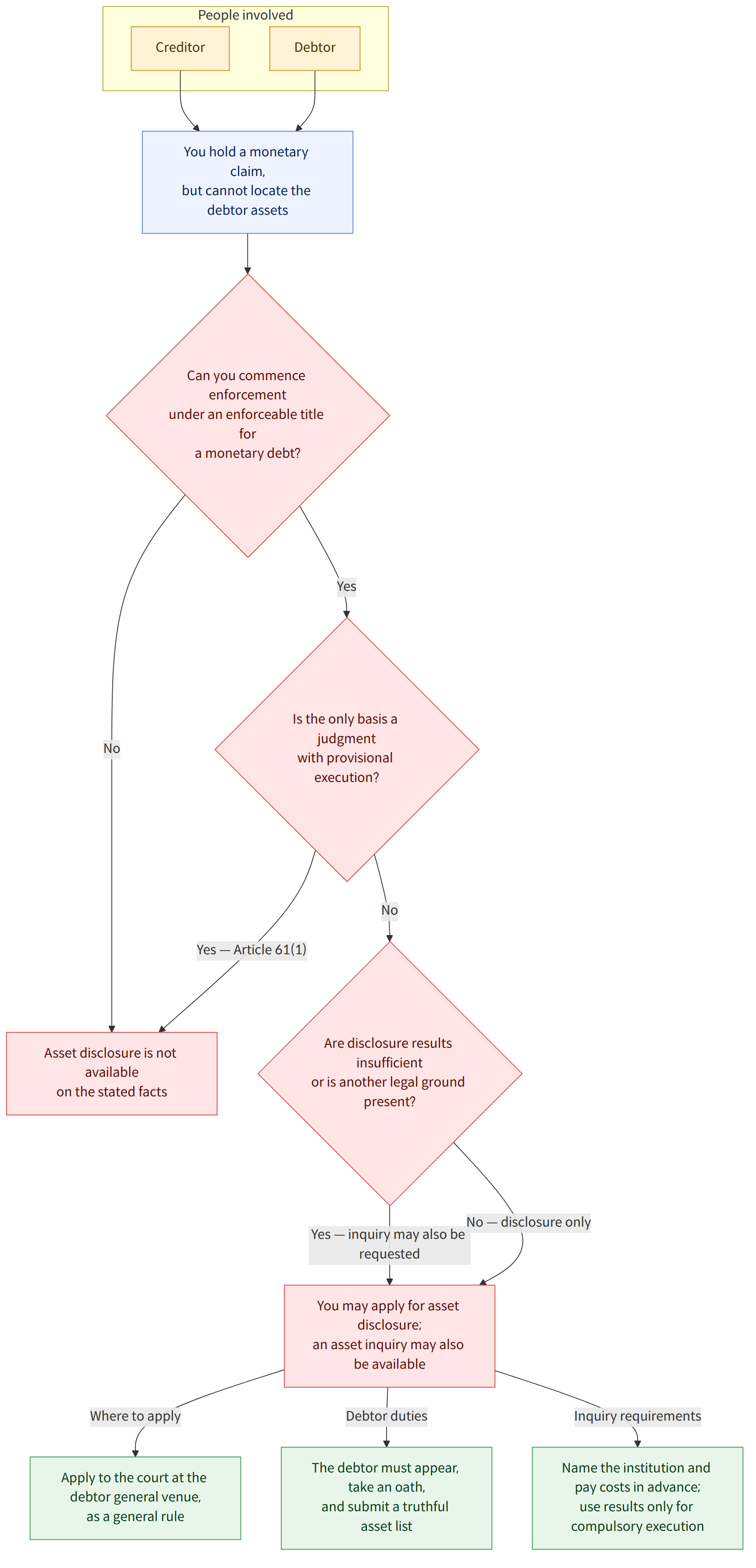
If you have an enforceable title for a monetary obligation but it is difficult to determine what assets the debtor has, you may apply to the court for asset disclosure if the requirements are met. If the results of asset disclosure are insufficient to recover the claim, you may also apply for an asset inquiry, but you cannot apply for asset disclosure based solely on a judgment with a declaration of provisional execution.
At a glance
Key points
- Asset disclosure is a procedure available when a debtor has failed to pay a monetary debt and it is difficult to locate the debtor’s assets. A creditor who may commence enforcement may apply to the court. As a general rule, the application is made to the court at the debtor’s general venue (Civil Execution Act, Article 61(1) (민사집행법 제61조 제1항)).
- A debtor who receives an asset disclosure order must appear in court, take an oath, and submit a truthful list of assets. The debtor may be subject to civil detention for failing to appear on the scheduled date without justifiable cause or for refusing to submit a list of assets or take an oath (Civil Execution Act, Articles 64, 65, and 68 (민사집행법 제64조·제65조·제68조)).
- The list of assets must include property subject to compulsory execution, regardless of whether it has any actual value. Omitting property on the grounds that it is considered to have no value may result in punishment for submitting a false list of assets (Supreme Court Judgment of November 29, 2007, 2007Do8153).
- An asset inquiry may be requested if the results of asset disclosure are insufficient to satisfy the claim, or if another ground specified by law exists, such as refusal to submit a list of assets. You must specify the institution or organization to be queried and pay the inquiry costs in advance. The results must not be used for any purpose other than compulsory execution (Civil Execution Act, Articles 74 and 76 (민사집행법 제74조·제76조)).
- An application for asset disclosure may be made based not only on a final judgment but also on an enforceable title such as a final decision in lieu of mediation. The court held that an application for asset disclosure may also be made based on a decision determining the amount of litigation costs when the purpose is to enforce payment of those costs together with the underlying enforceable title (Supreme Court Order of July 14, 1998, 98Ma988; Supreme Court Order of April 18, 1995, 94Ma2190).
- A judgment with a declaration of provisional execution may be enforced even before it becomes final, but an application for asset disclosure cannot be based on that judgment (Civil Execution Act, Article 61(1) (민사집행법 제61조 제1항)).
- Entry on the list of persons in default is a procedure for recording a debtor’s name and other information on the list when specified requirements are met. An application may be dismissed if, without any special investigation, it is evident that the claim can be recovered from the debtor’s assets without much time or expense (Civil Execution Act, Articles 70 and 71 (민사집행법 제70조·제71조); Supreme Court Order of September 9, 2010, 2010Ma779).
Frequently asked questions
Q. If I do not know what assets the debtor has, what can I apply for first?
If enforcement can be commenced under an enforceable title for a monetary obligation and it is difficult to locate the debtor’s assets, you may apply for an asset disclosure order to the court at the debtor’s general venue. If the court finds the application well-founded, it may order the debtor to submit a list of assets, among other things.
Q. Can I apply for asset disclosure based on a first-instance judgment with a declaration of provisional execution?
No. A judgment with a declaration of provisional execution is enforceable even before it becomes final, but the Civil Execution Act does not permit an application for asset disclosure based on such a judgment.
Q. I received a copy of an asset disclosure order. Was it properly served?
It may be proper. The precedent discussed in the example held that an asset disclosure order is not the type of decision for which service of an original copy is essential, and that it may therefore be served by delivery of a copy. The example advises that you may file an objection within one week from the date of service or, if you do not object, attend the asset disclosure date.
Q. Can an asset inquiry be made if the asset disclosure process does not identify sufficient assets?
Yes. If the submitted list of assets is insufficient to satisfy the claim being enforced, among other circumstances, the creditor who applied for asset disclosure may apply for an asset inquiry. You must specify the institution or organization to be queried and pay the inquiry costs in advance. The results must not be used for any purpose other than compulsory execution.
Q. Can I apply for asset disclosure based on a decision in lieu of mediation or a decision determining the amount of litigation costs?
A final decision in lieu of mediation has the same effect as a judicial settlement and may serve as a basis for an application for asset disclosure. The court also held that a decision determining the amount of litigation costs supplements the enforceable title that determines liability for those costs; accordingly, a creditor seeking to enforce payment of litigation costs under that decision may apply for asset disclosure.
Q. What happens if the debtor does not appear on the asset disclosure date or refuses to submit a list of assets?
If the debtor fails to appear on the asset disclosure date without justifiable cause, or refuses to submit a list of assets or take an oath, the court may order civil detention for up to 20 days. Submitting a false list of assets may be punishable by imprisonment for up to three years or a fine of up to KRW 5 million.
Q. Will an application to enter the debtor on the list of persons in default be dismissed if the debtor owns real estate?
The application is not necessarily dismissed merely because the debtor owns real estate. It must be evident, without any special effort or investigation, that the claim can be recovered with little time and expense; the debtor must prove that this ground exists. If the real estate is subject to other security interests or attachment that make it difficult to satisfy the claim through enforcement, the mere existence of a provisional attachment may not establish an obvious ground for dismissal.
Q. Can the debtor’s name be removed from the list of persons in default after the debt is repaid?
If the debtor proves that the debt has been extinguished, for example by repayment, the debtor may apply to the court to have the entry removed. The creditor’s consent to removal may not be sufficient on its own, and once 10 years have passed from the year following the year of entry, the court must order removal on its own authority.
Q. Does an application for asset disclosure affect the extinctive prescription period?
The precedent discussed in the example held that service on the debtor of a decision granting an application for asset disclosure may constitute a formal demand that interrupts the extinctive prescription period. However, a formal demand alone does not continue to have the effect of interrupting the period, so the example advises that an action must be filed within six months after service.
Relevant laws
- Civil Execution Act, Article 23(1) (민사집행법 제23조 제1항)
- Civil Execution Act, Article 56(5) (민사집행법 제56조 제5호)
- Civil Execution Act, Article 61(1) (민사집행법 제61조 제1항)
- Civil Execution Act, Article 62(1), (4), and (6) (민사집행법 제62조 제1항·제4항·제6항)
- Civil Execution Act, Article 64(1) and (4) (민사집행법 제64조 제1항·제4항)
- Civil Execution Act, Article 65 (민사집행법 제65조)
- Civil Execution Act, Article 67 (민사집행법 제67조)
- Civil Execution Act, Article 68(1), (2), (5), (6), (9), and (10) (민사집행법 제68조 제1항·제2항·제5항·제6항·제9항·제10항)
- Civil Execution Act, Article 70(1) and (3) (민사집행법 제70조 제1항·제3항)
- Civil Execution Act, Article 71(1) and (2) (민사집행법 제71조 제1항·제2항)
- Civil Execution Act, Article 72 (민사집행법 제72조)
- Civil Execution Act, Article 73(1) and (3) (민사집행법 제73조 제1항·제3항)
- Civil Execution Act, Article 74(1), (2), and (3) (민사집행법 제74조 제1항·제2항·제3항)
- Civil Execution Act, Article 76 (민사집행법 제76조)
- Civil Execution Rules, Article 30(2) and (3) (민사집행규칙 제30조 제2항·제3항)
Watch out for
- Even if a judgment with a declaration of provisional execution can be enforced, you cannot apply for asset disclosure based solely on that judgment.
- A debtor may be subject to civil detention for failing to appear on the asset disclosure date without justifiable cause or for refusing to submit a list of assets or take an oath. Check the order served on you and the date set for the hearing.
- Even if service of an asset disclosure decision is recognized as a formal demand for purposes of extinctive prescription, the example advises that an action must be filed within six months after service.
- The results of an asset inquiry must not be used for any purpose other than compulsory execution.
Source cases
This guide was compiled by AI from the following Korea Legal Aid Corporation consultation cases (in Korean).
- 채무자재산명시제도
- 민사집행법 제71조 제2항에서 말하는‘쉽게 강제집행할 수 있다고 인정할 만한 명백한 사유’의 의미
- 채무불이행자명부등재제도란 무엇인지
- 재산명시의무를 위반한 채무자에 대하여 감치에 처하도록 하는 규정이 헌법에 위배되는지
- 재산명시명령의 송달이 등본으로도 가능한지
- 소송비용액확정결정을 받은 채권자가 재산명시신청을 할 수 있는지
- 재산명시명령이 송달된 때 ‘최고’로서 소멸시효가 중단되는지
- 재산조회제도
- 조정에 갈음하는 결정으로 재산명시신청 할 수 있는지
- 채무불이행자명부등재의 말소방법
- 가집행선고 있는 판결을 집행권원으로 하여 재산명시신청을 할 수 있는지
- 재산명시절차에서 채무자가 법원에 제출할 재산목록에 기재해야 하는 재산의 범위
This guide is general legal information about Korean law, not legal advice for your situation. For a specific case, consult a lawyer or the Korea Legal Aid Corporation (call 132 in Korea).