
General Civil Enforcement: Key Guide to Compulsory Execution
Based on 103 consultation cases · Updated · Translated from the Korean original.
In compulsory execution, it is important to distinguish the effect of the title of execution, the status of the property subject to enforcement, the types of deposits and distributions, and enforcement costs. The scope of enforcement and the available ways to challenge it may vary depending on circumstances such as provisional attachment or provisional execution, or the debtor’s death or discharge.
At a glance
Key points
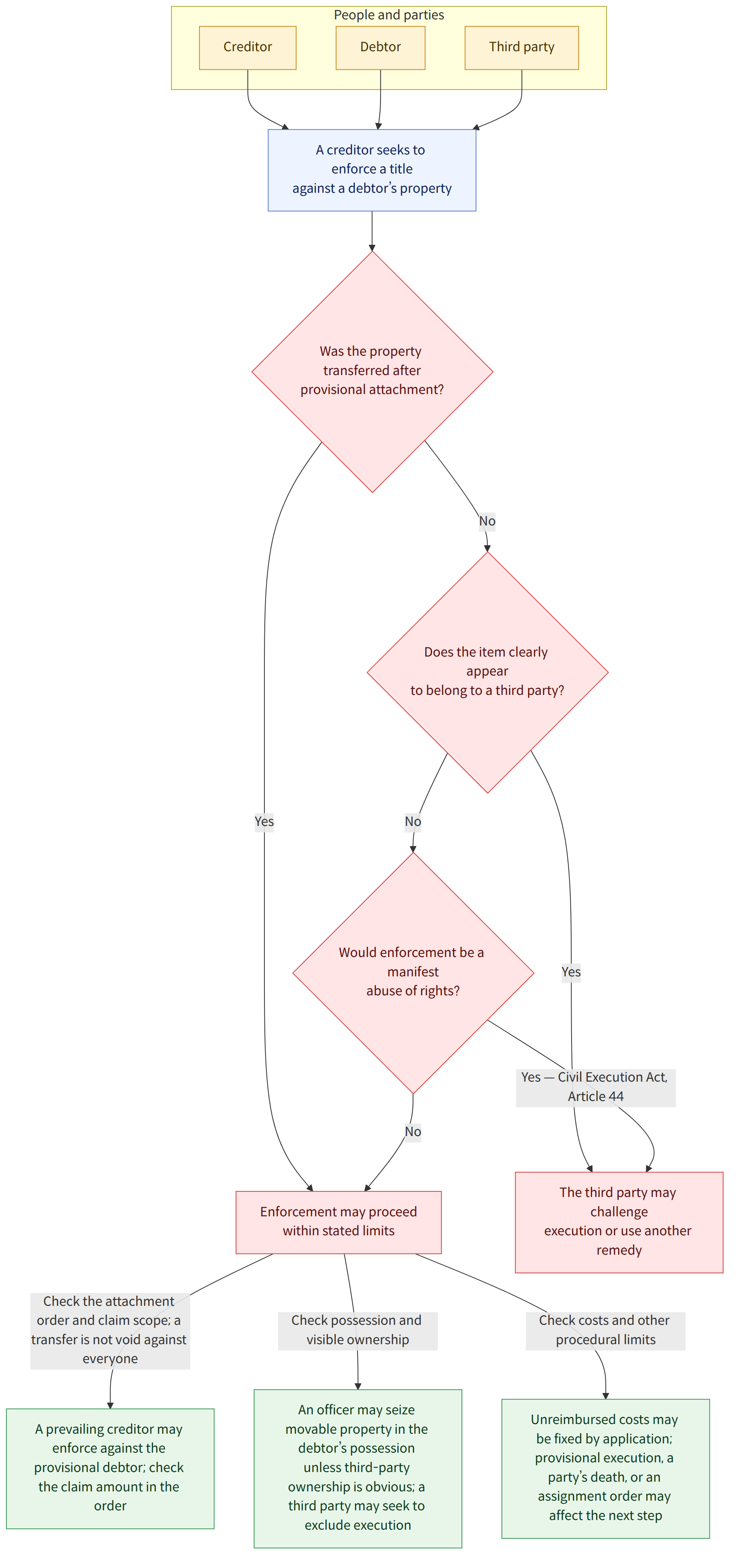
- Even if the property subject to provisional attachment is transferred to a third party, the disposition is not void against everyone; its effect may be limited as against the provisional attachment creditor. A creditor who prevails in the underlying action may enforce against the provisional attachment debtor as the enforcement debtor (Case 1).
- An enforcement officer may seize movable property in the debtor’s possession unless it is obvious from its appearance that it belongs to a third party. The third party may challenge enforcement through an action by a third party to exclude execution or other means (Case 4).
- The debtor bears the costs necessary for compulsory execution. Costs not reimbursed in the enforcement proceedings may be recovered by applying for an order fixing the amount of enforcement costs, rather than by filing a separate lawsuit (Civil Execution Act, Article 53; Civil Execution Rules, Article 24 (민사집행법 제53조, 민사집행규칙 제24조); Cases 12 and 18).
- An amount paid under a judgment with a declaration of provisional execution may not be treated as final payment until the judgment is affirmed without being revoked or modified. Accordingly, the appellate court may decide the merits of the claim without taking that payment into account (Case 7).
- Security for a stay of compulsory execution under a judgment with a declaration of provisional execution secures losses suffered by the creditor as a result of the stay. Losses equivalent to rent for the period during which enforcement to deliver possession of a building was stayed may fall within the scope of the security (Case 16).
- When a party dies during a lawsuit, the proceedings are stayed, but a judgment issued after the stay was overlooked is not automatically void. A procedural violation that excludes the authority of a lawful successor may be challenged by appeal or retrial (Civil Procedure Act, Article 233 (민사소송법 제233조); Case 3).
- Even a claim supported by a title of execution may be challenged through an action to object to a claim seeking to bar enforcement if the enforcement constitutes an abuse of rights, such as being manifestly unjust and contrary to justice (Civil Execution Act, Article 44 (민사집행법 제44조); Cases 19 and 21).
- A final assignment order may, in certain circumstances, extinguish the enforcement claim even if the attached claim is a future, uncertain claim. Whether a title of execution may be issued again after an assignment order is made with respect to a future claim must therefore be considered separately (Civil Execution Act, Article 231 (민사집행법 제231조); Case 5).
Frequently asked questions
Q. Can the property be subject to compulsory execution even if it is sold to a third party after provisional attachment?
Dispositions made after a provisional attachment may have limited effect as against the provisional attachment creditor. A creditor who prevails in the underlying action may enforce the provisional attachment as a full attachment, naming the provisional attachment debtor as the enforcement debtor; the scope of enforcement is related to the claim amount stated in the provisional attachment order.
Q. What can I do if an enforcement officer refuses to seize an item after hearing only that an item possessed by the debtor belongs to a third party?
There are cases in which property may be seized based on the debtor’s possession alone, without concluding that the debtor owns it, unless it is obvious from the property’s appearance that it belongs to a third party. If an enforcement officer refuses to carry out the enforcement, an objection may be filed with the court (Civil Execution Act, Articles 16(3) and 189(1) (민사집행법 제16조 제3항, 제189조 제1항)).
Q. Can I stop compulsory execution by depositing only the principal and accrued damages for delay?
If enforcement costs have not been reimbursed, it may be difficult to obtain an order barring all enforcement, even if the debt stated in the title of execution has been extinguished by deposit. However, one case found a deposit valid under the principle of good faith where the shortfall was very small. The amount deposited and the enforcement costs should therefore be checked together.
Q. Can I claim enforcement costs that were not recovered in the enforcement proceedings in a separate lawsuit?
According to the cases, enforcement costs should be recovered by applying to the enforcement court for an order fixing the amount of enforcement costs, rather than claiming them in a separate lawsuit or payment order proceeding. Compulsory execution may be carried out against the debtor’s property based on the final order (Civil Execution Rules, Article 24(1) (민사집행규칙 제24조 제1항)).
Q. If I paid money under a judgment with a declaration of provisional execution, will the appellate court deduct that amount when deciding the case?
Such payment may not constitute final payment, so the appellate court may decide the merits of the claim without taking the payment into account. The effect of payment may vary depending on whether the judgment with a declaration of provisional execution or the judgment on the merits is ultimately affirmed without being revoked or modified.
Q. Can I recover losses equivalent to rent for the stay period from security deposited to stay compulsory execution?
Security provided to stay compulsory execution secures losses suffered by the creditor as a result of the stay. If enforcement to deliver possession of a building is delayed, this may include losses equivalent to rent accruing during the stay. The security is described as covering losses caused by the stay of enforcement, not the underlying claim itself.
Q. If the debtor dies during the lawsuit and judgment is issued without an heir, is the judgment void?
The proceedings are stayed upon a party’s death, but a case has been cited holding that a judgment is not automatically void merely because it was issued after the stay was overlooked. A procedural violation that excludes the authority of a lawful successor may be challenged by appeal or retrial (Civil Procedure Act, Article 233 (민사소송법 제233조)).
Q. Can I carry out compulsory execution against a guarantor’s property based solely on a notarized deed of a promissory note?
A notarized deed of a promissory note stating that the debtor acknowledges compulsory execution may serve as a title of execution. In the cited case, if the debtor fails to pay, the creditor may obtain an execution clause on the notarized deed and carry out compulsory execution against the guarantor’s property as well. However, the guide explains that a notarized deed does not have the same res judicata effect as a judgment.
Q. Can I file an action to object to a claim even if there is a final judgment after a discharge order?
The case explains that, unless the debtor knew of the debt but omitted it from the list of creditors, the debtor may assert the effect of discharge at the enforcement stage even after a final judgment has been issued. In that situation, the debtor may seek to bar enforcement by filing an action to object to a claim.
Relevant laws
- Civil Execution Act, Article 16(3) (민사집행법 제16조 제3항)
- Civil Execution Act, Article 19(3) (민사집행법 제19조 제3항)
- Civil Execution Act, Article 25(1) (민사집행법 제25조 제1항)
- Civil Execution Act, Article 31 (민사집행법 제31조)
- Civil Execution Act, Article 39 (민사집행법 제39조)
- Civil Execution Act, Article 44 (민사집행법 제44조)
- Civil Execution Act, Article 52 (민사집행법 제52조)
- Civil Execution Act, Article 53 (민사집행법 제53조)
- Civil Execution Act, Article 56(4) (민사집행법 제56조 제4호)
- Civil Execution Act, Article 61(1) (민사집행법 제61조 제1항)
- Civil Execution Act, Article 83(1) (민사집행법 제83조 제1항)
- Civil Execution Act, Article 90 (민사집행법 제90조)
- Civil Execution Act, Article 176(1) (민사집행법 제176조 제1항)
- Civil Execution Act, Article 189(1) (민사집행법 제189조 제1항)
- Civil Execution Act, Article 231 (민사집행법 제231조)
Watch out for
- The mere existence of a provisional attachment or provisional disposition does not allow you to immediately demand that a third party be evicted or assert that a disposition is void. Check the necessary procedures, such as enforcement of a judgment on the merits or issuance of an execution clause against a successor.
- Distinguish the debt stated in the title of execution from enforcement costs. Even if the debt has been paid or deposited, enforcement may not be barred in full if enforcement costs remain unpaid.
- Money paid under provisional execution may not be treated as final payment on appeal. The cases explain that an application for the return of money provisionally paid, which requires fact-finding, is generally not allowed in the final appeal court.
- Interested parties in auction proceedings, such as tenants, should independently check the necessary procedures, including filing a claim of rights or a request for distribution. One case holds that it is difficult to assert that auction proceedings were unlawful merely because a party did not receive a current-status investigation or guidance on the proceedings.
Source cases
This guide was compiled by AI from the following Korea Legal Aid Corporation consultation cases (in Korean).
- 가압류집행 후 부동산 이전 시 가압류의 처분금지적 효력의 범위
- 임금채권과 국세체납채권에 의한 압류 경합 시 제3채무자의 공탁 가능 여부
- 소송절차 중단을 간과한 판결에 승계집행문을 부여할 수 있는지
- 집행관이 유체동산의 집행을 거절할 경우 이의를 제기하는 방법
- 장래채권에 대한 압류 및 전부명령 후 판결정본을 재도부여할 수 있는지
- 사망한 자를 채무자로 한 담보권실행 경매 시 시효중단 효력 있는지
- 가집행선고된 부분을 변제한 경우 항소심에서 이를 참작하는지
- 점유이전금지가처분 결정 후 점유한 자를 강제퇴거 시킬 수 있는지
- 변제공탁과 집행공탁사유가 동시에 발생한 경우 공탁방법
- 체납처분대금 배분시까지 배분요구 안한 임금채권자의 부당이득반환청구권
- 가처분등기가 말소된 경우 가처분부동산 매수자의 소유권취득 여부
- 집행권원 표시채무는 소멸되었으나 집행비용변상을 안한 경우의 집행력
- 선박경매과정에서 발생한 정박료 채권이 선박우선특권에 해당하는지
- 보전처분에 관한 본안소송이 계속 중인 경우 보전처분의 완결만으로 권리행사최고 및 담보취소의 요건이 되는 ‘소송완결’이 있다고 ...
- 채권자가 확정판결을 받은 채권에 대하여 변제자의 대위권 행사방법
- 가집행판결에 대한 강제집행정지 시 공탁한 담보의 피담보채무의 범위
- 무효인 공정증서에 기하여 강제집행을 신청한 채권자에게 과실이 있는지
- 집행절차에서 변상받지 못한 집행비용을 소송으로 청구할 수 있는지
- 면책결정이 내려져 확정 전 채권자가 보증채무 지급청구 소송을 제기하여 면책결정 확정 후 승소 판결을 받았고, 면책 신청 시 채...
- 상고심에서 가집행선고로 인한 가지급물반환신청을 할 수 있는지
- 확정판결의 집행이 권리남용이 되는 경우의 불복방법
- 주택임대차보호법상의 대항요건을 갖춘 임차인은 권리신고를 하지 않더라도 경매절차상 이해관계인이 되는지 여부
- 채권자가 재단법인의 기본재산 처분허가신청절차 이행청구를 할 수 있는지
- 약속어음공증의 효력
- 가압류채권자가 본안소송에서 승소하여 집행권원을 획득하고도 상당한 기간 본집행을 하지 않고 있는 경우, 피보전권리에 대한 보전의...
This guide is general legal information about Korean law, not legal advice for your situation. For a specific case, consult a lawyer or the Korea Legal Aid Corporation (call 132 in Korea).