
How to Stay or Cancel Civil Enforcement: Methods and Requirements
Based on 17 consultation cases · Updated · Translated from the Korean original.
Filing an action to oppose enforcement or taking an appeal does not automatically stop compulsory enforcement. You must submit the documents prescribed by law or an enforcement stay order to the enforcement authority. The available measures depend on the grounds and timing of the stay and on whether enforcement has already been completed.
At a glance
Key points
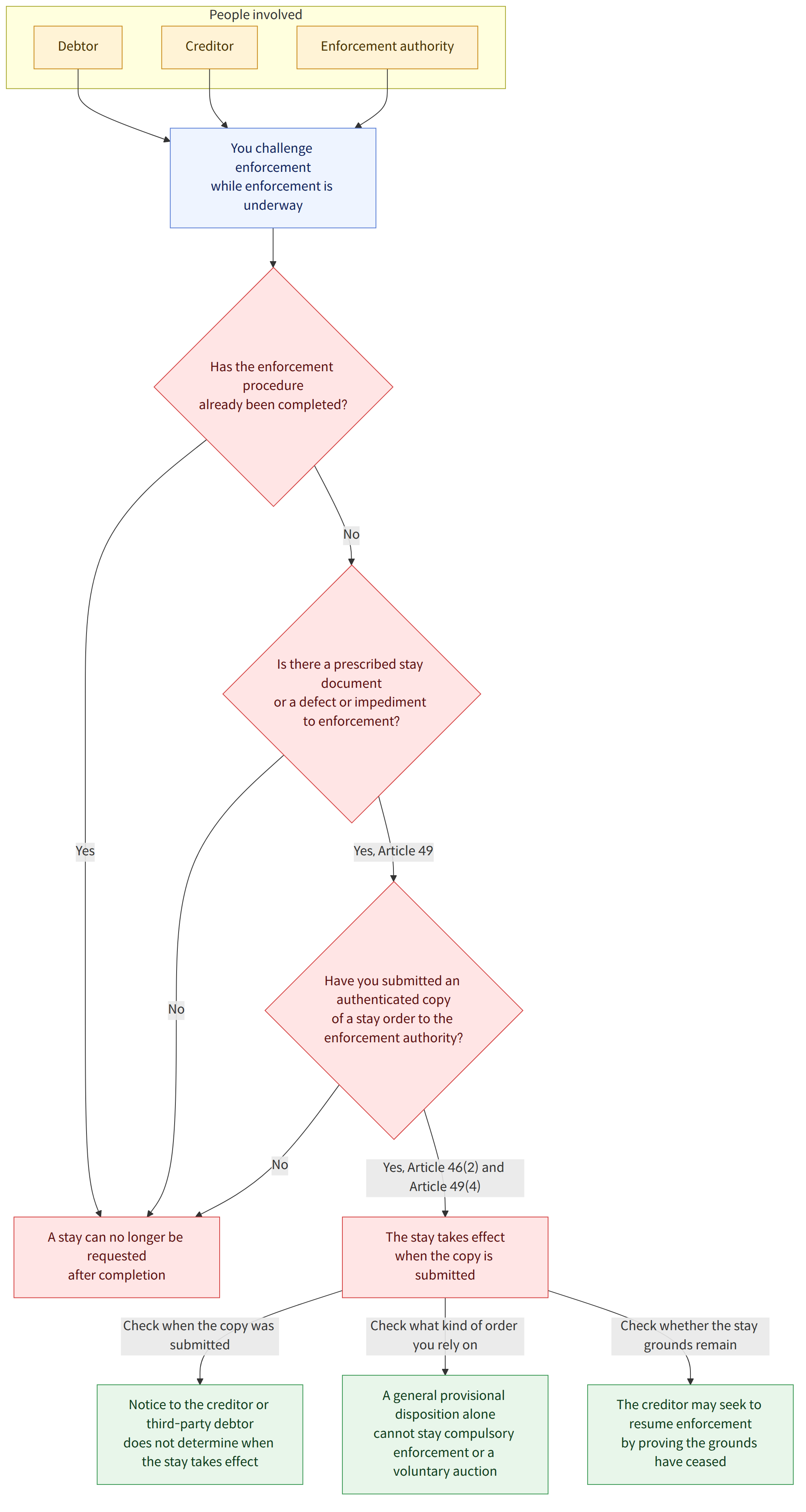
- Filing an action to oppose enforcement does not automatically stay the commencement or continuation of compulsory enforcement, so you must apply separately for a stay of enforcement (Civil Execution Act, Article 46(1) (민사집행법 제46조 제1항)).
- Enforcement may be stayed upon submission of documents prescribed by law or where there is a defect in the requirements for enforcement or an impediment to enforcement (Civil Execution Act, Article 49 (민사집행법 제49조)).
- To seek a stay of enforcement in an action to oppose enforcement, you may obtain an authenticated copy of the court ruling ordering a temporary stay and submit it to the enforcement authority (Civil Execution Act, Article 46(2), Article 49(4) (민사집행법 제46조 제2항, 제49조 제4호)).
- A general provisional disposition alone cannot stay compulsory enforcement based on a final judgment or similar instrument, or a voluntary auction (Cases 1 and 13).
- A stay takes effect when an authenticated copy of the stay order is submitted to the enforcement authority; it is not affected by when the creditor or third-party debtor is notified (Case 7).
- If the grounds for the stay have ceased to exist, you may apply to commence or resume enforcement by proving that fact (Case 8).
- You cannot apply for a stay of enforcement after the enforcement procedure has been completed. If the creditor withdraws the enforcement, the procedure ends upon withdrawal (Cases 5 and 17).
Frequently asked questions
Q. Does filing an action to oppose enforcement automatically stop compulsory enforcement?
No. Enforcement may continue even after you file an action to oppose enforcement. To prevent enforcement while awaiting the judgment on the merits, you must separately apply for a stay of enforcement. If the court orders a stay, you must submit an authenticated copy of that ruling to the enforcement authority.
Q. Can I apply for a stay of enforcement by filing only a claim for confirmation of nonexistence of a debt?
A claim for confirmation of nonexistence of a debt, by itself, is unlikely to satisfy the requirements for an interim measure staying enforcement. Even if you prevail in that action, the judgment does not have the effect of finally prohibiting the enforcement in question.
Q. Can a general provisional disposition prevent compulsory enforcement or an auction?
According to the cases, compulsory enforcement based on a final judgment or similar instrument must be stayed through the procedures prescribed by the laws governing enforcement; it cannot be stayed by a general provisional disposition alone. In the case of a voluntary auction, the objection procedure and enforcement stay order prescribed by law must also be used.
Q. When does a stay of enforcement take effect?
A stay of enforcement takes effect when an authenticated copy of the stay order is submitted to the enforcement authority. The relevant time is not when the order is served on the attaching creditor or when the third-party debtor receives notice of the stay.
Q. If a provisional enforcement judgment is partially set aside on appeal, must I apply for a stay?
As to the part set aside on appeal, the provisional declaration of enforceability ceases to have effect. You need only submit an authenticated copy of the appellate judgment to the enforcement court for that part; no separate application for a stay is required. The provisional declaration of enforceability may remain effective for the part upheld on appeal, so you may apply to stay that part if the requirements are met.
Q. How can enforcement resume once the grounds for a stay have ceased to exist?
A creditor may apply to commence or resume enforcement by proving that the grounds for the stay have ceased to exist. For example, if an order stayed enforcement until judgment was rendered by the appellate court, the creditor must prove that the appellate judgment has been rendered.
Q. What should I do if the enforcement authority proceeds with enforcement while it is stayed?
When enforcement is stayed, the enforcement authority may neither commence new enforcement nor continue enforcement already commenced. If enforcement proceeds despite grounds for a stay, an interested party may seek correction by filing an objection concerning enforcement.
Q. Can I apply for a stay of enforcement using a written instrument agreeing to defer performance of the obligation?
If, after the judgment authorizing enforcement has been issued, there is a written instrument recording the creditor’s consent to defer performance of the obligation, you may submit it and apply for a stay of enforcement. A stay on this ground may be granted no more than twice, and the total period may not exceed six months.
Q. How is the enforcement procedure cancelled after the debtor has paid?
Before the enforcement procedure is completed, the creditor may submit a written notice to the court withdrawing the enforcement. Withdrawal ends the enforcement procedure, and no separate cancellation order is required.
Relevant laws
- Civil Execution Act, Article 19(3) (민사집행법 제19조 제3항)
- Civil Execution Act, Article 44 (민사집행법 제44조)
- Civil Execution Act, Article 46(1)–(2) (민사집행법 제46조 제1항·제2항)
- Civil Execution Act, Article 49 (민사집행법 제49조)
- Civil Execution Act, Article 51 (민사집행법 제51조)
- Civil Execution Act, Article 130(3) (민사집행법 제130조 제3항)
- Civil Execution Act, Article 268 (민사집행법 제268조)
- Civil Execution Act, Article 269 (민사집행법 제269조)
- Civil Execution Act, Article 275 (민사집행법 제275조)
- Civil Execution Act, Article 282 (민사집행법 제282조)
- Civil Procedure Act, Article 51 (민사소송법 제51조)
- Civil Procedure Act, Article 122 (민사소송법 제122조)
- Civil Procedure Act, Article 215(1) (민사소송법 제215조 제1항)
- Civil Procedure Act, Article 500(1) (민사소송법 제500조 제1항)
- Civil Procedure Act, Article 501 (민사소송법 제501조)
Watch out for
- Enforcement does not stop merely because an action to oppose enforcement has been filed or an appeal has been taken. Be sure to separately apply for a stay and submit an authenticated copy of the order.
- You cannot apply for a stay of enforcement once enforcement has been completed. If delivery enforcement against a direct possessor has been completed, enforcement against an indirect possessor may also be considered completed.
- A stay based on a written instrument deferring performance of an obligation may be granted no more than twice and may not exceed six months in total.
- Enforcement may resume after two months have passed in the case of a stay based on submission of a certificate of payment, or after the deferral period has expired or six months in total have passed in the case of a stay based on submission of a written instrument deferring performance of an obligation.
Source cases
This guide was compiled by AI from the following Korea Legal Aid Corporation consultation cases (in Korean).
- 강제경매 절차의 정지 방법
- 취소된 가집행판결에 대한 강제집행정지 신청의 적법성 여부
- 강제집행정지 신청 시 공탁보증보험증권 제출로 담보제공할 수 있는지
- 국가가 강제집행정지 신청을 할 경우 담보제공이 면제되는지
- 직접점유자에 대한 인도집행 후 간접점유자의 강제집행정지 신청이 적법한지
- 의사의 진술을 명하는 판결에 대한 청구이의의 소의 허용여부
- 압류·추심명령에 대한 강제집행정지결정의 효력은 언제 발생하는지
- 정지된 집행의 속행
- 청구이의의 소 제기 없이 채무부존재확인의 소만 제기한 경우 강제집행정지신청을 할 수 있는지
- 집행정지, 취소와 청구이의의 소의 관계
- 집행정지의 원인(민사집행법 제49조 제4호)
- 집행정지 중에 한 집행처분의 효력
- 가처분을 통한 강제집행 정지 가능 여부
- 집행정지의 원인 (의무이행의 유예)
- 의사의 진술을 명하는 재판에 대한 집행정지
- 집행정지의 원인 (민사집행법 제49조 제2호)
- 집행의 취소
This guide is general legal information about Korean law, not legal advice for your situation. For a specific case, consult a lawyer or the Korea Legal Aid Corporation (call 132 in Korea).